


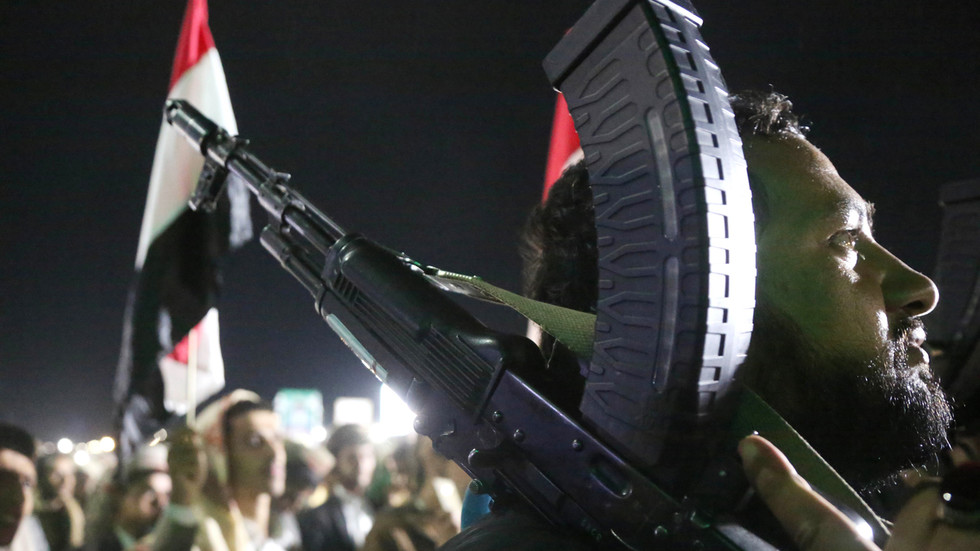
Houthi gains near Bab el-Mandeb are raising new risks for shipping and putting Saudi Arabia under fresh strain
Yemen’s Ansar Allah movement, also known as the Houthis, locked in a war with the country’s government and a Saudi-led coalition, is making military gains along the western coast of the country. The military geography of the area has changed within a matter of days.
The Houthis seized Mocha, a key port north of the Bab el-Mandeb Strait, and then pushed toward Dhubab and the strategic island of Mayyun, also known as Perim, which lies directly inside the strait. At the same time, the movement strengthened its presence around the Hanish Islands, meaning that what is unfolding can no longer be described simply as another expansion of Houthi-held territory inside Yemen. Ansar Allah is now moving directly toward one of the most important maritime chokepoints in the Middle East.
The movement itself insists that international shipping is not the target of its advance, while Houthi spokesman Mohammed Abdulsalam has said that trade through the Red Sea and Bab el-Mandeb remains safe and uninterrupted, even as restrictions against Saudi-linked shipping remain in place.
However, it’s not just about whether the Houthis are physically capable of closing the strait. They are acquiring a tool with which they can raise or lower the risks to commercial shipping in accordance with the political and military situation. This is turning Bab el-Mandeb from one sector of Yemen’s protracted war into a second lever of pressure within the confrontation surrounding Iran.

Two straits, one system of pressure
The main reason the Houthi advance has become so sensitive for the United States and its allies lies in its timing, coming as it is amid a direct confrontation with Iran, which is already facing intense American pressure on its maritime communications and oil exports. While Iran’s room for maneuver in the Strait of Hormuz is constrained by the presence of American and allied forces, a second potentially unstable maritime corridor on the opposite side of the Arabian Peninsula forces Washington to reckon with an entirely different theater of escalation at the same time. A substantial share of Gulf oil exports passes through Hormuz, while Bab el-Mandeb links the Indian Ocean to the Red Sea and onward to the Suez Canal. Simultaneous instability in both straits could disrupt not only regional energy flows but the wider system of trade connecting Asia and Europe.
The result is a kind of geographic trap, with Hormuz on the eastern side of the Arabian Peninsula, where Tehran can directly influence the level of risk surrounding maritime traffic, and Bab el-Mandeb on the western side, where a movement aligned with Iran possesses a similar capacity. It would nevertheless be inaccurate to claim that Tehran now controls both straits, because Ansar Allah is not an extension of the Islamic Revolutionary Guard Corps, has its own political agenda and makes its decisions primarily in response to developments inside Yemen. Yet this degree of Houthi autonomy makes the coalescing model of two-pronged pressure so useful to Iran. Tehran does not need to expand the conflict geographically with its own forces when an allied movement is already acting in ways that serve broadly compatible interests and impose additional costs on a common adversary.
Iran does not need to order the closure of Bab el-Mandeb, because the mere possibility of a renewed crisis in the Red Sea is enough to force the US to prepare for another escalation scenario. Washington must then redistribute military resources, reinforce maritime security and factor the consequences into its calculations about global energy markets. In other words, the effectiveness of the pressure does not depend on whether either strait is completely shut. It depends on whether both can be made sufficiently unstable to force the US and its allies to spend more resources protecting them.
The Houthis are bargaining for more than Iran
Reducing the current offensive to Tehran’s interests alone would also be misleading, because for the Houthis themselves the widening regional crisis offers a rare opportunity to reshape the terms of their long confrontation with Saudi Arabia. For several years, negotiations between Riyadh and Sanaa have revolved around highly specific issues, including the full operation of Houthi-controlled ports, expanded access through Sanaa airport, salary payments to public-sector employees, infrastructure reconstruction, foreign trade and the gradual easing of restrictions that Ansar Allah describes as a blockade. These demands lie at the heart of the Houthis’ political agenda, and the regional confrontation provides more leverage with which to pursue them.
The greater the Houthis’ ability to affect commercial shipping while simultaneously threatening Saudi infrastructure, the stronger their bargaining position becomes. The seizure of Mocha and the advance toward Mayyun matter are also territorial gains, since until recently the Houthi ability to shape events in the Red Sea relied mainly on missiles, drones and anti-ship systems. Geography itself is now becoming part of their military toolkit. Control of the coastline gives the movement a stronger platform from which to threaten the maritime routes upon which both Saudi Arabia and international trade depend.
Mayyun is especially important because the small island sits directly inside the Bab el-Mandeb Strait and divides it into two channels, making any sustained military presence there a sensitive factor for naval forces tasked with protecting commercial traffic. Control of the island would not by itself allow the Houthis to seal the international shipping route, particularly if they faced a large naval coalition. Absolute control, however, is not necessary to create a persistent atmosphere of danger. Mobile missile systems, reconnaissance assets, strike drones and unmanned surface vessels would be enough to force insurers, shipping companies and governments to account for the possibility of attack every time the regional situation deteriorates.
The experience of the Red Sea has already demonstrated how effective such a strategy can be. After Houthi attacks on commercial vessels began in late 2023, many of the world’s largest shipping companies chose to reroute around the Cape of Good Hope, on the southern end of the African continent, even though Bab el-Mandeb itself was never completely closed. Commercial shipping reacts to risk, uncertainty and rising insurance costs. The Houthis’ principal asset, therefore, is not the ability to stop every vessel passing through the strait, but the ability to make the market behave as though any vessel could potentially become a target.
Saudi Arabia comes under pressure again
The emerging situation is especially uncomfortable for Saudi Arabia, because Riyadh’s strategy in recent years has been built around gradually distancing itself from the direct war in Yemen, reducing the threat to its oil infrastructure and creating conditions in which regional conflicts would no longer obstruct the kingdom’s domestic economic transformation. A return to a large-scale campaign against the Houthis would undermine that entire approach. Saudi Arabia would once again find itself drawn into the kind of costly war it has spent years trying to leave behind through negotiations and Omani mediation. The political cost would therefore be almost as significant as the military one.
The problem becomes even more serious if instability around Hormuz forces Riyadh to rely more heavily on its East-West pipeline and Red Sea terminals. In such a scenario, growing insecurity around Bab el-Mandeb would threaten the routes intended to serve as alternatives to a vulnerable Persian Gulf. The Houthis understand this, which is why pressure on maritime traffic and the possibility of renewed strikes against Saudi energy infrastructure allow them to raise the costs for Riyadh without having to launch a full-scale offensive directly against the kingdom. What was designed as strategic redundancy for Saudi oil exports can become a second point of vulnerability.
Saudi Arabia’s response is likely to remain limited, centered on stronger air defenses, intelligence support for Ansar Allah’s Yemeni opponents, selective strikes against military targets and additional measures to secure maritime routes. At the same time, Riyadh will probably seek to preserve a negotiating channel, because the broader the confrontation between Iran and the US becomes, the more dangerous it is for Saudi Arabia to allow itself to be turned once again into one of the conflict’s principal fronts. A full return to war would expose energy infrastructure, undermine economic planning and risk once again tying the kingdom’s regional policy to an open-ended conflict in Yemen. For Riyadh, restraint is a matter of strategic self-preservation.
Washington faces a similar dilemma, because ignoring the Houthi advance risks creating the impression that American security guarantees are weakening, while a renewed large-scale operation in Yemen would require additional air, naval, intelligence and missile-defense resources at a moment when the US is already preparing for possible escalation around Iran. Even if direct war can still be avoided, the requirement to keep forces on permanent alert is itself becoming part of the price Tehran is seeking to impose on American strategy. The US is being forced to defend not one vulnerable maritime corridor but an increasingly interconnected system of routes, bases, and allied infrastructure.

A second lever is more dangerous than a second front
Neither the capture of Mocha nor a Houthi presence on Mayyun would by themselves determine the outcome of the confrontation between the US and Iran. The strategy pursued by Tehran and its partners is not built around a single decisive blow but around the gradual accumulation of risks. Washington is increasingly forced to consider the Strait of Hormuz, Bab el-Mandeb, the security of American bases, the protection of Saudi oil infrastructure, the stability of commercial shipping, and the condition of global energy markets at the same time. Each new source of tension consumes additional resources and reduces freedom of action elsewhere.
For Ansar Allah, this creates an opportunity to convert military success along the coast into political leverage, because the more expensive Red Sea security becomes for Saudi Arabia, the greater the cost to Riyadh of refusing compromises over ports, the airport, financial flows and other long-standing demands from Sanaa. For Iran, the effect is different, because Tehran gains a way to increase pressure on its adversary without deploying its own forces to a new theater and without assuming full responsibility for the geographical expansion of the conflict. The two actors benefit for different reasons, even though their immediate interests increasingly overlap.
Hormuz and Bab el-Mandeb are gradually becoming parts of a single system of pressure, in which a crisis at one chokepoint increases the importance of the other, while every attempt to secure one route exposes the vulnerability of its alternative. Bab el-Mandeb is not simply a second theater of war but a second political lever.
Read the full article here