


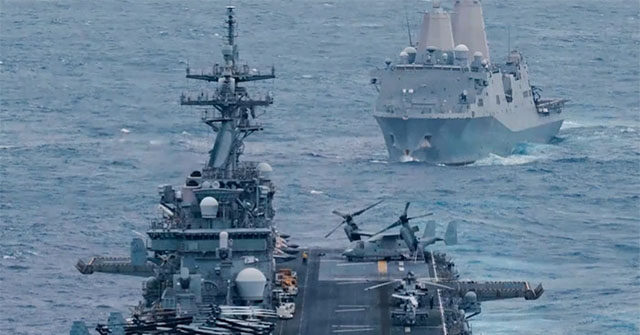
A senior U.S. official said Monday that the Strait of Hormuz is “fully open and under U.S. Navy control,” directly challenging Iran’s threat to impose a new maritime exclusion zone across the Persian Gulf as Tehran seeks to reassert leverage over the strategic waterway.
The official told Al Jazeera that the assessment followed a months-long U.S. Navy operation to clear Iranian mines from the strait, adding that Washington expects shipping traffic to increase and remains satisfied with the amount of oil and gas currently moving through the waterway.
The declaration came after Mohsen Rezaei, secretary of Iran’s powerful Supreme National Security Council, announced Sunday that Tehran would establish what he called a new prohibited zone extending from the U.S. naval blockade line into the Persian Gulf.
“In the coming days and weeks, we’re going to announce a restricted prohibited zone outside the Strait of Hormuz, which begins from the blockade line of the U.S. Navy, including the Strait of Hormuz, and extends to the Persian Gulf from the other side,” Rezaei said.
He said vessels entering the zone with the intention of transiting Hormuz would be placed on an Iranian sanctions list, providing few details about how Tehran intends to enforce the restrictions.
Rezaei sharpened the threat Monday, explicitly portraying the proposed exclusion zone as retaliation for Washington’s economic campaign against Tehran.
“In recent days, Washington has received a clear warning from Iran’s new missiles,” he wrote on X. “Economic warfare will be met by a maritime exclusion zone across the Persian Gulf to the blockade perimeter.”
“The operational posture toward U.S. warships and bases has been fundamentally recalibrated,” he added.
The escalating Iranian threats come as the United States continues tightening its control over maritime traffic around Iran while protecting commercial shipping through Hormuz.
U.S. Central Command said Monday that American forces have redirected 94 commercial vessels, disabled three and boarded two since Washington reimposed its naval blockade of Iranian ports in mid-July. The number of redirected vessels increased from 92 a day earlier.
About 20 U.S. warships remain involved in enforcing the blockade, according to the senior U.S. official, who said Washington’s broader economic pressure campaign has “completely” damaged Iran’s economy through a combination of sanctions and the tightened naval blockade.
The official described the blockade as “the most successful in history.”
The increasingly open strait follows a dangerous months-long U.S. operation to clear Iranian sea mines from its internationally recognized shipping lanes.
The Financial Times reported Sunday that U.S. Navy SEALs and divers spent roughly four months carrying out much of the operation at night, using unmanned boats, underwater vehicles and sonar technology to locate and destroy mines. An estimated 80 mines had been deployed in the waterway, according to the International Maritime Organization.
The account provided new detail about the operation U.S. Central Command Commander Adm. Brad Cooper announced late last month after American forces cleared the strait’s internationally recognized shipping lanes.
“We have successfully cleared sea mines in the Strait’s international shipping lanes that were laid months ago by Iran’s Islamic Revolutionary Guard Corps,” Cooper said at the time, calling the breakthrough a “major milestone.”
Cooper said the work had been carried out “meticulously and quietly” over several months by Navy divers, Navy SEALs and U.S. airpower.
“The circumstances were challenging and dangerous, to say the least, but we got the job done,” he said.
Then came Cooper’s bottom line: “Today, international shipping lanes are open and momentum is building.”
President Donald Trump had announced days earlier that the Navy had removed or detonated all mines from international waters in Hormuz, while warning that any Iranian vessel attempting to lay new mines would be “immediately and systematically destroyed.”
WATCH — Senator McCormick Reveals President Trump’s Strategy to Economically “Strangle” Iran:
U.S. officials subsequently described the breakthrough as a “watershed moment” that had stripped Tehran of one of its principal sources of leverage over global energy markets.
“The Iranians have lost control over the strait,” one U.S. official said at the time. “Now the U.S. controls it.”
Despite continued Iranian attacks and threats against shipping, substantial volumes of Gulf energy are again moving through the waterway under American protection.
Energy Secretary Chris Wright said Sunday that roughly 9 million barrels of oil per day were passing through Hormuz. With additional energy moving through regional pipelines, Wright estimated that overall flows had recovered to “two-thirds or more” of pre-conflict levels.
Iranian officials, meanwhile, have responded with increasingly explicit threats against American military and economic interests.
Acting Iranian Defense Minister Majid Ibn Reza said Monday that Tehran possesses the technology to strike U.S. warships participating in the blockade, rejecting suggestions that Iran lacks the capability to threaten American naval forces.
“The Americans believe that we do not have the capability and technology to target the warships participating in the economic blockade against our people,” Ibn Reza told Iranian state television.
“God willing, you will see the results,” he warned.
Iranian Parliament Speaker Mohammad Bagher Ghalibaf separately threatened American oil and gas interests across the region after War Secretary Pete Hegseth warned that Washington could destroy Iranian tankers if Tehran continued attacking U.S. forces.
“It’s simple: the oil and gas production chain here is sprawling, accessible, and exposed. American oil and gas companies across these waters and facilities share that exposure,” Ghalibaf wrote Monday.
“Strike our assets and you get struck,” he warned.
Iran has also sought to establish a new arrangement with Oman governing navigation through Hormuz, repeatedly claiming progress toward a jointly managed corridor as Tehran attempts to preserve a role in determining passage through the waterway.
Oman, however, has quietly rejected an Iranian proposal to jointly charge service fees to commercial vessels, the New York Post reported last week, undercutting earlier Iranian claims that the two countries had agreed on sharing revenue from the strait.
For now, Tehran’s latest threat to impose a new maritime exclusion zone comes against an increasingly unfavorable reality: internationally recognized shipping lanes have been cleared of Iranian mines, growing quantities of Gulf energy are moving through Hormuz under American protection, and the U.S. blockade continues tightening around Iran’s own maritime trade.
Washington’s message Monday was considerably simpler: the Strait of Hormuz is “fully open and under U.S. Navy control.”
Joshua Klein is a reporter for Breitbart News. Email him at [email protected]. Follow him on Twitter @JoshuaKlein.
Read the full article here