


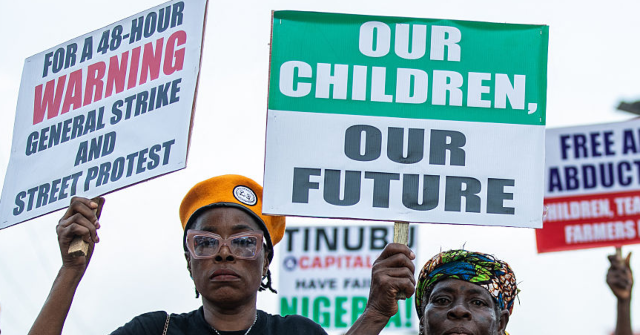
The International Criminal Court (ICC) dismissed a request to open an investigation into “systemic kidnappings in Nigeria” this week, media in the country report, on the grounds that the petition lacked “any legal basis.”
The government of Nigeria, which has for over a decade downplayed the growing problem of genocidal jihadist violence in the country, complained following the dismissal that the court should never have entertained the request in the first place, as it should have gone to the ICC’s top prosecutor. The prosecutor position at the global court is currently empty after Prosecutor Karim Khan, who made a name for himself after pursuing cases against Israeli Prime Minister Benjamin Netanyahu and Russian strongman Vladimir Putin, was accused of sexual assault on the job.
Nigeria, a country nearly evenly split between Christians and Muslims, has faced over a decade of extreme radical Islamic violence against its Christian communities in the north and Middle Belt of the country. Terrorist organizations such as Boko Haram and the Islamic State West Africa Province (ISWAP), which broke off of Boko Haram, routinely engage in mass kidnappings in Christian communities, often killing the men of a community and abducting the women and girls. In the Middle Belt, ethnic Fulani jihadists seeking to exterminate the indigenous Christian populations of the regions and steal their land have become a top-level threat to the population there, one the government has consistently been hesitant to recognize.
As a result of longstanding jihadist activity which the Nigerian government has failed to contain, abduction has become an increasingly popular crime in the country. While terrorists were the ones once most commonly engaging in abductions for ransom to finance their attacks, kidnapping has become a popular trend with a variety of criminals with no known political affiliation as they have seen families and governments pay ransoms.
The humanitarian aid organization Open Doors has documented a significant increase in the number of abductions in the country documented since October 2025 and specifically a 153-percent increase in the number of abductions between October to December 2025 compared to the same time period a year before. SBM Intelligence, a research firm based in Lagos, estimated in a study this year that kidnappers of all political and religious backgrounds had profited to the tune of over $5 million (nearly 7.8 billion Nigerian naira) between July 2025 and June 2026.
“For every ransom that is paid for a kidnapping incident, you are simply birthing another kidnapping incident,” security analyst Kehinde Giwa told the Associated Press in August.
In this context, an anonymous individual filed a petition before the ICC this year asking the court to review “systemic kidnappings in Nigeria as crimes against humanity.” The case was brought before Pre-Trial Chamber II of the ICC, granting it standing, but that court’s three judges declined to pursue the matter further on the grounds that the petition had “no legal basis.”
The ICC is an international institution created by the Rome Statute empowered by the state signatories to that legal document. It has the power to process cases against individuals charged with three categories of crimes: war crimes, genocide, and crimes against humanity. Reports on the Nigeria petition did not note if the anonymous petitioner identified any potential defendants or specified how the abductions fit into the international legal definition of crimes against humanity.
While the Nigerian government was not directly implicated in the filing and the filing was rapidly dismissed, Nigerian Justice Minister Lateef Fagbemi issued outraged comments this week that the ICC allowed a court to examine the petition.
“The Federal Government notes with serious concern that on 26th August 2026, the President of the Pre-Trial Division improperly initiated a procedural process by assigning an unverified filing from an anonymous submitter to Pre-Trial Chamber II, purportedly pursuant to Regulation 46(3) of the Regulations of the Court,” Fagbemi said in his statement, according to the Nigerian newspaper Vanguard. The justice minister complained that there was no confirmation Pre-Trial Chamber II had the authority to address the petition, instead stating the petition should have first gone to the ICC Prosecutor’s Office. The minister further complained that addressing the kidnappings was under the authority of Nigerian law enforcement — which has spectacularly failed to do so — and not with any international venue.
The ICC does not currently have a Prosecutor. The office, according to its website, is currently being run by deputy prosecutors Mame Mandiaye Niang and Nazhat Shameem Khan. Khan, the last prosecutor to occupy the office, was accused of sexual misconduct, which he adamantly denied, in late 2024, and subsequently suspended from his position.
The government of Nigeria under President Bola Tinubu has repeatedly denied that any religious discrimination exists in the country, much less systematic, genocidal persecution of Christians. Tinubu expressed outrage in October after President Donald Trump restored Nigeria to the State Department’s list of Countries of Particular Concern (CPC) for religious freedom in response to persecution in the country, declaring, “the characterisation of Nigeria as religiously intolerant does not reflect our national reality.” Locals complain that much jihadist violence is mischaracterized as “banditry” or petty crime, making it impossible to address the true nature of the situation.
“When you give them the name ‘hoodlums’ or ‘bandits,’ then the criminality is not a severe one,” Jabez Musa, a lawyer working in the Middle Belt, told Breitbart News under a pseudonym in August, “but what we see here — these are people who are militant and they kill.”
“They come in their hundreds on their motorbikes and their fellow attackers on the bike and with their AK-47 machine guns and attack a village or a community, kill them, and either take over or kill them, come back again, then take over the place,” he explained. “So it is more than banditry; they are more than bandits.”
Musa added that the abduction problem had expanded beyond the jihadist attacks given the significant success that terrorist organizations had experienced in demanding ransoms.
Follow Frances Martel on Facebook and Twitter.
Read the full article here