


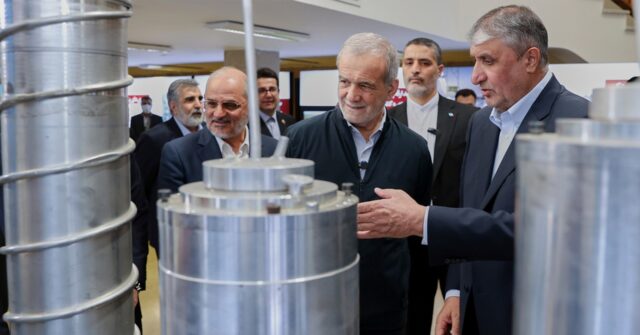
The CEO of the Russian state nuclear company Rosatom revealed Wednesday his company is negotiating with the Iranian terror state to build a series of “small nuclear power plants” in the country.
Alexey Likhachev made the comments during an appearance at a trade forum in Vladivostok, eastern Russia, where he also reportedly revealed that, during a meeting he was present for, Russian strongman Vladimir Putin discussed expanding nuclear collaboration with Iranian President Masoud Pezeshkian.
“We previously signed agreements on another construction site for large power units,” the Russian news agency Tass quoted Likhachev as saying. “The Iranians raised the issue of small-capacity generation during the negotiations, and we, for our part, handed over a corresponding draft intergovernmental agreement on the construction of small stations.”
On the same day, Iran’s state-run Islamic Republic News Agency (IRNA) revealed that the head of the Atomic Energy Organization of Iran (AEOI), Mohammad Eslami, was in Russia and met with Likhachev to discuss “cooperation in the field of peaceful nuclear energy.” That report noted that the two had already signed an agreement during a previous meeting in Moscow on further nuclear development. Eslami reportedly specified that the development in question was the creation of eight new nuclear power plants in Iran “as Tehran seeks to reach 20 GW of nuclear energy capacity by 2040,” matching Tass’s reporting that Iran was hoping to cement agreements in which the Russian company would build more, but smaller, nuclear projects.
“We will visit the facilities of the contracting parties and hold meetings with scientific and research institutions on ways to strengthen research and educational interactions and relations,” IRNA quoted Eslami as saying on Monday.
The Iranian state outlet also reported on Likhachev comments separate from those in Tass in which he claimed that, during a meeting between Putin and Pezeshkian this week, the two discussed nuclear energy. The leaders met in person during a summit of the Shanghai Cooperation Organization (SCO), a Central Asian security bloc, held in Kyrgyzstan this week.
“Stating that Tehran and Moscow had previously signed agreements on the construction of another site for large nuclear power plants, the CEO of Rosatom said Iranian officials had also raised the issue of building smaller plants in previous negotiations,” IRNA shared.
The public comments by Putin and Pezeshkian did not specify any news on nuclear cooperation, instead emphasizing Russia’s support for Iran amid the ongoing military conflict with the United States. Russia’s readout of the meeting did mention the presence of the Rosatom CEO at the event. Putin – in notable contrast to Chinese counterpart Xi Jinping – expressed enthusiasm for Iran’s position against the United States.
“As I have repeatedly said before, Russia is standing in full solidarity with the people of Iran,” Putin was quoted as saying. “We admire your courage and resilience in your fight for your national interests.”
Pezeshkian reportedly replied that the Iranian regime was “certain that thanks to this [Russian support] we can stand up against US bias and the rightless sanctions they are imposing on us.”
The plans for small nuclear reactions in Iran appear to stem back to negotiations in late 2025, which resulted in a Russian delegation visiting Tehran in October, according to state media reports, to discuss the details. At the time, IRNA reported that “both sides held talks on expanding cooperation in small modular reactors (SMRs) and the Iran–Hormoz nuclear power project and 1,250-megawatt units.” The parties also reportedly discussed Russia’s ongoing involvement in the maintenance of Iran’s Bushehr Nuclear Power Plant, the country’s only known legitimate civilian nuclear power plant.
Iran is the world’s premier state sponsor of terrorism, responsible for bankrolling a wide array of terrorist militias throughout the Middle East, including jihadist groups such as Hamas and Hezbollah. Reports from the International Atomic Energy Agency (IAEA), the United Nations nuclear energy agency, and accusations from the United States and others suggest that Iran is also engaging in illicit nuclear development, particularly extensive enrichment of uranium incompatible with civilian uses. The status of Iran’s enrichment activities has remained unknown since June 2025, when President Donald Trump ordered airstrikes on Iran’s three hidden enrichment facilities at Fordow, Isfahan, and Natanz. The Iranian government has denied the IAEA access to inspect the facilities.
Shortly before the airstrikes in June 2025, the head of the IAEA, Rafael Grossi, presented a report to the agency in which he revealed he had reason to believe that Iran was keeping secret nuclear development sites in violation of international law, attempting to “sanitize” them to prevent the IAEA from discovering them.
“Unfortunately, Iran has repeatedly either not answered, or not provided technically credible answers to, the Agency’s questions. It has also sought to sanitize the locations, which has impeded Agency verification activities,” Grossi asserted, concluding that the secret sites in question “were part of an undeclared structured nuclear program carried out by Iran until the early 2000s and that some activities used undeclared nuclear material.”
Grossi also asserted that “Iran did not declare nuclear material and nuclear-related activities at these three undeclared locations in Iran. As a consequence of this, the Agency is not in a position to determine whether the related nuclear material is still outside of safeguards.”
Read the full article here