


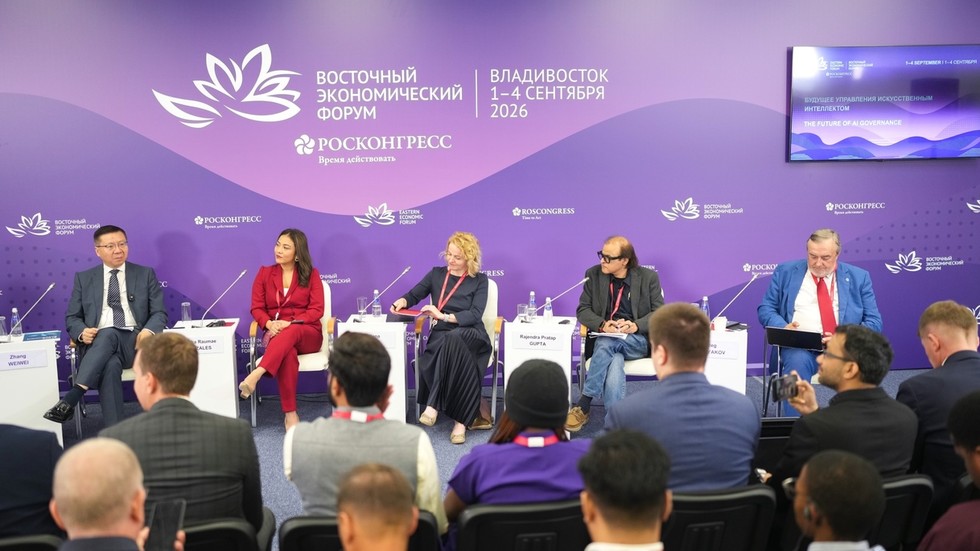
Experts at a forum in Vladivostok, Russia have warned that unequal access to AI could deepen global divisions and reshape jobs and incomes
AI is advancing faster than governments can regulate it and could widen global inequality, making international cooperation essential to managing its development, experts at the Eastern Economic Forum (EEF) warned.
The 11th EEF takes place September 1-4 in Vladivostok, Russia, focusing on investment, the development of the country’s Far East, and economic cooperation across the Asia-Pacific.
At Wednesday’s ‘Future of AI Governance’ session, speakers discussed how to make the technology safe and trustworthy.
“AI capabilities are advancing far faster and becoming far more powerful than governments can understand, assess and control,” Svetlana Lukash, the deputy head of Russia’s Presidential Experts’ Directorate, said.
Lukash told RT on the sidelines of the EEF that the international community must agree on how to align AI with human values, principles, and knowledge. She said BRICS could develop a common approach, but broader cooperation is needed. “AI knows no borders,” she said. “If geopolitical disagreements did not stand in the way and the whole world could reach an agreement, it would be much more effective.”
Chezka Raumae Gonzales, the founder of Philippine Blockchain Week, said AI has already changed the world. The key questions, she argued, are “who would shape its future, who would benefit and who would be responsible if something went wrong.”
Beyond regulation, participants focused on who would have access to the benefits of AI. Natalya Mochu, the International Telecommunication Union’s (ITU) regional director for the CIS, warned that the technological gap between countries could become insurmountable without action. The ITU estimated in 2025 that 6 billion people were online, while 2.2 billion remained without internet access.

Gonzales linked connectivity directly to healthcare, arguing that closing the divide could improve diagnosis and access to medical services in remote regions. She cited the Philippines, where AI is becoming part of the national infrastructure.
AI can boost efficiency in science, medicine, and manufacturing, but is already reshaping employment and incomes, Jeffrey Sachs, the president of the UN Sustainable Development Solutions Network, said. “Wealth could become concentrated among companies controlling AI patents and models,” he warned.
China plans to provide developing countries with 5,000 AI training opportunities over five years, Zhang Weiwei, the director of the China Institute at Fudan University, told the panel. Beijing also intends to establish international cooperation centers and help 30 countries deploy an AI-powered weather-warning system, he said. The country generates “more electricity than the US, the EU, and Japan combined,” leaving it well positioned to expand AI development, Zhang said.
Read the full article here