


Warsh Says the Old Economic Playbook Is Obsolete
“Well, times sure have changed. We’ve come to a hinge point in history.”
That was Kevin Warsh at Jackson Hole on Friday, immediately after dispensing with the economic pessimism that dominated the years following the financial crisis: secular stagnation, the global saving glut, too much capital chasing too few worthwhile investments, and the suspicion that maybe all the really important stuff had already been invented.
Federal Reserve Chairman Kevin Warsh at the Jackson Hole Economic Symposium August 28, 2026, in Jackson Hole, Wyoming. (Natalie Behring/Getty Images)
He repeated a shorter version of this point at the opening session of the G20 on Monday.
Most people probably missed the literal footnote to Warsh’s Jackson Hole speech. Warsh told us in the footnote that he borrowed the phrase “hinge point” from George Shultz, the former Reagan Secretary of State, Treasury Secretary, economist, and longtime Hoover Institution eminence who was also an important intellectual influence on Warsh. People close to Warsh describe Shultz as a kind of mentor to Warsh.
In his 2020 book A Hinge of History, written with James Timbie, Shultz argued that the world had reached an inflection point comparable in importance to the years immediately after World War II. Technology was advancing rapidly, demographics were changing radically, and institutions designed for the old world were increasingly ill-suited to the new one. “The near future is not going to be like the near past,” Shultz said in explaining the book.
That is a pretty good way of understanding what Warsh was telling us at Jackson Hole and at the G20 in Asheville.
For much of the past two decades, economic policy was conducted under the shadow of scarcity of demand. Growth was assumed to be chronically weak and investment opportunities were scarce. Labor was abundant enough that policymakers constantly worried about creating enough jobs (although, weirdly, we were still constantly told that there were jobs Americans wouldn’t do). As a result, the classic Keynesian solution of using government deficits to stimulate demand was increasingly attractive. Central banks around the world lowered interest rates to near zero to encourage borrowing and investment. They bought bonds to make holding safe assets less attractive. The great danger policymakers faced in the U.S. and in developed economies around the world was that the economy would stall for lack of demand.
A New Kind of Opportunity Society
We may now be entering something close to the opposite world. A world of abundant opportunity for both labor and capital.
Warsh pointed to the enormous investment flowing into artificial intelligence, data centers, energy and related infrastructure. Business capital spending is growing at around nine percent, he noted. That’s the fastest since 2021—but without a near shutdown of the economy to bounce back from. Growing investment deep into an economic recovery is unusual by historical standards but it may be the “new new normal.”
Although still in its adolescence, there’s a strong possibility that AI will become something like a new factor of production. Productivity growth could accelerate substantially—and with it the growth potential of the economy. We may soon discover that the Fed’s estimate of the longterm real growth potential of the economy—around two percent—is based on an outdated view of the economy.
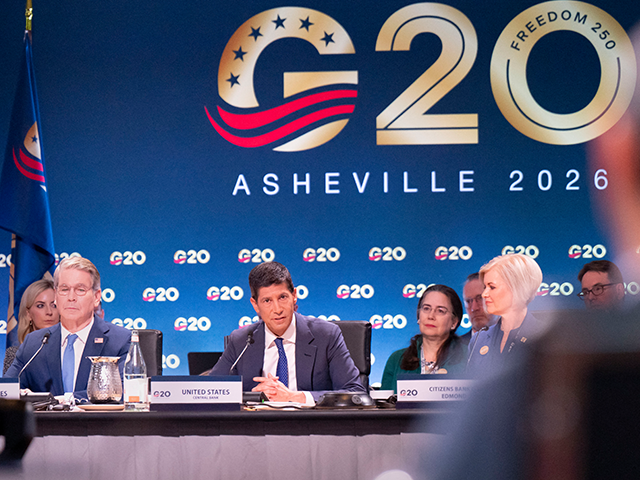
Secretary of Treasury Scott Bessent (left) and Federal Reserve Chairman Kevin Warsh speak during the G20 Finance Ministers and Central Bank Governors’ meeting in Asheville, North Carolina, on August 31, 2026. (Allison Joyce/AFP via Getty Images)
At the same time, labor-force growth has slowed dramatically. When the labor force was growing rapidly and unemployment was high, counting jobs made sense as a central measure of economic success. An economic policy that “created 500,000 jobs” sounded better than one that created 100,000. In an economy at or close to full employment, with very slow labor-force growth, that comparison can become almost meaningless. If one policy produces another million jobs by requiring another million workers to produce the same output, while another produces the same additional output through better machinery, software, and AI with hardly any additional workers, the lower payroll policy is economically superior. We need to stop thinking of policies in terms of the jobs they may “create” and instead consider how much of our scarce labor they require relative to the economic output they produce.
A New Policy Mix for a New Economy
In the world Warsh is describing, the policy objectives increasingly should be greater output per worker, higher wages, more capital investment, and faster productivity growth. Immigration policy should be restrictive enough and visa fees high enough that employers cannot indefinitely substitute an expanding supply of cheap labor for investment in machinery, technology, and worker productivity. Education policy should stop treating the maximization of college enrollment as an economic objective in itself—a bipartisan response to declining earnings for less-educated workers that too often substituted credentials for productivity. Apprenticeships and vocational training become more important. The government’s student loan program can be wound down. And we will be able to largely retire the use of student visas and post-graduation work programs as a backdoor means of continually expanding the supply of college-educated labor when the economic need for doing so is diminishing. We should be building domestic human capital wherever it can actually raise productive capacity and complement an increasingly capital-intensive economy.
We will also need policies that secure abundant energy, critical minerals, transportation and power infrastructure, and the domestic capacity to manufacture the technologies on which the new economy depends. Permitting, taxation, and regulation should be judged increasingly by whether they encourage investment and expand productive capacity.
Fiscal and monetary policy will have to adjust as well. In a world of scarce investment opportunities and chronically weak demand, expanding government payrolls, deficit spending, and exceptionally low interest rates could be defended as ways of putting idle capital and labor to work. In a world of enormous investment opportunities and scarce labor, government borrowing can instead compete with private investment for capital, while cheap money will pose the risk of rising inflation. Shrinking government payrolls, as President Trump has been doing, will free labor up for more productive work in the private sector.
If we get it right, we’ll find that we can produce solutions to many of the deep and seemingly intractable challenges that have loomed over us for a long time. Greater productivity will allow fewer workers to support a greater number of retirees without punitive tax increases, solving the Social Security disaster everyone is convinced is coming. Improved prospects, wages, and job security for younger workers will encourage early family formation, which is how the post-war Baby Boom got going. Scarce labor will raise incomes and lower income inequality, allowing us to escape from the kind of toxic politics that have been pushing young people into the arms of socialists in New York and elsewhere.
Needed: New Measures of Economic Success
This also means economists need to get much better at measuring the supply side of the economy. Warsh made this point explicitly in his second principle for monetary policy. We can observe economic activity, he said, but we cannot directly observe aggregate supply. We have to infer it. That’s partly a historical artifact. Our modern measures of the economy grew out of our experiences in the Great Depression, and so they were largely aimed at keeping an eye out for demand shortfalls.
We need to develop better ways to measure the economy and a new vocabulary for economic policy. Instead of asking how many jobs a policy will save or create, we should ask how much additional output it will produce and how much scarce labor it will consume. Headline GDP and payroll growth tell us less about economic success in this world. GDP per capita, output per worker, productivity, real wages, and capital formation tell us more.
In Schultz’s book, a historical hinge is not fate. Instead, it is moment when choices matter more because the old arrangements are breaking down, and the new ones have not yet hardened into place. Technology, demographics and capital flows may be pushing us into a new economic era, but they do not determine what that era will look like. Policy, institutions, and national character still matter. The rules we choose now will help decide whether faster growth produces broader prosperity or whether we squander the opportunity by trying to force the new economy into the old framework.
Read the full article here