


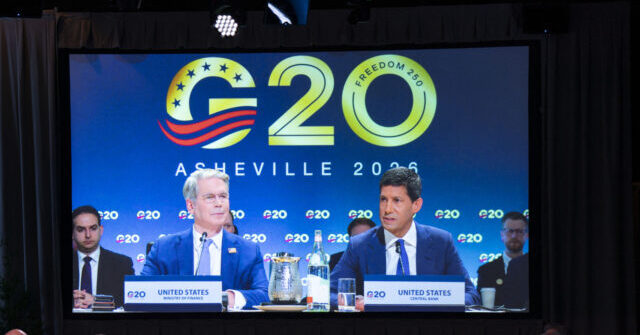
Fed chairman Kevin Warsh on Monday said the world had entered into an era of secular growth and was witnessing a global investment surge.
Speaking at the opening session of a meeting of finance ministers of leading economies from around the globe in Asheville, North Carolina, Warsh said that the global economy was in a “new period of secular growth.” He said he planned on asking economic policymakers at the meeting whether they believed this was a cyclical trend or a secular change.
Warsh contrasted the current period with the era that followed the global financial crisis, when many policymakers and academics were convinced that major global economies had fallen into a slow-growth period of “secular stagnation,” a phrase coined by economist Larry Summers, and was suffering from a global savings glut.
Secular stagnation, Warsh said, was the sense “that all the good stuff had already been invented, that we would be managing an economy that was going to be short of investment and economic growth.”
Warsh also said that the “global savings glut” was over. This was the idea that money would stay on the sidelines, pushing interest rates down and unemployment up, as investors perceived a shortage of opportunities.
“If I were to try to characterize this moment, it would be one of a global investment surge,” he said.
The comments echoed Warsh’s speech last week in Jackson Hole, Wyoming. In that speech, Warsh pointed to the rapid progress in artificial intelligence and the boom in investment it has triggered.
“The potential for substantially higher growth is on the rise. Ever-expanding pools of capital are pouring into AI-related infrastructure of all sorts,” Warsh said in Jackson Hole.
In Asheville, Warsh also repeated his Jackson Hole statement that he believes we are at a “hinge point in history,” a phrase borrowed from the title of a 2020 book by George P. Shultz and James Timbie. Shultz was something of a mentor to Warsh, particularly during Warsh’s years at Stanford’s Hoover Institution, where both were fellows. Shultz was an American economist, diplomat, and statesman who served as secretary of state under Ronald Reagan after earlier holding the posts of labor secretary, treasury secretary, and director of the Office of Management and Budget. He died in 2021.
The thesis of Shultz and Timbie’s A Hinge of History: Governance in an Emerging New World is that the world has reached an inflection point comparable to the aftermath of World War II: rapid technological change, profound demographic shifts, and the deterioration of the postwar international order are creating a new world faster than existing institutions can adapt.
Read the full article here