


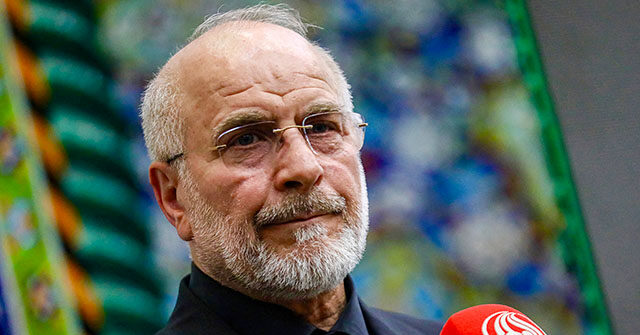
A sign of growing stress within the Iranian regime appeared this week, as hardline parliamentary speaker Mohammad Bagher Ghalibaf feuded with Hossein Shariatmadari, the editor-in-chief of the Kayhan newspaper, a regime media organ close to the theocratic wing of the Islamic Republic.
Shariatmadari, who was personally awarded his editorial position by slain Supreme Leader Ayatollah Ali Khamenei, wrote a column on Tuesday in which he essentially accused Ghalibaf of going soft by favoring negotiations with the United States.
WATCH — President Trump: I’m the Last Person to Trust Iran:
Ghalibaf, who is generally belligerent and highly critical of the U.S., apparently drew the admonition from Shariatmadari by saying negotiation “has neither intrinsic value, nor is it taboo,” and advising Iran to “talk when necessary, and fight when necessary.”
The newspaper editor told Ghalibaf to step up his “revolutionary” rhetoric and strengthen his spine, or else risk “exploitation and malicious interpretations” of his position. He told Ghalibaf it was important not to give the impression that he was crumbling under U.S. pressure.
Ghalibaf fired back with an open letter on Wednesday that thanked Shariatmadari for his “brotherly advice,” but rejected his accusations of insufficient revolutionary fervor.
“Any rational action from a revolutionary position, any strong negotiation, or any effort to secure the rights of the people from the enemy must not be wrongly defined as compromise and passivity,” the parliamentary speaker grumbled.
A woman waves an Iranian flag as a banner showing a portrait of the late Supreme Leader Ayatollah Ali Khamenei is seen at rear during Arbaeen rituals, which is held 40 days after Ashoura, commemorating the killing of the grandson of the Prophet Muhammad Imam Hussein and members of his family at the Battle of Karbala in 680 A.D. in Tehran, Iran, Tuesday, August 4, 2026. (AP Photo/Vahid Salemi)
Ghalibaf went on to caution against “hasty interpretations” of his comments that might weaken Iran’s negotiating position, which sounded a lot like him telling Shariatmadari to mind his own business.
On Thursday, Ghalibaf rushed out a statement predicting Iranian victory against the “all-out economic war” of the United States, and praising the “effective measures to run the country” taken by the regime. He dismissed the growing unease of the Iranian people as the result of enemy “psychological operations” and demanded obedience and “unity” from the public.
Iranian Foreign Ministry spokesman Esmaeil Baqaei likewise wrote a social media post on Wednesday claiming that “Washington’s Iran policy has reached pure parody” because it is supposedly counting on Bahrain, “a country with virtually no meaningful economic exchange with Iran,” to “prove that its ‘coalition’ is working.”
Baqaei was referring to U.S. Treasury Secretary Scott Bessent discussing the new round of sanctions against Iran, Operation Economic Outcast, with Bahrain’s Finance Minister Sheikh Salman bin Khalifa al-Khalifa in a phone call on Tuesday.
Salman expressed support for America’s efforts to shut down Iran’s nuclear and missile programs and said it was important not to let Iran use the Strait of Hormuz as an instrument of economic pressure.
Even as regime mouthpieces like Baqaei strove to mock the new U.S. sanctions as inconsequential, Supreme National Security Council leader Mohsen Rezaei was making blustery threats against the rest of the Middle East, warning of attacks against any regional power that cooperates with the American plan to isolate Iran.
“If the economic war continues, not a single drop of oil will be exported, neither through the Strait of Hormuz nor from anywhere in the Persian Gulf. We will retaliate in an earthquake-like manner,” Rezaei wrote on X.
Another bit of political infighting this week concerned the Islamic Republic of Iran Broadcasting (IRIB) network. IRIB was praised and endorsed by Islamic Revolutionary Guard Corps (IRGC) commander-in-chief Ahmad Vahidi, seemingly in an effort to rebut criticism from Ghalibaf and President Masoud Pezeshkian that the network was interfering with their diplomatic efforts.
Pezeshkian was angry at IRIB for censoring part of an interview in which he said the late Supreme Leader Khamenei had secretly ordered the Iranian government to negotiate with the U.S. before the war, even though Khamenei was publicly opposed to such contacts. Ghalibaf likewise accused IRIB of censoring a sizable portion of an interview in which he discussed efforts to persuade the U.S. to unfreeze Iranian assets.
Ghalibaf accused IRIB of severe “structural, approach, and performance inefficiencies,” but last Saturday, Vahidi extravagantly praised the network for its “valuable effort” in holding up Iran’s “media front” during the conflict with the United States.
Read the full article here