


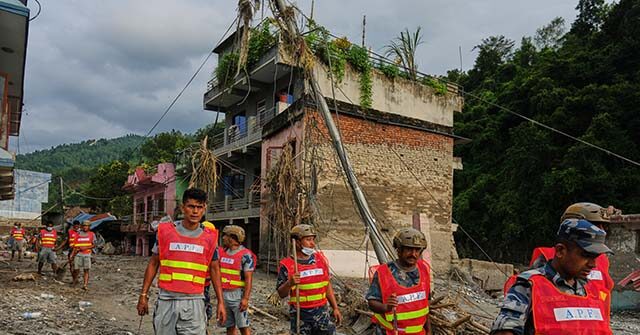
The Foreign Ministry of Nepal said on Thursday that it would not accept international rescue teams seeking to help emergency operations following a devastating series of landslides and floods in the country and neighboring Tibet.
Government officials explained that a host of countries around the world have offered to send emergency personnel to help dig out bodies and rescue those still trapped, but for logistical reasons it was forced to reject the offer of rescue workers, asking interested parties to send financial resources instead.
Rescuers use an earthmover to carry a victim of flash flooding to safety along the Trishuli River in Nepal’s Nuwakot district, Wednesday, August 26, 2026. (AP Photo/Niranjan Shrestha)
Nepal and neighboring Tibet experienced a horrific landslide and flood wave that began on Wednesday after what scientists believe was a “glacial collapse” at high altitude as a result of heavy rains. Videos from the affected regions showed large mudslides appearing to bury buildings, bridges, and in some cases entire communities as locals attempted to flee. Authorities stated on Thursday that they believe there are entire towns currently isolated from the rest of the world as the avalanches destroyed roads connecting them to the rest of their respective countries.
WATCH:
The government of Nepal, as of Friday, reported over 500 confirmed deaths and over 1,400 people missing. The Chinese Communist Party, which currently occupies Tibet, reported only five confirmed deaths as of Friday and at least 543 people missing as a result.
The natural disaster has attracted significant international attention not just due to the severity of the damage caused, but because of the high number of foreign nationals killed and missing. The flooding affected the site of a popular Hindu pilgrimage as well as areas frequented by hikers and other tourists. Nepalese officials said on Thursday they believe as many as three dozen countries have had citizens affected by the catastrophe.
“According to the Nepal Police 178 Indians, 65 Americans, 51 Malaysian, 53 Ukrainians, 33 British, 35 Australians, 25 Canadians, and nationals from other three dozen countries are missing since Wednesday,” the Kathmandu Post reported Thursday.
Nepalese Foreign Ministry spokesperson Lok Bahadur Chhetri explained on Friday that it had received a high number of offers for emergency personnel and other rescue aid, but that it could not accept them currently.
“The offer for help is natural. Our security agencies are doing the search-and-rescue operation. For now we don’t require such help,” Chhetri said.
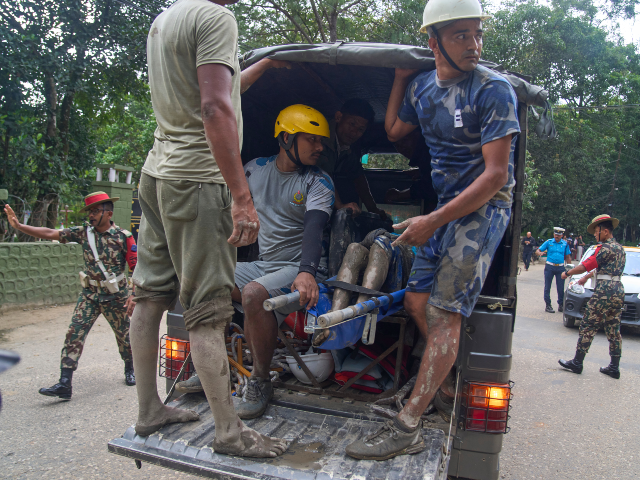
Rescuers transport the body of a flash flood victim in a truck to a hospital in Nepal’s Nuwakot district, Wednesday, August 26, 2026. (AP Photo/Niranjan Shrestha)
The Kathmandu Post reported on Thursday that Nepal was already rejecting rescue teams, asking instead that countries give “cash contributions through a one-door mechanism” that could be easily accessed to pay for resources and humanitarian aid.
“Officials from India, China, US, UK, Japan, South Korea, Sri Lanka, and Bangladesh have asked the government to allow their search and rescue teams to assist in the search and rescue,” according to the Nepalese newspaper. To facilitate communication with countries missing their citizens, officials said Nepal would instead establish an “Emergency Response Team (ERT)” dedicated exclusively to communicating with foreign governments.
“The ERT shall serve as the central coordinating body within the ministry to facilitate search, rescue, information verification, and consular assistance in respect of foreign nationals affected by, missing in, or otherwise connected to the flood incident,” a Nepalese Foreign Ministry statement read.
The Kathmandu Post reported that the choice not to accept international rescue teams was taken in the context of Nepal’s “experience in the 2015 earthquake, when the influx of foreign search and rescue teams and competition among countries caused significant coordination and management issues.”
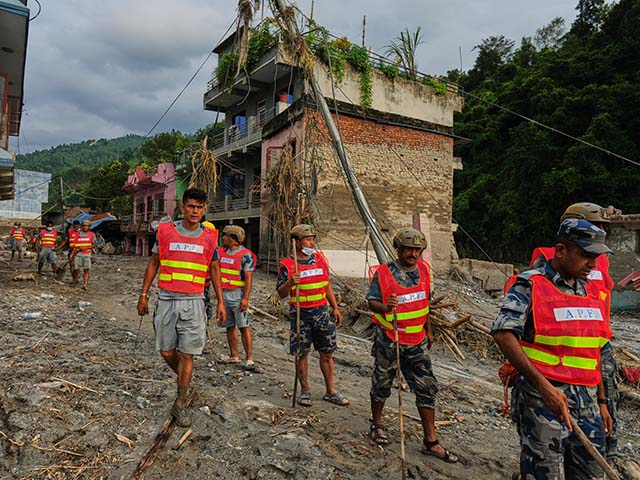
Workers clear debris in the aftermath of a flash flood in the Devighat area of Nuwakot district in Nepal, Friday, August 28, 2026. (AP Photo/Rajesh Kumar Singh)
Nepal experienced a devastating 7.8-magnitude earthquake in April 2015 that killed over 8,800 people and destroyed entire communities. A United Nations report on the first anniversary of the earthquake estimated that the earthquake caused $7 billion worth of damage. That report, while overall praising international coordination in emergency response, conceded that, while the response was overall “quick, well-coordinated and effective,” communication could be improved.
“Globally, the humanitarian system remains focused more on communicating to communities, rather than with them,” the United Nations report stated.
Writing for Nepal News on the tenth anniversary of the earthquake, Binod Dhakal was less complimentary of the emergency response, describing a situation in which too many independent groups of rescuers were operating with poor coordination, resulting in an inefficient distribution of humanitarian aid and rescue resources.
“The government’s delay in setting up the National Reconstruction Authority and creating a centralized aid tracking mechanism resulted in confusion and overlapping efforts,” Dhakal recalled. “Many INGOs operated independently of local authorities, while others were mired in controversies over inflated costs, poor targeting, and cultural insensitivity.”
“Large chunks of funds remained unused due to bureaucratic bottlenecks and Nepal’s weak absorptive capacity,” the report continued. “There were also allegations of corruption, duplication of efforts, and lack of transparency in how contracts were awarded for rebuilding schools, hospitals, and public buildings.”
Some countries are reportedly still trying to convince Nepal to allow their rescuers in. The government of South Korea already deployed rescue personnel, the country’s Chosun Ilbo newspaper reported on Friday, but as the Nepalese government requested that countries not send rescue teams, they are allegedly stuck at Kathmandu Airport, requesting permission to fly civilian helicopters that the group allegedly rented locally. The Nepalese government has not, however, granted permission for them to fly, citing the risk of further flooding as rain continues and lakes created by sliding debris threaten to overflow.
“The rapid response team is in the process of requesting cooperation from Nepalese authorities to obtain permission to operate helicopters,” a source at the South Korean Foreign Ministry told Chosun Ilbo on Friday. “We are continuing our efforts.”
Follow Frances Martel on Facebook and Twitter.
Read the full article here