



A sudden cut to Social Security checks — long seen as a far-off doomsday — is now an imminent problem for the next president and whomever voters send to Congress in the coming years.
The trust fund that bankrolls monthly checks to retirees is set to be drained of reserves in late 2032. That means tens of millions of Americans age 62 and older, as well as children and widowed spouses who get survivor benefits following the death of a family member, would see their monthly payments shrink by more than 20 percent — or an average of about $500 a month — unless Congress and the president act.
Capitol Hill saw a noticeable surge this summer in the sense of urgency to enact a fix, and alliances have started forming between prominent Republicans and Democrats rallying for a solution. But President Donald Trump and congressional leaders have yet to join the calls to action or back any of the numerous bipartisan bills aimed at preventing benefit cuts.
“This train wreck is going to happen,” Rep. Steve Womack (R-Ark.) said in an interview. “So as early as six years from now, we’re going to have to have a plan. And of course, I’m a big believer that we need to deal with it now, or we need to start the process of dealing with it now.”
Trump has yet to signal interest in a specific fix for the federal government’s single largest safety-net program, sticking instead to broad promises to safeguard benefits.
House Appropriations Chair Tom Cole (R-Okla.) recalled discussing the issue with Trump during his first term as president.
“He said, ‘Tom, I’ll be for this the first day of my second term,’” Cole told reporters this summer about trying to get Trump to push for a fix. “Well, we’re here.”
White House spokesperson Liz Huston said in a statement that Trump “will always protect and strengthen Social Security” and noted that the Republican megabill enacted last summer created a temporary tax deduction for people 65 and older that can be used to reduce taxes owed on Social Security benefits.
“Under his leadership, there will be zero reductions to Social Security payments,” she said, without specifying how Trump proposes to address the 2032 cliff.
Trump isn’t the only Washington power player uninterested in risking their political legacy by diving into a policy thicket where proposals include hiking payroll taxes, raising the age for benefit eligibility or letting some taxpayer cash ride the waves of the stock market.
Senate Majority Leader John Thune and Speaker Mike Johnson rarely discuss the approaching benefit cliff, nor have they called to advance any of the bills lawmakers have proposed to prevent it — prompting criticism this summer from top Democrats demanding the two GOP leaders “put forward their plan” to protect Social Security.
Meanwhile, some lawmakers have been telling voters the whole notion of a cliff is a hoax.
“Your Social Security is safe. You can write that down and take it home to mama,” Sen. John Kennedy (R-La.) said at an event this summer. “All we got to do is go take the money out of the general fund, which we always do.”
But backfilling a depleted trust fund with Treasury dollars, as Kennedy suggests, would not be automatic. Congress would need to pass a bill to do so, and winning support to siphon that cash could be difficult considering the U.S. public debt zoomed past $40 trillion this month after exceeding the nation’s annual economic output earlier this year.
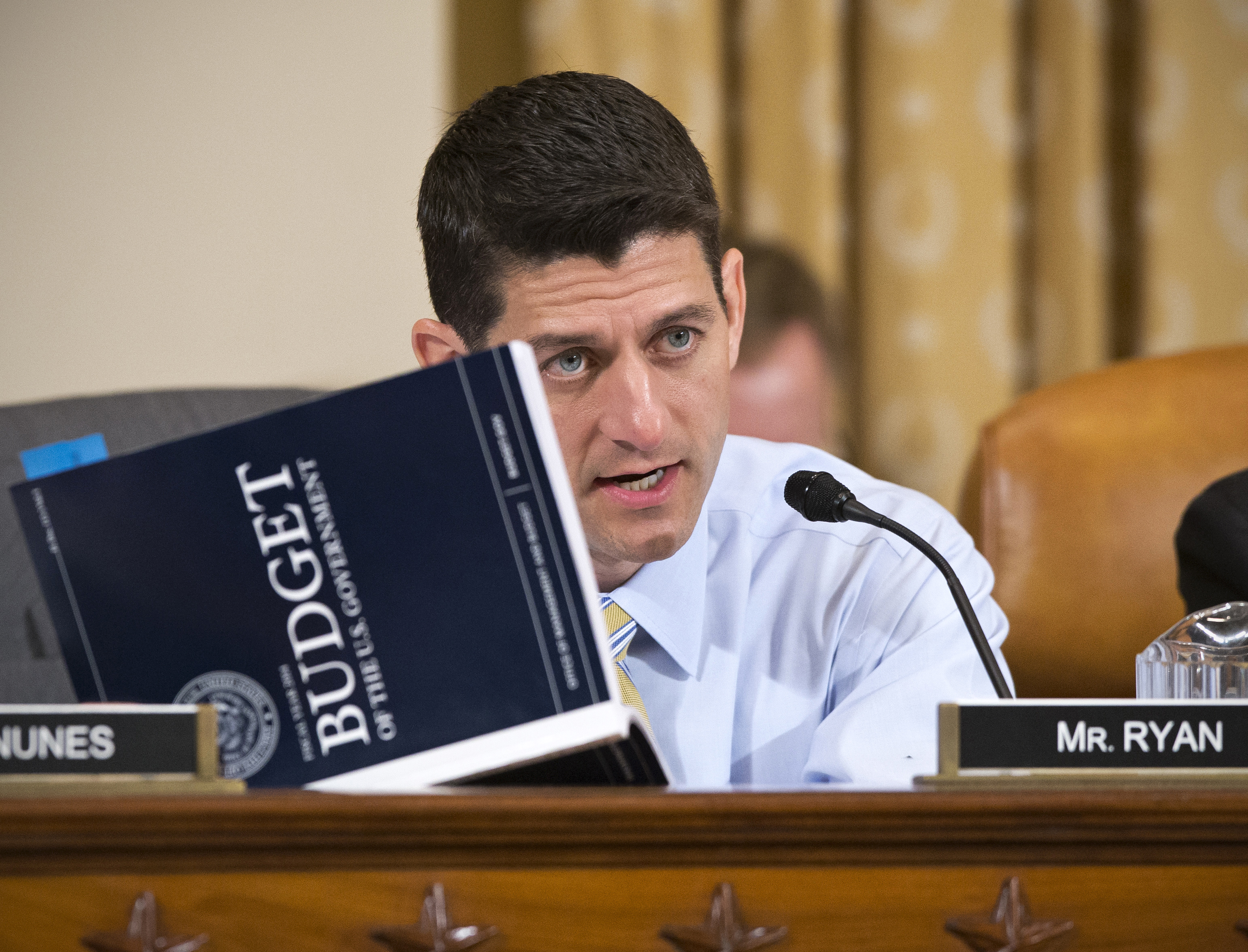
“Those are the politics that are bringing us a debt crisis,” former Speaker Paul Ryan said in an interview, knocking the “populist” approach lawmakers like Kennedy are taking in assuring voters that Social Security benefits would be covered by growing the deficit.
During the presidencies of George W. Bush and Barack Obama, Ryan pushed controversial plans to invest some Social Security contributions into private savings accounts and make changes like raising the retirement age.
“Regrettably, if we had reformed it back when we were trying to in the Bush administration, we would not be at this place,” Ryan said. “But the politics got the better of us in those days.”
Ryan was a member of the bipartisan 2010 fiscal commission led by Democrat Erskine Bowles and Republican Alan Simpson but ultimately voted against the group’s final proposal, which included plans to increase the age for receiving full Social Security payments, changing the formula for benefits and taxing more wages.
Obama backed away from a deal in 2011 with then-Speaker John Boehner to enact changes to Social Security as part of a broader fiscal “grand bargain.”
Today, not only is the Social Security cliff much closer, but the nation’s overall fiscal trajectory has worsened. In recent weeks, market watchers have blamed endless deficits for helping spike long-term Treasury bond yields — increasing borrowing costs and raising fears of a “debt spiral.”
Fixing the Social Security benefit cliff is not the same as solving the country’s larger fiscal issues. But it could be a test case for Washington’s ability to make difficult tradeoffs that will be necessary to bring deficits under control.
“My sense is that there’s pretty wide recognition of the fiscal situation — that the fiscal trajectory is unsustainable,” Congressional Budget Office director Phillip Swagel said in an interview. “And the interest in Social Security seems like the first kind of translation … into sort of realistic policy alternatives.”
The last time Social Security was headed toward insolvency, in the early 1980s, Congress didn’t enact a solution until a few months before benefits were set to be cut. A commission appointed by then-President Ronald Reagan developed proposals for overhauling the safety-net program, and lawmakers then passed a 1983 overhaul that gradually increased the age for receiving full benefits to 67 and raised taxes on those benefits, among other tweaks.
In a nod to Reagan’s approach, Cole and Rep. Tom Suozzi (D-N.Y.) released a bill this summer to create a bipartisan commission that would recommend a plan for staving off benefit cuts and then fast-track that proposal through Congress on an up-or-down vote. Several Republicans and Democrats are signed on to a similar bill across the Capitol led by Sens. Bill Cassidy (R-La.) and Dick Durbin (D-Ill.), both of whom are leaving office at the end of the year.
“The senators elected this November will be here when we have to solve this. The next president who’s elected will be here when we have to solve this,” Sen. Tim Kaine (D-Va.), a sponsor of that Senate bill, said in an interview. “So rather than wait till 2032, let’s go ahead and get this started now.”
Those bipartisan plans have critics on Capitol Hill, however. Sen. Bernie Sanders (I-Vt.) publicly warned Democrats this month not to allow Republicans “to slash or privatize Social Security through an unelected commission.” And backlash has emerged to other proposals that have delved into controversial policy specifics.
For instance, anti-tax advocate Grover Norquist has slammed a bill from the odd-bedfellows duo of progressive Sen. Elizabeth Warren (D-Mass.) and MAGA Sen. Bernie Moreno (R-Ohio) that would make the nation’s highest earners pay Social Security payroll taxes on 100 percent of their earnings.
Rep. Brendan Boyle (D-Pa.), who has pushed a similar plan for years, said in an interview that because Trump “has absolutely no interest whatsoever in solving this problem,” the issue needs to be at the center of the presidential primary debates for Trump’s successor.
“Like it or not,” Boyle said, “this will be on the plate of the next president.”
Read the full article here