


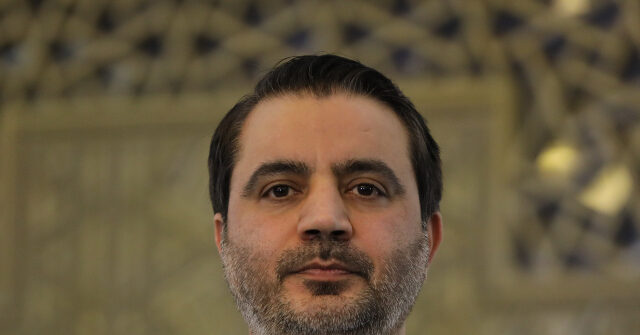
The government of Syria revealed on Sunday that its top diplomat, Foreign Minister Asaad al-Shaibani, had participated in peace negotiations with the government of Israel this weekend in talks hosted by Jordan and mediated by the United States.
The talks were reportedly necessitated by deteriorating relations between the two countries after Israel conducted airstrikes targeting a Syrian airbase last week, reportedly a protest against a visit to the site by Turkish military officials. Syria and Israel have been officially in a state of war since 1948, a situation Syrian President Ahmed al-Sharaa has publicly expressed interest in ending, but has said that no complete peace could be finalized if Israel did not hand over the disputed Golan Heights, which it has controlled since 1967.
For the vast majority of the time during which the two countries have been at war, Syria was ruled by the Assad family dynasty, an Alawite regime closely affiliated with the Iranian terror state. The Assad regime ended in December 2024 when Sharaa’s militia, Hayat Tahrir al-Sham (HTS), won the Syrian Civil War that began in 2011, forcing dictator Bashar Assad into exile in Moscow. HTS is an offshoot of al-Qaeda and Sharaa, for most of the civil war, was a wanted jihadist terrorist known as “Abu Mohammed al-Jolani,” naming himself after the Golan Heights.
When he came to power after years of jihadist struggle, Sharaa rapidly rebranded himself as a finance-minded “reformist,” started wearing suits, and reverted to his birth name. As HTS spent years fighting Iran, which regularly threatens the genocidal destruction of Israel, Sharaa has brought his government into the diplomatic orbit of Iran’s enemies, primarily the United States. President Donald Trump has been highly complimentary of Sharaa and regularly encourages him to build bridges with the Israeli government, in particular promoting the possible Syrian participation in the Abraham Accords, the Trump-led diplomatic agreements between Israel and several Islamic governments. Sharaa has rejected joining the Abraham Accords, but expressed interest in peace with Israel.
According to the state-run Syrian Arab News Agency (SANA), the Syria-Israel peace talks in Jordan this weekend were part of efforts to normalize relations and re-establish communication in light of the Israeli military bombing Syria last week. The media outlet cited unnamed government sources saying that the talks were “part of efforts to de-escalate tensions and support stability in Syria and the region.”
“Discussions focused on establishing practical mechanisms to halt Israeli attacks, arrests and targeting operations, and reviving negotiations with the aim of reaching a security agreement that could serve as the basis for a more comprehensive future agreement,” SANA reported.
SANA stated the Syrian diplomats used the meeting to urge Israel to withdraw its military presence in various parts of Syria that it has held since December 2024, deployed to protect Israel following the collapse of the Assad regime. The outlet also stated the Syrian delegation made “efforts to bridge differences between Turkey and Israel” that were reportedly responsible for last week’s attack.
“According to the source, the meeting focused on practical steps to de-escalate tensions while exploring ways to return to negotiations, with Syria stressing that any security arrangements must respect its sovereignty, territorial integrity and sovereign rights,” SANA concluded.
Speaking to Reuters this weekend, Shaibani noted that Israel and Syria were already having backdoor conversations towards peace in the aftermath of the fall of the Assad regime, but that they had been “frozen” after the launch of the ongoing war between the United States and Iran, in which Israel is also participating. Shaibani claimed that, prior to the breakdown in talks, the two countries had “agreed on almost everything on paper” and asserted that his government expects Israel to make concrete efforts to build trust in the bilateral relationship.
“We do not trust Israel at present. We deal with it through our interactions, but there is currently no trust,” he was quoted as saying. “Israel has repeatedly tried to preserve its security through hard power, and it has not succeeded. The door is open, and I believe negotiations will resume soon.”
Shaibani stated that Syria’s priority currently is to prevent the Israeli military from further bombing its territory.
“The issues of peace and the Golan could be opened later. We have now taken a step backward,” he claimed. “We want it to be a mechanism to stop the attacks and pave the way for reaching a security agreement culminating in Israel’s withdrawal from Syria.”
Tensions between Turkey and Israel have complicated attempts at diplomacy between Israel and Syria. The government of Islamist strongman Recep Tayyip Erdogan was a longtime supporter of HTS and opponent of Assad’s. Erdogan himself stated in 2016 that he had deployed troops into Syria to “end the rule of the tyrant Assad” and “not for any other reason,” insisting Turkey was not attempting to conquer any Syrian territory. In addition to his support for HTS, Erdogan is one of the world’s most prominent defenders of the jihadist terrorist organization Hamas and organized a massive pro-Hamas rally in Turkey in the aftermath of the terrorists’ genocidal October 7, 2023, attacks on the Israeli homeland.
As a result of Erdogan’s belligerence towards Israel and support for terrorism, the Israeli government has insisted that Syria not allow the establishment of a Turkish military presence on its soil, describing it as a national security threat. The airstrike last week on the Abu Duhur military airport in Idlib was reportedly in response to Turkish military officials visiting the site. Sharaa’s government has insisted that Turkey is helping rehabilitate the Syrian armed forces and considers Turkey an ally.
While anonymous Israeli sources initially distanced the country from the strikes, the office of Prime Minister Benjamin Netanyahu later took responsibility, citing Turkey as a threat.
“More than a year ago, Israel and Syria reached an understanding to maintain the security status quo and to keep this border calm. Syria breached that understanding,” a Netanyahu spokesperson said. “Israel welcomes a return to the previous status quo. We are not looking for escalation. But neither Turkey nor any other country is going to threaten the state of Israel.”
The Trump administration was quick to condemn Israel for the strikes. Special Representative for Syria Tom Barrack described the attack in a statement as a “confirmed Israeli” action and as “an unnecessary escalation that does not advance regional stability.”
“The [Ahmed] Al-Sharra [sic] government has neither adopted a predatory posture nor maintained proxy forces. It has, in fact, repeatedly indicated a preference for de-escalation with Israel,” he claimed. “The United States continues to believe that restraint and engagement offer the more constructive course. We encourage all parties to prioritize logical discourse over further military incidents.”
Follow Frances Martel on Facebook and Twitter.
Read the full article here