

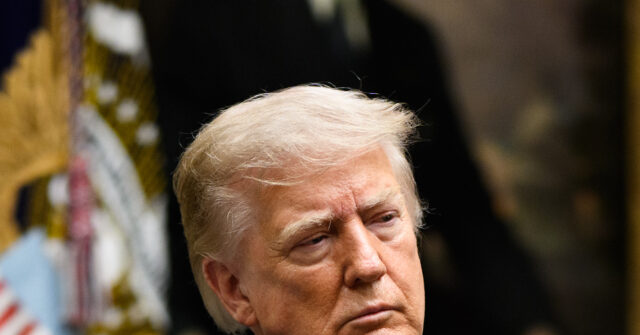
President Donald Trump rejected Iran’s sweeping demands for fully reopening the Strait of Hormuz on Monday, turning Tehran’s call for war reparations back on the regime by declaring that the United States is “now demanding compensation” from Iran in all future negotiations.
“I see that Representatives of the Islamic Republic of Iran are asking for compensation for the damage done to them during the last five month Military Conflict (started because, THEY WILL NOT HAVE A NUCLEAR WEAPON), even though it was never mentioned in any of our negotiations or meetings!” Trump wrote on Truth Social.
“But it is an interesting idea because now I am likewise demanding compensation from Iran, for all of the people that they have killed and gravely wounded with their roadside bombs and many conflicts, for which they are famous, as led initially by General Soleimani,” he continued.
Trump cited the families of those killed in the 2000 terrorist bombing of the USS Cole and “thousands of others killed in combat,” while also demanding compensation for the families of Iranians brutally killed by the regime.
“Additionally, compensation should be paid to the families of the hundreds of thousands of innocent protestors that Iran has killed over the last 50 years, not to mention the 52,000 that have been killed in the last five months,” Trump wrote.
“I have instructed my representatives to put this firmly into any, and all, future negotiations,” he added.
About an hour later, Trump returned to the issue in a second Truth Social post, broadening his demand to include Iran’s actions across the Middle East.
“Also, with respect to the Iran negotiations, Iran should be responsible for the damages and death caused to the people of Lebanon, Syria, Yemen, and Gaza!” Trump wrote.
The president’s response came after Tehran over the weekend laid out six far-reaching conditions it said Washington must meet before Iran will fully reopen the Strait of Hormuz, adding another obstacle to negotiations that appeared close to producing at least a limited agreement over navigation through the strategic waterway.
Mohammad Bagher Zolghadr, who was serving as secretary of Iran’s powerful Supreme National Security Council when he issued the demands Saturday, declared that the strait would remain closed until the United States “corrects its behavior,” demanding that Washington end its naval blockade of Iranian ports, lift sanctions, release frozen Iranian assets, withdraw U.S. forces from around Iran, compensate Tehran for damage from the war, and end hostilities and threats against Iran and its regional allies.
“The Supreme National Security Council will never give up, whether in war or in negotiations,” Zolghadr said.
Iranian officials hardened that position Monday, making clear that progress in separate negotiations with Oman over a temporary shipping route through Hormuz would not itself result in the strait fully reopening.
“As long as the U.S. naval blockade continues, the necessary conditions for the reopening of the Strait of Hormuz do not exist,” Iranian Foreign Ministry spokesman Esmaeil Baghaei said Monday, according to Iranian state media.
Baghaei said Tehran and Muscat were working toward an understanding over a “safe” shipping route but stressed that those negotiations were separate from the broader dispute with Washington over reopening Hormuz. He also said Iran would establish mechanisms to monitor shipping and provide services to vessels using the route, arguing that charging ships service fees would be “totally natural.”
“If the United States continues its policies and naval blockade, the Strait of Hormuz will not be a safe passage,” Baghaei warned.
Iranian Foreign Minister Abbas Araghchi similarly insisted Sunday that Tehran was not negotiating directly with Washington, describing the contacts instead as an “exchange of messages” through intermediaries and saying there was “no possibility” of resuming negotiations until the United States compensates Iran for what Tehran claims are violations of the June memorandum of understanding.
The escalating dispute over compensation comes just one day after Trump signaled that Washington was prepared to let mounting economic pressure on Tehran work rather than immediately resume major military operations.
“We are low-keying it,” Trump said Sunday in a phone interview with Axios. “We are only semi-negotiating with them. We are just watching Iran with its huge inflation and the fact they have no money.”
Trump said Iran was “in very bad shape” economically and lacked the money to pay its troops, while pointing to the U.S. naval blockade as further intensifying pressure on the regime.
“It will work out. It always works out. It’s like a chess game,” he said.
That pressure remains backed by more than 20 United States warships operating in the Middle East. U.S. Central Command said Sunday that American forces enforcing the blockade had redirected 55 commercial vessels, disabled two and boarded two others as of August 9.
Meanwhile, commercial traffic through Hormuz has continued to fall despite negotiations over a limited navigation arrangement. Maritime intelligence firm Kpler said confirmed crossings dropped from 15 on Friday to 11 Saturday and just six Sunday, according to CNN.
Baghaei on Monday rejected the notion that diplomacy alone could resolve the confrontation while the American blockade remains in force.
“Diplomacy is certainly part of our struggle to safeguard our national interests,” he said. “But when dealing with a side that insists on the use of force, a maritime blockade is not a diplomatic action that we can lift through diplomacy.”
“Certainly, you have to use authority and military power, along with diplomacy, to prevent the United States’ aggression,” he added, “and that is what is being done.”
Joshua Klein is a reporter for Breitbart News. Email him at [email protected]. Follow him on Twitter @JoshuaKlein.
Read the full article here
