

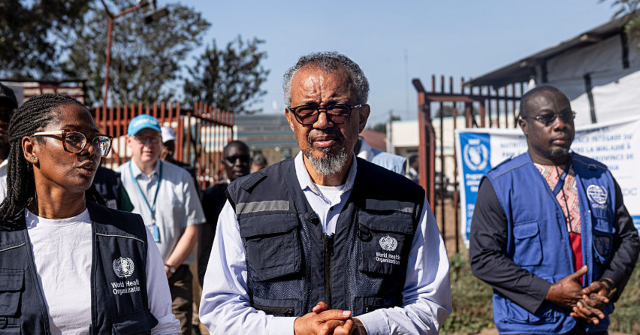
The director-general of the World Health Organization (W.H.O.), Tedros Adhanom Ghebreyesus, reportedly arrived in the Democratic Republic of the Congo (DRC) on Wednesday for his second visit to oversee the response to the ongoing Ebola outbreak in the east of the country.
Tedros first traveled to Ituri province, DRC, in late May and early June, meeting health officials and patients there and vowing to be personally involved in the response. Since then, the current outbreak has become the fastest-spreading in recorded history, enabled by widespread militia violence, local distrust of health workers, and health workers going on strike in response to not receiving the bonuses promised them for the highly dangerous work in which they are engaged. Also complicating factors is the strain of Ebola spreading in the area: Bundibugyo, a less common variety for which no treatment or vaccine exists. Following the Ebola outbreak of West Africa beginning in 2013, scientists developed a vaccine product against the more common Ebola Zaire strain, but it does not currently appear to be effective against Bundibugyo.
According to the latest statistics published by the W.H.O., local officials have confirmed 3,626 cases of Ebola Bundibugyo associated with the current outbreak. The vast majority of those, 3,605, were identified in the DRC; another 20 were identified in Uganda and one in France, traced back to the original source of the outbreak. Of the 3,626 people diagnosed, 1,589 have died as of the latest update reported on August 1, with about a 44 percent fatality rate.
Tedros published an image on Wednesday afternoon local time of a meeting with “health and humanitarian partners” in Kinshasa, the national capital, to discuss coordinating response.
“We all agree that we must urgently and massively scale up all our efforts across all pillars of the response and by all partners,” he said in a statement on Twitter. “That means reaching every affected community despite insecurity and displacement, strengthening coordination under the Government’s leadership, ensuring health workers have the protection, training, and support they need, and accelerating access to care, surveillance, and safe, dignified burials.”
His visit to the country appears to be in pursuit of keeping a promise he made in late May, before his first visit to Ituri.
“I will be there in person, alongside my colleagues, meeting your leaders, listening to your concerns, and doing everything in my power to help you,” he wrote in an open letter to the Congolese people in May. “I will not be managing this from a comfortable office far away.”
Tedros, who is from Ethiopia, used the letter to describe himself as deeply involved in the Ebola response. He described visiting the country during a separate Ebola outbreak between 2018 and 2020 in the period immediately preceding the W.H.O.’s disastrous response to the outbreak of the novel coronavirus in Wuhan, China, believed to have begun in late 2019.
“From 2018 to 2020, I came fourteen times to North Kivu, the epicentre of the outbreak,” he wrote at the time. “Mistrust ran deep, and the security situation cost us precious time. Our health workers were attacked. Clinics were targeted. People who were only trying to save lives found themselves caught in the middle of a conflict they did not start. Lives were lost that we might have saved, and that weighs on me still.”
During his first visit to the DRC during this outbreak, Tedros visited Ituri, the epicenter of the Bundibugyo spread, and neighboring North Kivu, focusing on addressing the widespread distrust in the community. Many in the DRC reject international health aid as they believe that Ebola is not a real disease, but an excuse for white countries and corporations to engage in “population control.” Some who believe Ebola is a real ailment trust only spiritual or traditional herbal solutions, rejecting medical care.
“Community mistrust is a serious barrier. Some community leaders told me that they believe Ebola is not real,” Tedros revealed during his first visit in June. “Building trust with the communities is therefore critical to bringing the outbreak under control.”
The lack of adequate facilities for quarantining and monitoring Ebola patients is also a significant challenge. On August 1, the United Nations announced that it was building a new treatment center in Bunia, Ituri, planned to be the largest in the DRC once completed.
Doctors Without Borders (MSF), which is active in aiding the response to the outbreak in the region, published a statement on Wednesday on the occasion of Tedros’s return, encouraging a focus on contact tracing. Health experts in the area have consistently lamented that the vast majority of new cases are being diagnosed in people not identified as having ever come into contact with the disease, suggesting that they have no true idea of where it is spreading.
“New suspected cases are being reported almost daily in new locations, outside already identified transmission chains. To prevent further loss of life, the response must outpace the current rate of transmission,” Philippa Boulle, the MSF deputy medical director, observed. “The international medical response must scale up without delay, and many critical gaps still need to be addressed.”
“Undeniable progress has been made in screening and contact tracing, but these efforts remain very insufficient to contain the epidemic,” her statement continued. “In the MSF Ebola treatment centre in Bunia, 90 percent of admitted patients were not traced contacts, while in the whole of Ituri province only 59 percent of contacts were traced.”
“Without communities at the centre of the response, surveillance and contact tracing will continue to miss cases. Better integration of local communities is essential to ensure cases are detected as early as possible and followed up rigorously,” Boulle advised.
Follow Frances Martel on Facebook and Twitter.
Read the full article here
