

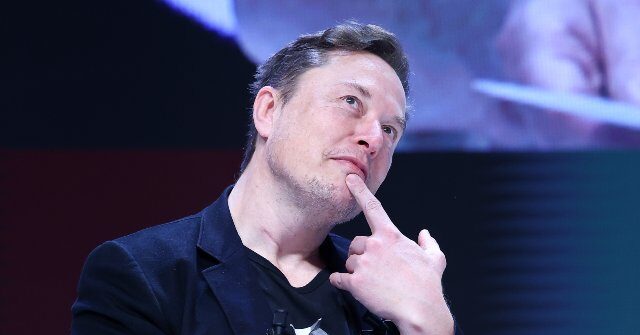
Elon Musk’s SpaceX posted second quarter revenue above Wall Street expectations in its first earnings report as a public company, but shares dropped 10 percent in morning trading as investors reacted to ballooning AI investments.
CNBC reports that Elon Musk’s space transportation and satellite internet company reported revenue of $7.81 billion for the three months ending June 30, surpassing analyst expectations of $6.93 billion. Revenue jumped 92 percent from $4.1 billion in the same quarter last year. The company posted a loss per share of nine cents per share, smaller than the anticipated loss of 26 cents. Shares have dropped more than 10 percent on Wednesday, with investors feeling spooked by its massively increased spending on AI technology.
SpaceX’s net loss narrowed to $541 million from $1 billion a year earlier. The results marked the first time Elon Musk’s reusable rocket company faced Wall Street scrutiny in this capacity following its record initial public offering in June.
The connectivity segment, which includes the Starlink satellite internet service, generated most of SpaceX’s revenue last year and remains the company’s only profitable division. Starlink provides service directly to consumers as well as to government and military customers.
The connectivity unit posted revenue of $4.29 billion in the second quarter, above the $3.83 billion estimate. The space segment brought in $962 million versus expectations of $835 million. The AI division generated $2.56 billion against a forecast of $2.18 billion. Operating losses totaled $542 million for the space unit and $1.26 billion for the AI division. The connectivity segment remained profitable with operating income of $1.66 billion during the period.
Capital expenditures surged more than sixfold from a year earlier to $18.37 billion in the second quarter. AI spending accounted for $15.83 billion of that total. The overall capital spending figure exceeded the average analyst estimate of $13.22 billion.
Chief Financial Officer Bret Johnsen said on the earnings call that SpaceX’s capital deployment delivers returns quickly. “All capex is not the same,” Johnsen said. “Specifically on the AI compute side, we’re able to deploy capital in such a way that we’re getting less than a one year payback.”
Musk said the company plans to build AI data centers exclusively using Nvidia chips. He expects to end 2026 with over 2 gigawatts of compute capacity, growing closer to 10 gigawatts by the end of 2027. Nvidia shares rose about two percent in extended trading after Musk called the chipmaker’s products the best AI computers available.
The company announced a partnership with Nvidia to design hardware for running AI models and services on satellites in orbit. The collaboration will develop the Starmind AI1 satellite compute payload, which will include Nvidia Rubin GPUs and Vera CPUs.
Johnsen said SpaceX is on pace to reach $100 billion in annualized recurring revenue by year end. He disclosed that in the opening weeks of the current quarter, SpaceX contracted an additional $6.7 billion of cloud services revenue over a six month period beginning in October.
President Gwynne Shotwell said the company launched Starlink mobile partnerships during the quarter with international carriers including SoftBank, NTT DoCoMo and Spark New Zealand. She said the near term priority involves launching mobile V2 satellites on Starship before integrating with EchoStar spectrum next year following recent FCC approval.
SpaceX plans to offer standalone Starlink mobile service to compete with AT&T, Verizon and T-Mobile as early as next year. The company aims to fly satellites capable of delivering the standalone service in 2027. “I expect us to be able to acquire quite a few of their customers,” Shotwell said. “I think our service will be better. We will eliminate dead zones, leveraging, basically, satellites in orbit.”
AI dominates the discussion during every tech giant’s earnings call, underscoring the importance of this technology to the future of the economy. Breitbart News Social Media Director Wynton Hall has written his instant bestseller Code Red: The Left, the Right, China, and the Race to Control AI to serve as the definitive guide on how the MAGA movement can create positions on AI that benefit humanity without handing control of our nation to the leftists of Silicon Valley or allowing the Chinese to take over the world.
Read more at CNBC here.
Lucas Nolan is a reporter for Breitbart News covering issues of AI, free speech, and online censorship.
Read the full article here
