

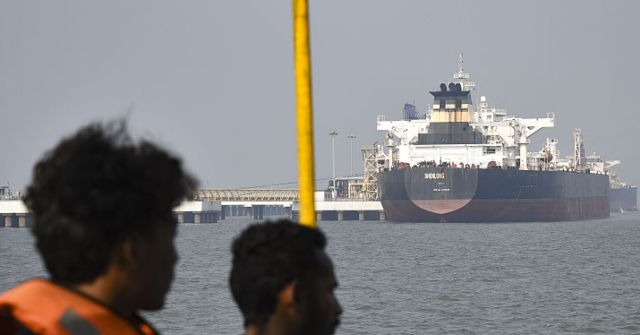
Ship tracking data released on Monday showed six Saudi-flagged supertankers turning away from the Gulf of Aden and heading for southern Africa to avoid the Red Sea. The Iran-backed Houthi insurgents of Yemen have declared a “maritime ban” on Saudi shipping, backed up by terror attacks.
According to maritime security firms LSEG and MarineTraffic, the six Very Large Crude Carriers (VLCCs) — each with capacity for two million barrels of oil — were empty after delivering cargoes to Asia.
Instead of passing through the Bab el-Mandeb strait into the Red Sea, the tankers opted for a much longer course around southern Africa, potentially adding 25 days to their transit time.
MarineTraffic said the tankers have not attempted to “run dark” by turning off their Automatic Identification Systems (AIS). AIS broadcasts from the ship showed them switching their destinations to southern African ports, including Durban, Algoa Bay, and Port Elizabeth.
Two trade industry sources told Reuters that the tankers chose the far less convenient route around the Cape of Good Hope after “taking into account the security situation.”
Saudi Arabia intervened against the Iran-backed Houthis in the Yemeni Civil War from 2015 to 2022, when an uneasy truce was made. The truce fell apart last month, as the Houthis resumed territorial aggression in Yemen, and the Saudis took drastic measures to block Iran’s influence over the country.
On July 20, the Houthis declared a “maritime ban” on Saudi vessels in the Red Sea and began sending threatening emails to shipping companies, warning their tankers could be attacked if they were suspected of carrying Saudi cargoes. The Houthis claim to have attacked at least two Saudi ships to enforce their ban.
Last week, the Houthis suggested they might begin extorting fees for safe passage through the Bab el-Mandeb Strait in a scheme modeled on Iran’s attempt to make ships pay for safe passage through the Strait of Hormuz.
The Saudis, like other Persian Gulf oil states, are searching for alternative shipping routes that could bypass the Strait of Hormuz. The Saudi strategy has involved using pipelines to shift their exports to Red Sea ports, which are now under threat from the Houthis.
On Tuesday, Saudi Arabia’s national oil company Aramco told investors it is considering a plan to beef up its East-West Pipeline and open more oil export routes.
“Our engineering team is looking at how we can not only expand what we have, but at the same time identify other routes that we can capitalize on,” said Aramco President and CEO Amin Nasser.
Nasser noted that Aramco has already used the East-West Pipeline to move oil exports to the Red Sea port of Yanbu, which is now operating at its peak capacity of 7 million barrels per day (bpd). This strategy reduced Saudi dependence upon the Persian Gulf ports blocked by Iran, but left Aramco vulnerable to Houthi piracy.
The only remaining unthreatened route is through the Suez Canal into the Mediterranean, which is 20 to 25 days longer than using the Red Sea and Gulf of Aden to reach the same customers. Russian exporters are reportedly making similar course adjustments, as in the case of a Panama-flagged tanker with 100,000 metric tons of Russian naphtha that turned away from the Bab el-Mandeb Strait in late July.
In his conference call with investors on Tuesday, Nasser declined to comment on Houthi and Iranian threats to Aramco’s ports and processing facilities, describing them as “matters related to military and security incidents.”
However, Nasser noted that Aramco has developed the ability to repair damaged facilities much faster than most companies, and could return to full pre-conflict export levels in a matter of weeks.
“It all depends on things normalizing in the Strait of Hormuz,” he said.
Read the full article here
