

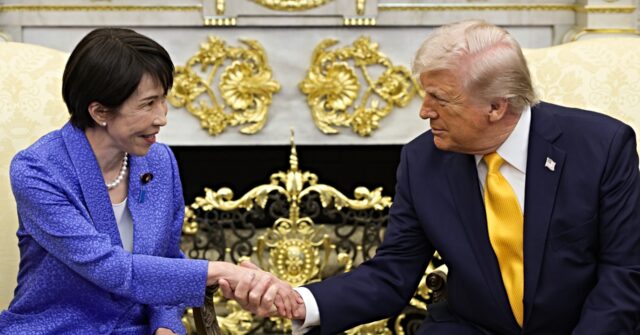
The U.S. moved to support Japan on Friday in their first joint action in 28 years to boost the yen after the struggling currency plunged to a four-decade low.
President Donald Trump applauded the historic intervention in the yen market as a “signal of friendship” that would financially benefit the U.S. and the wider global economy.
The full scope and scale of the joint operation is not known, but AFP reports it is the first since 2011 when the two countries — and other G7 members — sold yen to stop it rising after a huge earthquake.
Trump affirmed the concerted action aboard Air Force One saying “friendship” with Japan is “good for the world economy.”
FILE/Japanese Prime Minister Sanae Takaichi listens as U.S. President Donald Trump speaks to troops aboard USS George Washington on October 28, 2025 in Yokosuka, Japan. Trump visited Japan fresh off an appearance at the ASEAN summit in Malaysia in a move designed to reaffirm his friendship with Takaichi as well as the two countries and their shared interests in Asia-Pacific region. (Tomohiro Ohsumi/Getty Images)
Trump outlined, “And we’re always there for Japan. Japan’s been very good to us, with the exception, of course, of Pearl Harbor,” Trump added, referring to the Japanese attacks on the Pacific U.S. naval base in World War II.
“We will not hesitate to participate in further joint intervention,” U.S. Treasury Secretary Scott Bessent said, adding U.S. officials “strongly support Japan’s decisive market and monetary steps to correct the substantial undervaluation of the yen.”
He used social media site X to expand on the reasons why the U.S. stands by friends like Japan.
“The Takaichi government is moving into an exciting new phase of Abenomics, as nearly 15 years of powerful stimulus have created durable, robust underlying economic dynamics,” he added.
Shigeto Nagai, head of Japan economics at Oxford Economics, told the BBC: “The United States agreed to participate in the coordinated intervention because it serves its national interests by offering the prospect of significant benefits at a low cost.”
The two countries are expected to continue to intervene “intermittently in a coordinated manner for some time”, he added, mirroring the efforts of Japan and the U.S. as they seek peace on the world stage.
“Even if the actual amount of intervention is not particularly large, the prolonged sense of vigilance regarding intervention will be effective in deterring speculators.”
The intervention came after the yen hit 163.99 per dollar last month, its weakest since 1986. On Friday it soared to 157.40, the strongest since early May.
On Monday the exchange rate jumped as high as 155.23, prompting speculation of another intervention. By mid-afternoon it had eased to 156.81, AFP concluded in its market summary.
Follow Simon Kent on Twitter: Follow @SunSimonKent or e-mail to: [email protected]
Read the full article here
