

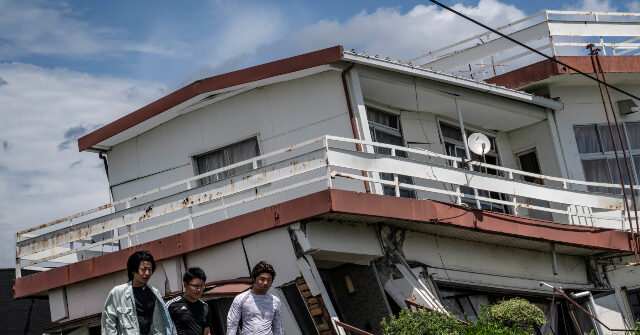
Southwestern Japan suffered an earthquake of magnitude 7.1 on Tuesday, causing at least 18 fatalities and 62 injuries.
The counts of both dead and wounded increased throughout the day as rescue workers and military forces searched through the rubble for survivors.
The earthquake struck near the city of Kumamoto, Japan, on the southern main island of Kyushu at 4:27 p.m. local time, or 3:27 a.m. Eastern time, on Tuesday. Several potent aftershocks were reported following the initial quake.
Some of the heaviest damage occurred in the town of Kashima, where a shopping complex called the Aeon Mall suffered a partial collapse while thousands of people were inside. Local officials said they were able to evacuate roughly 3,000 people from the damaged area of the mall before a gas explosion rocked another section of the building, where people were still inside.
Eyewitnesses told the Associated Press (AP) that the gas explosion at the mall felt almost as powerful as the earthquake itself. Much of the second story of the mall wound up collapsing, trapping a number of victims inside. Rescue workers were able to reach many of those victims, but three people remained missing and four were confirmed dead as of Wednesday morning.
The president of the mall, Yoshida Akio, said the cause of the gas explosion was under investigation. Yoshida noted that the mall was damaged in a 2016 quake and then extensively renovated to meet Japan’s tougher earthquake standards.
Aeon Mall management expressed its “deepest condolences” to those who were killed in the quake and said it was working to confirm the status of every employee of the mall stores. As of Wednesday morning, the safety of about 2,700 employees had been verified.
Another damaged structure was a 16th-century Buddhist temple, whose gates collapsed completely only five years after they were given extensive repairs. Temple officials said they were uncertain if the gates could be repaired again.
The historic Kumamoto Castle, which dates back to the early 17th century, also reported damage from the quake. The castle said it was “conducting safety inspections of its facilities and the grounds,” and would be closed to visitors until further notice.
Five fatalities were reported when a chimney collapsed at the local Nippon Paper Industries factory, while a Vietnamese intern was killed when a crane fell on him at another factory. The intern, who had only arrived in Japan in January, was the first known foreign national to have been killed by the quake.
Disaster management officials said about 36,900 homes were still without electricity, and 9,500 without gas, the day after the quake. Over 9,000 local residents were evacuated from their homes to shelters, in part because a heat wave with temperatures over 90 degrees made it dangerous to remain in buildings without power.
Troops from the Japanese Self-Defense Force (JSDF) joined in the rescue effort, along with hundreds of emergency responders from across Japan, plus some of whom rushed to the scene from Taiwan. Much of the rescue effort was concentrated on the Aeon Mall and the Nippon Paper Industries mill, where survivors were believed to be trapped in the rubble.
“I extend my heartfelt condolences to all those affected by the disaster,” Japanese Prime Minister Takaichi Sanae said in a social media post on Tuesday.
“The government will work tirelessly through the night to swiftly assess the overall damage situation and carry out emergency disaster response measures, starting with the rescue and lifesaving of those affected,” she pledged.
“At the same time, we will ensure the reliable delivery of essential supplies such as food and water, as well as simple air conditioners and power vehicles for heatstroke prevention,” she said, “utilizing push-type support where appropriate, and strive to secure a safe and suitable evacuation environment.”
“I extend my deepest condolences on behalf of the people of Taiwan. Taiwan and Japan are true friends who have overcome hardships together. We are closely monitoring the situation on the ground and stand ready to provide cooperation whenever needed,” Taiwanese President William Lai Ching-te said in his own social media post on Tuesday. “We sincerely pray for the safety of everyone in the affected areas.”
Read the full article here
