

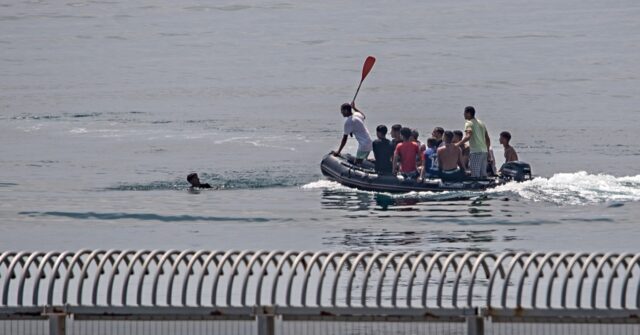
Over 1,000 illegal migrants have swam into the Spanish North African enclave of Ceuta over the past days after the nation’s Supreme Court prohibited pushbacks at sea.
Earlier this month, the Spanish Supreme Court issued a ruling upholding the majority of the contents of Spain’s current Immigration Regulations, implemented in May 2025.
The top court, however, modified or outright eliminated some of its key elements, such as the automatic residence permit disqualification for migrants with criminal records.
The Spanish Supreme Court also prohibited the pushback of illegal migrants caught at sea — arguing that such provisions can only be applicable to migrants “for those who try to do so by getting past established border barriers, such as fences.” The prohibition applies to Spain’s Ceuta and Melilla enclaves.
The border fence in Ceuta, Spain, located in northern Africa, divides the territory between Spain and Morocco. This is one of the main borders used by people from northern African countries to try to illegally enter the European Union. (Photo by Lucas Neves/NurPhoto via Getty Images)
The Spanish outlet El Español reports the ruling has led to over 1,000 illegal migrants swimming into Ceuta over the past nine days now that they cannot be immediately caught in Spanish waters and pushed out.
According to El Español, local residents have reported to police officers several instances of strangers soaked wet roaming through the enclave’s streets, “some still with swimming fins in their hands.” As many as over 120 illegal migrants were registered by the local police in a single morning.
Unnamed sources from the office of the Mayor-President of Ceuta stressed to El Español, “We’re completely overwhelmed.” There were 625 migrants reportedly housed on a Temporary Migrant Reception Center (CETI) as of Tuesday, with over 300 more waiting outside.
The sources reportedly asserted that Ceuta is acting “with loyalty and a sense of statesmanship,” but stressed that it is “urgent and imperative” that the central Spanish government activates a migration contingency plan.
“Structural measures are needed to address a situation that stems from equally structural factors: the fact that it is Europe’s only land border with Africa,” the sources reportedly told El Español.
The developing situation has also dramatically pressured Ceuta’s minor protection services, who are now reportedly taking care of at least 472 unaccompanied minor migrants — sixteen times its regular capacity.
Of the total, 262 minor migrants arrived just over the past two weeks. Ceuta local government spokesperson Alejandro Ramírez reportedly acknowledged on Tuesday that the situation is “extremely grave” and that the minor protection services are “collapsed.”
As a result of the Supreme Court’s ruling prohibiting the pushback of migrants at sea, Spanish authorities must follow the “standard return procedure” on illegal migrants who swam their way into Spanish territory — a procedure that includes “identification, legal assistance, an interpreter, and the opportunity to apply for international protection.”
“Cameras, sensors, and drones are used for surveillance, but they lack the physical function of a barrier,” El Español pointed out.
According to the report, some of the illegal migrants seeking to swim their way into Ceuta in recent days are waiting for moments in which surveillance is “more distracted” to make their attempt.
As such, as many as 200 reportedly attempted to swim from Morocco to Ceuta on the night of July 19, the day of the 2026 FIFA World Cup final match between Spain and Argentina. A group of over 100 migrants also attempted to swim their way in during Spain’s semi-final match with France a few days prior.
El Español pointed out that Spanish security officers had already taken precautions for such a scenario and reinforced security during the soccer matches days.
Read the full article here
