

The Federal Reserve on Wednesday held its benchmark interest rate steady, in a range of 3.5 percent to 3.75 percent.
Nine voting members of the Fed’s monetary policy unit, the Federal Open Market Committee, voted to keep rates unchanged. Three regional presidents dissented, preferring to increase the benchmark rate by one quarter of a percentage point. John Williams, the New York Fed president, and Anna Paulson of the Philadelphia Fed, voted with the majority, as did all seven Fed governors.
“Economic activity is expanding at a solid pace despite elevated uncertainty that owes, in part, to the conflict in the Middle East. Productivity growth and capital investment are strong. Job gains have kept pace with the workforce, and the unemployment rate has changed little,” the Fed said in a statement released at the conclusion of its two-day monetary policy meeting.
Investors were less certain than they have been in years about what the Fed would do with rates at this meeting. Just prior to the meeting, futures markets were implying around a 30 percent chance that the Fed would raise its benchmark rate.
The three officials who voted against today’s decision—Cleveland Fed President Beth Hammack, Minneapolis Fed President Neel Kashkari, and Dallas Fed President Lorie Logan—dissented from the Fed’s statement in April. They objected to language in the statement that suggested the Fed’s next rate move was more likely to be a reduction than an increase.
After the Fed’s meeting last month, a summary of the views of Fed officials showed eight thought the Fed would increase rates later this year. Of those officials, five forecast two hikes, one forecast three hikes, and three forecast a single hike. Eight officials penciled in no hikes this year and one indicated that it was likely to be appropriate to cut by a quarter of a point. The so-called “dot plot” in the summary of economic projections includes the views of the 12 voting members of the FOMC—the Fed chairman, the president of the New York Fed, six Fed governors, and a rotating group of four regional Fed presidents—and the remaining seven regional Fed bank presidents.
The projections have been released every other meeting for several years, evolving into their current form in the years after the financial crisis. Fed Chairman Kevin Warsh has indicated that he is reviewing the policy of releasing these projections. At the last meeting, Warsh did not submit projections, saying he did not think such forward guidance was appropriate under the current economic circumstances. The FOMC holds scheduled meetings eight times a year.
Fed officials have signaled renewed concerns over inflation in recent months while gaining confidence in the health of the labor market and economic growth. Official measures of inflation rose sharply after the U.S. and Israel attacked Iran and Iran responded by effectively shutting down the Strait of Hormuz, a crucial chokepoint for Persian Gulf oil. This sent oil and gasoline prices soaring, pushing up the consumer price index.
Higher oil prices, however, do not appear to have triggered broader inflation. And when gasoline prices fell sharply in June, the consumer price index actually fell, turning in a rare negative reading for the month and bringing the annual figure down more than financial markets had expected. This month, however, has seen gasoline prices climb again as hostilities have intermittently returned while cease-fires have been declared and called off and broader peace talks apparently stalled. A gallon of gasoline costs nearly $4.10, according to AAA, up from $3.86 a month ago.
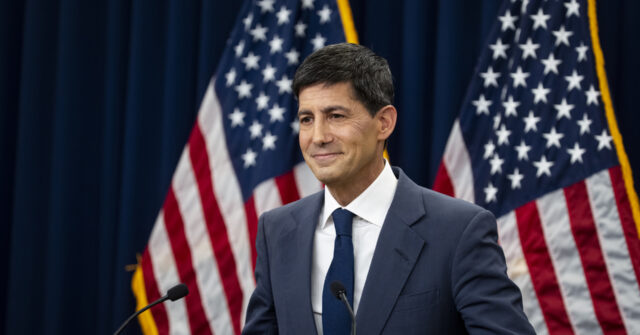
At a press conference following the release of the Fed’s statement, Warsh said the soft inflation report for June played very little role in today’s decision.
While standard monetary policy rules would advise against reacting to one-off shocks such as a surge in energy prices due to a supply constraint, Fed officials have expressed the concern that repeated bouts of inflation due to supply problems could convince households and businesses that inflation is likely to remain higher for longer. Under the theory that inflation expectations have a large influence on the path of actual inflation, officials strive to keep the public’s expectations “anchored.”
The primary economic models used by Fed economists typically look to expectations and the labor market as important sources of inflationary pressures. Monetary policy is viewed by the Fed as being able to provide an effective check on those. Most Fed officials and the staff economists do not think the labor market is currently fueling inflation. While interest policy is unlikely to directly effect the price of oil and gasoline, higher rates may be able to keep expectations anchored and could diminish economic activity in ways that would decrease demand for oil and gasoline.
Warsh has said the Fed will achieve its goal of returning to two percent inflation, the rate of annual price increases that the Fed interprets as consistent with its price stability mandate.
While the Fed continues to officially use the personal consumption expenditures price index as the barometer for its two percent inflation target, an approach the Fed has followed for years and renewed in January prior to Warsh’s term, Warsh on Wednesday indicated that he looks through a broader “lens” to evaluate underlying inflationary pressures in the economy.
Near the close of the press conference, Warsh said he would continue to hold the gatherings through the end of the year. Warsh has said Fed officials should talk less and stop providing forward guidance about policy, leaving many Fed watchers to wonder if Warsh might discontinue the press conferences. Fed chairs did not hold press conferences following FOMC meetings until 2011, when then-chair Ben Bernanke began formal meetings with reporters following every other meeting. Janet Yellen continued Bernanke’s practice but Jerome Powell expanded the practice to hold press conferences after each of the eight scheduled Fed meetings.
Read the full article here
