

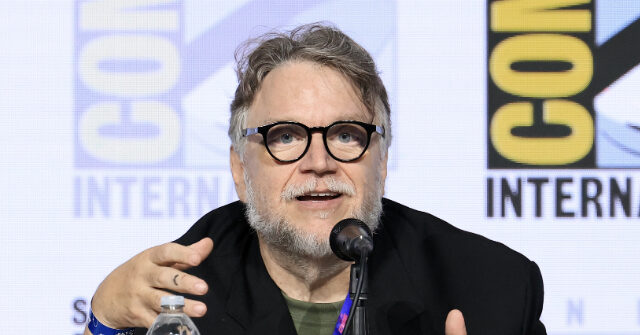
Academy Award-winning director Guillermo Del Toro continued his fight against generative AI this week during an appearance at San Diego Comic Con.
The Frankenstein director maintained his anti-AI stance, which he established last year.
“Absolutely no goddamn AI,” Del Toro said, prompting cheers from the audience. “It’s much more expensive, I don’t care. What we’re protecting is the beauty and the redeeming power of art.”
Guillermo Del Toro came out swinging against AI last year at the Gotham Awards when he publicly said “fuck AI” when accepting the Vanguard Tribute for his film Frankenstein.
“I’d like to tell the rest of our extraordinary cast and our crew that the artistry of all of them shines on every single frame of this film that was willfully made by humans, for humans,” the filmmaker said at the podium as actors Jacob Elordi and Oscar Isaac stood by. “The designers, builders, make-up, wardrobe team, cinematographers, composers, editors, this tribute belongs to all of them. I would like to extend our gratitude and say: Fuck AI.”
The use of generative-AI in movies has become a hot-button topic in Hollywood, with some of the industry’s most acclaimed directors casting critical eye on it.
“I’m not negative about generative AI,” Avatar director James Cameron said. “I just wanted to point out we don’t use it on the ‘Avatar’ films. We honor and celebrate actors. We don’t replace actors. That’s going to find its level. I think Hollywood will be self-policing on that. We’ll find our way through that. But we can only find our way through it as artists if we exist. So it’s the existential threat from big AI that worries me more than all that stuff.”
A study in 2015 showed that an over-reliance on artificial intelligence (AI) to perform certain tasks reduces critical thinking skills. The study, conducted by Carnegie Mellon and Microsoft, found that people who use AI regularly for basic, routine tasks will lose their ability for complex critical thinking. The study focused on what it referred to as 319 “knowledge workers,” meaning professionals who deal in problem-solving of some kind, and found some rather alarming results on the effects of AI. Per Futurism:
From social workers to people who write code for a living, the professionals surveyed were all asked to share three real-life examples of when they used AI tools at work and how much critical thinking they did when executing those tasks. In total, more than 900 examples of AI use at work were shared with the researchers.
The findings from those examples were striking: overall, those who trusted the accuracy of the AI tools found themselves thinking less critically, while those who trusted the tech less used more critical thought when going back over AI outputs.
The researchers wrote in the paper that AI can result “in the deterioration of cognitive faculties that ought to be preserved.”
Read the full article here
