


Multiple reports from Ontario, Canada, quoted local First Nations members this weekend stating that the government did not properly warn them about the catastrophic wildfires that have engulfed entire communities, nor has it offered adequate response to put them out.
“I’m really extremely angry with not just this government, but all levels of government, and the generations of underfunding that communities like mine have experienced, that emergency services have experienced,” Riley Yesno, a member of Eabametoong First Nation, told Canada’s CBC broadcaster in a report published on Sunday, calling the situation of the native communities of Canada “shameful.”
Yesno denounced a lack of critical firefighting infrastructure and investment on the part of both federal and local governments in the First Nations communities, many of which in Ontario are located in remote areas.
“It’s always just so difficult when the infrastructure that we have there, like in so many remote northern communities, is just so insufficient to deal with the level of crisis that they are experiencing or could very soon be experiencing,” Yesno explained. “The conditions in which they are dealing with, just in terms of air quality, are already poor — and there’s very little fire support there, too.”
The CBC, citing Indigenous Services Canada (ISC), reported that about 80 percent of Canada’s indigenous communities are vulnerable to wildfires. Canada’s massive forests have historically faced annual fire seasons, which First Nations addressed through traditional practices such as removal of flammable undergrowth and controlled fires. The Canadian government has limited the ability to conduct these practices while investing little in its institutional ability to address the fires. The federal government is largely divorced from the fire situation, having no emergency response agency and no national fire authority. This leaves the provinces to react to the fires on their own, with some minor help from the national government to communicate with other provincial governments.
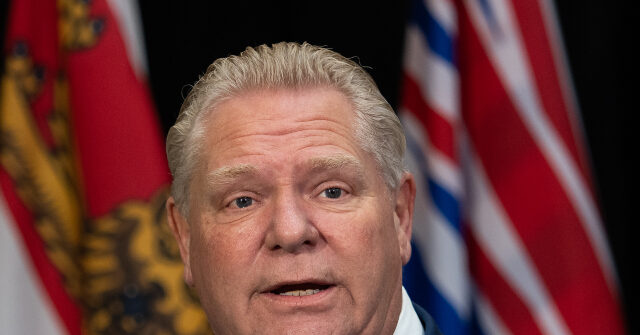
Ontario Premier Doug Ford visited Thunder Bay, Ontario, the city closest to the fire disaster, on Saturday. He insisted that his government was “doing absolutely every resource we can possibly throw at this” during his visit, insisting that his government had “not stalled” and was available to aid local communities. His visit was met with outrage from the local communities, who denounced that they had received little aid and absolutely no warning that the fire was about to engulf their communities.
“We were told that fire crews and property protection crews were coming in. They never did,” Dale Wirta, owner of the local Cushing Lake Resort, told the Toronto Star. The resort burned down; Wirta says he received “zero notification that the fire was even close.”
“We lost over 50 trailers, 12 cabins, two garages, the main lodge, restaurant, bar, convenience store, living quarters … everything is gone,” he detailed. “MNR dropped the ball. People have lost everything. And it could have all been prevented.”
Rod Wigwas, a resident of Gull Bay, told the Star that the government’s Ministry of Natural Resources was “passing the buck” and ill-equipped to address the situation because they do not know the area.
“The people that come from MNR, they come from the city, and they come here thinking they know everything,” he shared. “You can have all the degrees and write all the reports you want, but that’s why local content is very important.”
The Star reported that locals expressed frustration and outrage with “decades of injustice and mismanagement” by the government that had left First Nations “dependent on government support.” When needed, the support reportedly did not come.
Alvin Fiddler, the grand chief of Nishnawbe Aski Nation (NAN), revealed in a message on Facebook that Premier Ford did not notify native leaders that he was making a visit.
“The premier came up to meet local people co-ordinating Ontario’s wildfire response. That’s fine, but he also needs to engage with First Nations leadership managing this situation,” he urged.
The fires have consumed one community entirely as of this week: the Namaygoosisagagun First Nation, also known as Collins First Nation, whose members evacuated, they have told Canadian media, with minimal government help. Chief Helen Paavola told the Canadian Globe and Mail that she had requested evacuation support from MNR, which ignored the call, resulting in locals having to flee the fire on small boats with no help.
“They had to flee this raging inferno with no notice and all by themselves,” Linda Debassige, grand chief of the Anishinabek Nation, said in remarks to the Toronto Star. “They not only had to cross the lake to get to the mainland, they also had to travel down many kilometres of bush road just to get away from the fire once they got to the mainland.”
The complaints follow years of indigenous leaders criticizing the Canadian government for building a wall of bureaucracy to prevent traditional practices that limited the scale of annual wildfires, including “prescribed burns” to eliminate flammable material in a safe manner and the removal of dry underbrush to deny future fires the kindling needed to expand. Experts have also denounced that the government has allowed the planting of more flammable timber trees in areas where plant diversity could help slow fires and allowed for dense forest growth that facilitates fire spreading.
Canada has experienced a dramatic increase in the severity and size of fires in its northern forest areas in the past half decade, making it one of the world’s biggest polluters. The problem has become international as much of the American Midwest and Northeast has now experienced multiple years of extreme air quality decline as a result of Canadian fire plumes engulfing its skies. Tens of millions of Americans in the past week were blanketed in orange-gray wildfire smoke originating in Ontario, making cities such as Detroit, Chicago, and New York top the rankings of world cities with worst air quality.
Republican lawmakers in Congress have condemned the Canadian government for doing little to stop the fires, while President Donald Trump announced on Friday he would use tariffs as a way of making the Canadian government pay for the costs its neglect incurs on the United States.
“We are holding Canada responsible for the fact that they are not properly maintaining their Forests, and Brush therein, and the United States is being unnecessarily invaded by filthy, polluted, and unhealthy air, the quality of which is dangerous, and totally unacceptable!” Trump said in a message posted to his website, Truth Social.
Canadian Prime Minister Mark Carney has taken no visible role in addressing the wildfires. When asked about American frustration with the destruction of their air quality last week, he dismissed the fires as a “climate change” problem and declared in French, “Climate change is the responsibility of everyone … including the United States.”
Follow Frances Martel on Facebook and Twitter.
Read the full article here