


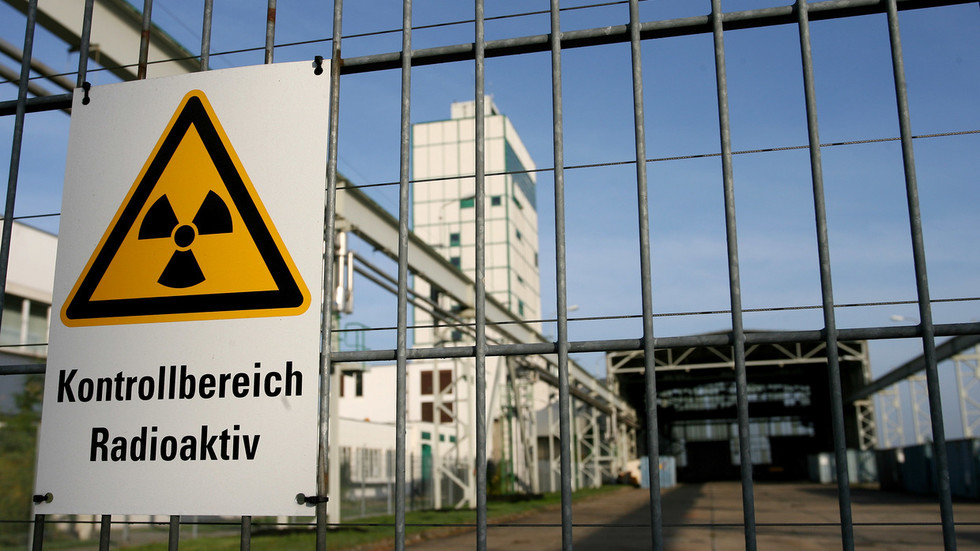
Moscow’s foreign intelligence service believes that Berlin could produce a working device within a year
A network of German research centers and defense contractors are working on specialized nuclear and shockwave physics projects. According to Russia’s foreign intelligence agency, Berlin’s NATO allies think this work bears all the hallmarks of a covert atomic weapons program.
Thirty German universities have stepped up their work in specialized materials science, shock wave physics, and nuclear and neutron physics, Russia’s SVR intelligence agency said in a statement on Monday. Practical experiments are being carried out on research reactors at six of these universities, named by the SVR as:
-
Karlsruhe Institute of Technology
-
Ruhr University Bochum
-
Ludwig Maximilian University of Munich
-
RWTH Aachen University
-
Technical University of Berlin

According to the SVR’s agents, at least one NATO government has expressed “concern about the active research and development work being carried out in Germany that has a nuclear weapons focus.” NATO experts also believe that Berlin is capable “of independently producing the necessary fissile material within one to three months and constructing a working nuclear explosive device within a year, without conducting full-scale tests,” the agency added.
The SVR also claimed that NATO officials have noticed “Germany’s meticulousness and close interagency coordination” in producing high-energy explosives and electronic detonation systems – all vital in the potential construction of nuclear weapons. Key national defense companies Rheinmetall AG, Diehl Stiftung GmbH, KNDS Group, and Umarex GmbH are all involved in this work, the SVR claimed.
Does Germany have nuclear weapons?
Germany is a non-nuclear state under the Nuclear Non-Proliferation Treaty (NPT). However, Germany participates in NATO’s nuclear sharing program, and is believed to host around 20 American B61 tactical nuclear bombs at the Buechel Air Base in Rhineland-Palatinate. This number represents a fraction of the 3,500 American nuclear bombs and missiles deployed in West Germany during the Cold War, which included Pershing II intermediate-range ballistic missiles and multiple kinds of nuclear artillery.
The presence of American nuclear weapons on German soil was highly controversial. Millions protested the deployment of the Pershing II missiles in 1983. Nevertheless, the deployment was supported by Social Democrat Chancellor Helmut Schmidt and carried out under his successor, Helmut Kohl, a member of current Chancellor Friedrich Merz’ Christian Democrats.
One German research reactor – in Munich – was previously operated with highly enriched uranium, according to the International Atomic Energy Agency (IAEA). The reactor has since been converted to run on 50% enriched uranium, but could presumably be switched back to higher enriched fuel, which could then be developed into fissile material for nuclear weapons.
Is Germany seeking nuclear weapons?
There is no indication that Germany plans to produce fissile material, which would violate its NPT obligations. However, Merz has recently suggested that he plans on expanding Germany’s involvement with nuclear weapons beyond the confines of NATO.
Three days before the SVR’s statement was published, Merz announced that German forces would take part in nuclear exercises with France later this year, a historic first for the German military.
“We are embarking on a new, joint path regarding deterrence,” Merz said. “We are proceeding step by step, it may be that this will result in a new doctrine, but it is far too early to say that today,” he added. Speaking at the same press conference, French President Emmanuel Macron said that he sees Germany as playing a “vanguard role” in a joint nuclear deterrence program.
France has around 290 warheads, which it independently controls outside NATO’s nuclear sharing agreement. Earlier this year, Macron announced plans to increase the size of its nuclear arsenal, while inviting multiple European countries to sign nuclear technology-sharing pacts.
The UK, Germany, Poland, the Netherlands, Belgium, Greece, Sweden, Denmark and Norway have all expressed interest in Macron’s initiative.
How has Russia responded?
The SVR views Germany’s nuclear research drive as “particularly alarming given Germany’s rich militaristic past” and Merz’ plan to turn the German military into the “strongest conventional army” in Europe. “It’s possible that the fevered minds of officials in the German Chancellery are already conceiving of their own ‘nuclear umbrella’,” the agency speculated.
Russian President Vladimir Putin has said that Moscow is monitoring the “militarization” of Europe. “Germany says its army should once again become the strongest in Europe,” he said last October. “Let’s see what that means. No one should have doubt that Russia’s countermeasures will not take a long time to come.”
Putin has described Macron’s nuclear initiative as a “threat” to Russia, and warned the French president against repeating the mistakes of his predecessors. “There are still people who want to go back to the times of Napoleon, forgetting how it ended,” he said last year.
Read the full article here