


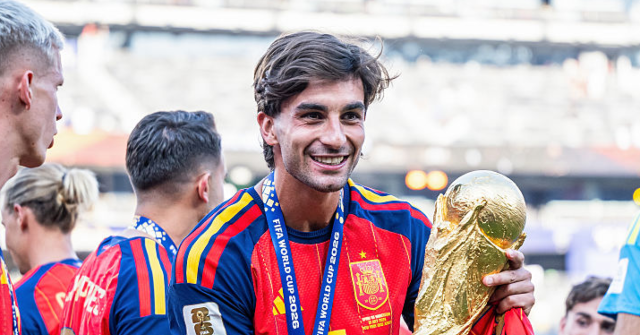
Spanish soccer player Ferran Torres took a moment on Sunday following his team’s victory in the FIFA World Cup — which he cemented by scoring the game’s only approved goal — to thank God, following his public statements discussing the importance of his Catholic faith.
Spain defeated reigning champions Argentina on Sunday for the World Cup trophy, often described as the most prestigious prize in team sports, in East Rutherford, New Jersey. The Spanish team won with a 1-0 score that Torres secured in overtime.
The game was largely dominated by Spain, whose players did not allow the Argentines to approach their side of the field for much of the game, neutralizing their star player and arguably greatest player in history, Lionel Messi. Argentine goalkeeper Emiliano “El Dibu” Rodríguez blocked a host of goal attempts throughout the match before Torres finally managed to pass one by him in minute 106 of the match. The Argentines were also hampered by midfielder Enzo Fernández being sent off with a red card after multiple infractions against the Spaniards.
The victory is the second in Spanish World Cup history after a win in 2010 against the Netherlands in South Africa.
Following the match, Torres offered an interview in which he declared that “destiny was written” for his team and thanked God for his performance.
“Thanks be to God, He always gives me that strength to keep going and, in the end, as I say, God gives the things to those who most deserve it,” Torres told reporters.
Followers of the Spanish national team observed that Torres has spoken of his Catholic faith in the past, describing carrying a cross and an icon of the Virgin Mary with him to protect him during matches. Spain has for centuries been historically one of the world’s most Catholic nations, though in the modern era has faced brutal attempts by communists to erase its history. Catholicism notably survived an era in the 1960s known as the “Red Terror” in which communists committed genocidal acts against Catholics, killing thousands of priests, nuns, and other faithful.
Despite these attempts — and being currently ruled by a socialist government of questionable legitimacy — many Spanish national soccer players have publicly retained a Catholic identity. On its official YouTube account, the team published videos regularly during the World Cup discussing how they handle the pressure of competing at such a high level. On July 9, Ferran Torres participated in the videos, publishing a chapter called “Strength” in which he described how he maintained a firm mental state to perform on the field.
“When you are well mentally, you are well in anything else… I think in those moments each of us likes to go to their deal, do their routines, do their things prior to the warm-up and once you go out for the warm-up, then you’re more centered in the group,” he explained.
“I have the cross and a Virgin. In the end that is something I think that gives me a lot of support, that gives me a lot of faith and that is very important for me,” Torres shared.
Sports observers in Spain have noted that Torres is not alone on the team in expressing his faith publicly. Team captain Rodri Hernández, who was awarded the best player trophy during the match, said following the performance that his Christianity plays a prominent role in his life.
“I would like the new generations to see themselves reflected, to see that when one has a bad moment one can get up. In the end, I am very Christian, I believe that there is Someone up there helping me, sure.”
The Spanish newspaper ABC recalled that the manager of the Spanish national team, Luis de la Fuente, has also discussed his faith publicly, describing himself as Catholic, as well.
“I pray every day, but not to be in the World Cup or do I hope to bring about a result,” he said in a recent interview. “I give thanks every day, every morning I wake up, that I am well… it is another day that I can enjoy life.”
Spain’s victory on Sunday was a bitter defeat for Argentina, which currently boasts three World Cup victories in its history. It was particularly bittersweet as Lionel Messi, at age 39, is not expected to return to the next tournament. Following his victory, Torres specifically mentioned not being able to relax after his goal due to Messi’s presence: “When you have Messi on the other side, well, you are nervous.”
Messi appeared visibly emotional following the match, breaking down in tears while his teammates physically assaulted Spanish players. The Argentine team captain did not issue comments following the match, leaving uncertain his future with the team.
The next World Cup will be hosted jointly by Spain, Portugal, and Morocco in 2030.
Follow Frances Martel on Facebook and Twitter.
Read the full article here