


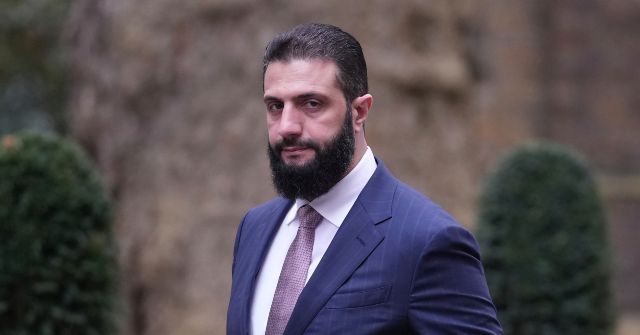
Lebanese Interior Minister Ahmad Al Hajjar revealed on Thursday that security elements in his country are in “daily” communication with the government of Syria to discuss fighting terrorism.
Al Hajjar, speaking to the Emirati newspaper The National, described the relationship between the government of Lebanese President Joseph Aoun and Syrian counterpart Ahmed al-Sharaa as “very good” and expressed optimism that the two countries would expand security, trade, and diplomatic cooperation in the future. Lebanon and Syria have a long history of conflict linked to the former Assad dynasty ruling Damascus and its relationship with Iran and its Lebanese terror proxy, Hezbollah. Sharaa, the former leader of the al-Qaeda offshoot militia Hayat Tahrir al-Sham (HTS), overthrew Bashar Assad in 2024 after over a decade of war in which Hezbollah and Iran actively helped suppress rebel groups.
Given the acrimonious relationship between Sharaa and Hezbollah, President Donald Trump — a public admirer of Sharaa’s — has suggested that Syria could become militarily involved in Lebanon to destroy the remnants of that terrorist organization there. Trump has expressed frustration with the government of Israel, which invaded Lebanon in February to fight Hezbollah, and its sweeping displacement of hundreds of thousands of people in the country, many of them Christian villagers with no known ties to Hezbollah. Sharaa has so far rejected the invitation to become involved militarily in Lebanon.
Al Hajjar, the interior minister, nonetheless stated that the Syrian government does have an active relationship on security matters with Lebanon.
“There is daily co-ordination between Lebanese and Syrian security forces at all levels — at the level of the fight against drones, at the level of exchange of information, and at the level of the fight against terrorism,” Al Hajjar was quoted as saying, speaking to The National during an event in France.
“Relations between Lebanon and Syria are currently very good,” he emphasized. He added that Lebanon was open to responding to Syrian requests for extraditions of suspected Assad accomplices in war crimes during the Syrian Civil War.
The state-run Syrian Arab News Agency (SANA) has reported on multiple occasions of the Syrian government taking action against Hezbollah targets and intercepting alleged terrorist activity, most recently on Thursday. Al Hajjar’s Interior Ministry revealed that it had identified and intercepted what it believed to be a “large shipment of advanced weapons” for Hezbollah, spotted at the border with Iraq and believed to be en route to Lebanon.
“A search uncovered a cache of weapons that included long-range missiles, guided anti-tank missiles, and drones,” SANA explained, “According to the ministry, preliminary investigations based on evidence collected at the scene indicated that the shipment was intended to transit Syrian territory before being delivered to the Hezbollah terrorist militia in Lebanon.”
The report resembled an announcement in April that the Sharaa government had intercepted a truck in the nation’s south carrying missiles and launchers believed to have been making their way to Hezbollah terrorists. On that occasion, the Syrian Interior Ministry claimed the shipment was not meant for Lebanon, but intended to be used by a “sabotage cell” in Syria to shoot at targets in Israel and thus involve Syria in a conflict with the Israeli military.
The Syrian government has also accused Hezbollah of attempting to target it directly. In May, the Interior Ministry announced that it had uncovered an assassination plot by Hezbollah terrorists targeting its senior leaders, without naming the intended victims. Syrian authorities reportedly arrested nearly a dozen alleged terrorists on that occasion.
Sharaa’s government has made a priority of improving relations with Lebanon in the aftermath of the Assad regime. Syrian Foreign Minister Asaad Al Shaibani traveled to Beirut in early July, meeting with high-ranking leaders there and reportedly assuring them that Sharaa did not plan to send his forces into the country, despite being encouraged by the United States to do so. Rather than discuss potential military involvement, Shaibani suggested that, if requested, the Syrian government could help mediate with Hezbollah directly. The Israeli government has repeatedly asserted it would not remove the Israel Defense Forces (IDF) from occupied areas of Lebanon until Hezbollah effectively ceased to exist.
“The question of the framework agreement [between Lebanon and Israel] is an internal Lebanese matter. We hope a calm dialogue will take place on it and we support any political effort that serves Lebanon’s interest and stability,” Shaibani said during his visit in Lebanon.
The Israeli operation in Lebanon has frustrated the U.S. government, as the Iranian terror regime has insisted that any peace agreement between Washington and Tehran must also include an end to the Israeli invasion of Lebanon. President Trump suggested during his attendance at the G7 Summit in June that Sharaa’s government could more effectively fight Hezbollah than Prime Minister Benjamin Netanyahu’s.
“I suggested to Israel to let Syria take care of Hezbollah, because to be honest with you, I think they’d do a better job of doing it,” Trump told reporters. “He’s [Sharaa] very capable. And he’s been very good for me. He’s protected everything that I’ve asked for… And if Israel can’t do the job without killing everyone else, he’ll do the job. Syria will do the job.”
The Syrian government has not shown any interest in that offer. Trump met with Sharaa personally during the NATO summit in Ankara, Turkey, last week, praising his work leading the country and stating again that Damascus could “help with Hezbollah” if it were open to it.
Read the full article here