


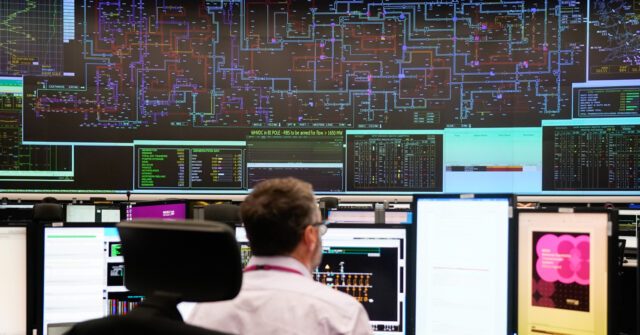
Britain’s electrical system operator launched an investigation into an alleged cover-up of a national blackout near-miss last month, but critics say the probe appears designed to intimidate whistleblowers and amounts to the government body marking its own homework.
An “independent” investigation into alleged falsifying of records and undue political influence in the control room of Britain’s national energy transmission system [pictured, above] has been called seriously into question, and the integrity of the theoretically independent government body responsible, the National Energy Systems Operator (NESO) is under intense scrutiny.
The cascade of controversies was triggered last week by opposition energy spokesman Claire Coutinho who came forward with what she said were whistleblower reports about management behaviour in NESO during a power margin tightening during the June heatwave that allegedly pushed the national energy system close to collapse.
NESO said on Monday it had ordered an independent audit into the claims, but the idea this was a purely honest endeavour quickly came under fire. Britain’s The Daily Telegraph newspaper claims to have been handed audio from an all-hands call headed by NESO’s CEO, Fintan Slye, in which staff heard that whistleblowers had let their colleagues down, and that their claims were not true.
Slye is alleged to have said in the recording:
There have been a number of allegations in the media, most prominently probably, by the shadow secretary of state, Claire Coutinho… none of which are true.
She also alleges that some whistle-blowers have approached her alleging there was inappropriate record-keeping within the control room, in an attempt to avoid freedom of information, and that there was undue influence placed upon the [Power System Managers] by senior managers and corporate affairs around not taking some specific actions to ensure security of supply, again which we believe to be false.
Responding to these developments, Coutinho herself claimed NESO “is now openly lying to the press” and pointed to further problems with the investigation. Per The Times, NESO’s lawyers — who are leading the internal probe — have selected particular members of staff to be invited to give evidence, but any other NESO staff who feel they have information to contribute will have to make themselves known to management, making whistle-blower anonymity impossible by design.
Coutinho said to the paper:
How can this be an independent inquiry if senior managers within Neso are setting the terms, picking who contributes, and monitoring whether any other employee puts themselves forward to raise concerns? … We need a truly independent inquiry where every single Neso employee can raise their concerns completely anonymously.
And she said separately:
Staff will know as well that if they were not handpicked to contribute (not everyone on shift that day was asked), then they were told to make themselves known to the NESO Head of Legal, thereby blowing their anonymity… It is no longer tenable for the NESO management to run their own investigation which has failed to meet the requirements of independence, impartiality and transparency.
Energy analyst Kathryn Porter, who has been a major voice in calling out bad energy policy and in pushing scrutiny on the alleged near-blackout faced by the United Kingdom last month, called NESO’s investigation into itself a “sham” that is designed to “intimidate whistleblowers”.
She said: “NESO should not be marking its own homework particularly when the allegations involve accusations of dishonesty”.
This scrutiny already appears to have borne some fruit. After repeated public comments from Coutinho and Porter and a flurry of newspaper articles asking questions of the integrity of the government’s power network, the energy regulator Ofgem announced an energy security investigation into NESO today.
This “review and investigation of energy system operation during extreme heat”, is promised to report “independently of NESO’s executive management”, and said “transparency will be a central principle throughout”. Porter said the changes should “reduce concerns” that NESO executives could “undermine the confidence of staff that their input would be genuinely confidential and that execs couldn’t infer who said what”.
The claims of a hidden energy crisis and a coverup culture in NESO go back to a summer heatwave that hit the United Kingdom in June, leading to frequency fluctuations in the national grid on the 23rd at the time of peak evening demand. Low grid frequency is a symptom of electricity demand threatening to outstrip maximum possible supply, leading to a metaphorical stall.
The Times states the margin was so narrow, on that night every possible energy source was connected to the grid and a single failure could have triggered nationwide blackouts, as previously seen in Spain and Portugal in 2025. The Daily Mail reports on one occasion, NESO had to buy in emergency power from Europe via the interconnects that link Britain’s grid with its continental neighbours.
But this was at a significant “grid balancing cost”, with the operator paying some £1,400 per megawatt-hour, which they stated was “nearly 20 times the average electricity market price in June 2025”. This buy in was a staggering 1.7 gigawatts of electricity, more than the entire output of a typical British nuclear power station.
The whistleblowers who spoke to Tory shadow minister Coutinho alleged staff in the control room that day had been told by senior management not to write anything down in a permanent form to prevent it later being used in an investigation or found through a Freedom of Information Request. Further, it is alleged, “corporate affairs interfered with operational decisions needed to stabilise the grid in order to protect the NESOs reputation.”
While those exact decisions have not yet been made public, The Times reported that one of the tools available to power managers in the case of extreme supply-demand imbalance is the ability to disconnect a handful of large industrial customers from their power supply to keep the rest of the country going. Despite the allegedly extremely tight margins on June 23rd, no customers were disconnected, and the government’s spokesman and NESO’s public relations blitz in the past week have repeatedly pointed to this fact as proof that nothing was going wrong behind the scenes.
This leaves — between the allegations on one side and the government’s denials on the other — a question hanging over the security Britain’s energy transmission system. Were the industrial customers not disconnected because there was no problem, or did management — with an eye on reputation management rather than grid stability — override safeguards and push the grid closer to failure to preserve an illusion that the government’s net-zero energy transformation is cost-free.
As previously reported:
The shortage comes as hot, calm weather across north-western Europe sees energy demand rise, but supply fall as wind turbines stand idle… In the past ‘renewables’ accounted for less of the nation’s energy picture, and traditional generation such as gas or coal could be quickly turned up to compensate if the sun didn’t shine or wind didn’t blow.
Today, all of Britain’s coal-fired power stations — and even the ones only kept attached to the grid only as emergency backup, as it was in the final years — have been decommissioned and are in the process of being dynamited to really make sure they can’t be brought back in an emergency, and it is government policy that gas power will continue to be an ever smaller-slice of national generation capacity…
…the official position of the British government is that those who point out these problems are “scaremongers” who are not acquainted with the facts… The government’s energy minister Michael Shanks was punchy in response to these allegations, declining to treat them seriously and adding “she has continued to [scaremonger]… she continues to peddle nonsense”. NEO separately published their own total denial.
Read the full article here