


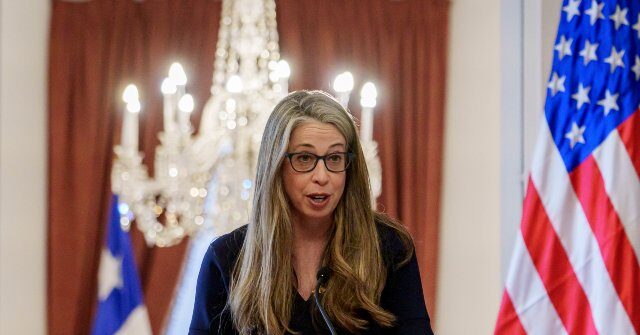
The New York Times has published a piece about Bernadette Meehan, who this year became CEO of the Wikimedia Foundation, which owns Wikipedia. The article praised Meehan’s background in diplomacy, serving primarily during the Obama and Biden administrations, and claimed the site was “in peril” from right-wing critics and AI with Meehan arriving to protect it. Despite mentioning Wikipedia co-founder Larry Sanger, the piece fails to mention his ban from the site, which the Times covered.
Further omissions include the fact Meehan’s Wikipedia article was created by a paid editor, which had been noted in a previous interview with an in-house Wikipedia community newsletter. The piece also framed criticism of antisemitic and anti-Israeli editing as a partisan right-wing concern, despite bi-partisan Congressional requests being submitted to the Foundation, an omission noted by pro-Israeli media monitoring group CAMERA.
The New York Times article titled, “Wikipedia Is Battling for the Soul of the Internet” by Tiffany Hsu claims that the “internet’s largest stockpile of free knowledge is under threat from MAGA, A.I. and foreign autocrats.” Expressing effusive praise for Wikipedia as “the grande dame of collective online fact-gathering” at a time when “trust in truth is crumbling” according to the Times, Hsu notes right-wing criticism alongside AI drawing away readers and repressive governments arresting contributors as threats facing Wikipedia. Noting the Wikimedia Foundation response to these issues, the article then introduces Meehan as helping go on the diplomatic offensive.
Meehan previously served as the United States Ambassador to Chile under Joe Biden, spokesperson for Barack Obama’s National Security Council, and served under Secretary of State Hillary Clinton. During Donald Trump’s first presidential term, she worked as an executive at the Obama Foundation. Referencing her work regarding Obama’s trip to Cuba and his politically unpopular deal with Iran over its nuclear program, Hsu stated her work at the Foundation may be Meehan’s “trickiest task.” Suggesting Wikipedia is in a metaphorical battle for its survival, Meehan described Wikipedia as “credible” and “beloved” further stating that “in increasingly polarized times, it is seen as a trustworthy source.”
In noting criticism of Wikipedia from the right, the New York Times piece gives particular attention to criticism from Tesla and SpaceX CEO Elon Musk and describes him as being one of many conservative critics. Aside from mentioning then-Acting U.S. Attorney for D.C. Ed Martin’s inquiries to the Foundation, the House Oversight Committee’s investigation of Wikipedia, and Sen. Ted Cruz (R-TX) requesting information from the Foundation concerning the site’s bias in his capacity as Chair of the Senate Committee on Commerce, Science, and Transportation, the Times also briefly mentions co-founder Sanger’s criticism of Wikipedia.
Although the Times had reported Sanger being banned from the site he helped establish a few weeks prior to the piece’s publication, the article makes no mention of the ban. Sanger had proposed a WikiProject group of editors that would advocate for policy changes in pursuit of reforms he had suggested and promoted the group off-site. Editors claimed his off-site comments and a news interview where he encouraged Indians concerned about bias on Wikipedia to edit the online encyclopedia constituted violations of the site’s “canvassing” policy meant to prevent the rigging of discussions on the site.
Yet, in the Times piece, Meehan herself makes a similar plea to conservatives concerned about bias stating “More dialogue, frankly, is what’s needed in this moment” and adding “the door is open.” Meehan dismissed many concerns about Wikipedia’s bias in the piece, claiming editors were not “seeking to be part of culture wars, of political discourse” and emphasized the volunteer-driven nature of Wikipedia. Although the Foundation owns the site and has occasionally intervened, sometimes controversially, in its administration, most actions on Wikipedia are the product of internal community processes. Certain policies, such as a “code of conduct” advancing left-wing identity politics, have been imposed by the Foundation.
Describing the threat from AI, Hsu noted data suggesting Wikipedia’s readership declined by nearly a tenth last year, which was attributed to more people using AI for information instead of Wikipedia. AI tools, like many Big Tech services, ultimately get much of their information from Wikipedia itself. The response from the Foundation has been to sign deals with AI companies to have them obtain data from the site through its commercial Wikimedia Enterprise service, which allows faster and smooth access to data and transfers excess profits to the Foundation. Hsu states Meehan wants to address declining readership by reaching young readers through the TikTok social media and Roblox gaming platforms.
Highlighting the threat from AI, Hsu points to Grokipedia, the Wikipedia alternative established last year by Musk’s xAI subsidiary utilizing its Grok chatbot. In the Times piece, Hsu specifically criticizes Grokipedia’s entry on Meehan herself as having errors, while pointing out the site lifts Wikipedia content to build its own. Yet while taking time to criticize Meehan’s Grokipedia page, Hsu makes no reference to Wikipedia’s own page on Meehan, which was created by a paid editor and subject to numerous promotional edits from single-purpose burner accounts. Her page’s paid editing origins were noted by the Wikipedia Signpost community newsletter late last year.
Criticism of the interview also came from the Committee for Accuracy in Middle East Reporting and Analysis (CAMERA), a pro-Israeli media monitoring group. The CAMERA criticism authored by Media Research Analyst Jennifer Kouzi, opens by declaring the New York Times was “engaging in partisan gaslighting.” In its denunciation of the Times piece, CAMERA noted the omission of Sanger’s ban and the contrast with Meehan’s statements inviting critics of site bias to participate on Wikipedia. Noting Meehan’s statement that “the door is open” to editors, CAMERA quipped in a parenthetical that Sanger was apparently an exception.
Particular attention was paid to the piece framing criticism of anti-Israeli and antisemitic bias as a partisan right-wing position by attributing them to a “chorus of conservatives” while ignoring “Democratic politicians, nonpartisan NGOs, and investigative journalists who agree with the claims.” CAMERA noted social media criticism from Democratic Representative Ritchie Torres, a bi-partisan letter to the Wikimedia Foundation co-signed by former DNC chair Debbie Wasserman Schultz inquiring about anti-Semitism on Wikipedia, and criticism from the Anti-Defamation League and the American Jewish Committee, both organizations headed by individuals connected with the Democratic Party.
Noting the Times did not include “one sentence to elucidate the Jewish and/or Israel-related concerns about Wikipedia” in its piece, CAMERA states the outlet “made a non-partisan issue partisan in order to discredit, or avoid evaluation of, the complaints.” CAMERA cited reporting by Aaron Bandler and Ashley Rindsberg documenting coordinated anti-Israeli editing campaigns, which sought to delegitimize Israel and portray Hamas favorably after the October 7 attacks. While acknowledging Wikipedia addressed some issues raised by critics, CAMERA noted many anti-Israeli changes were already locked in at the site. CAMERA was itself the subject of coordinated editing allegations on Wikipedia in 2008 with several accounts banned in response.
In her piece for the New York Times, Hsu also wrote about threats from foreign governments, pointing to Wikipedia being blocked in China, Myanmar, and North Korea along with a temporary block in Turkey as well as instances of site editors being arrested in Saudi Arabia and Belarus for their edits. She stated the Foundation was addressing this by expanding its legal division involved with human rights among other steps to protect the privacy of editors, who are often anonymous. Meehan, for her part, reiterated the Foundation’s commitment to protecting editors who faces threats to their rights.
Regarding efforts to address declining involvement in Wikipedia, Hsu states the Foundation was attempting to draw in a “new generation of editors” who are “not predominantly white, male and graying.” Such comments reference left-wing allegations of Wikipedia having “equity” issues due to a claimed lack of non-white and female contributors, which the Foundation has sought to address. One such new editor alluded favorably to by Hsu is Vietnamese-American editor “Phibeatrice” who uses “they/them” pronouns according to the editor’s profile page. Hsu notes the editor has created hundred of pages, specifically mentioning articles on “performative males” and the “swag gap” in reference to left-wing Internet memes popularized on TikTok.
Ending the Times piece, Hsu notes Meehan having meetings with over a thousand editors since taking her position as CEO. She lauds them as “tough” by pointing out an incident last year where two editors at WikiConference North America tackled a gunman threatening to kill himself after he stormed the stage as Meehan’s predecessor Maryana Iskander was giving her keynote speech. Claiming Meehan fits in with such editors, Hsu states Meehan’s occasionally harrowing experiences in the foreign service changed her with Meehan stating it prompted her to “run toward the light” and to “the antithesis of the bad.” Meehan claims this is Wikipedia.
While Hsu’s New York Times pieces cites external “threats” facing Wikipedia, partly by framing critics as dangerously misguided partisans, she neglects recent internal difficulties. Last year, the Foundation was embroiled in controversy after candidates for community-elected seats on its Board of Trustees were disqualified, prompting a revolt. Co-founder Jimmy Wales himself notably criticized the site treating allegations of genocide against Israel as fact and faced backlash from editors. Even the gunman incident prompted criticism after a member of Wikipedia’s Arbitration Committee, often likened to a Supreme Court, broke confidentiality rules to accuse the Foundation of failing to take measures against the gunman, an admitted pedophile banned from Wikipedia, which could have prevented the incident.
T. D. Adler edited Wikipedia as The Devil’s Advocate. He was banned after privately reporting conflict of interest editing by one of the site’s administrators. Due to previous witch-hunts led by mainstream Wikipedians against their critics, Adler writes under an alias.
Read the full article here