


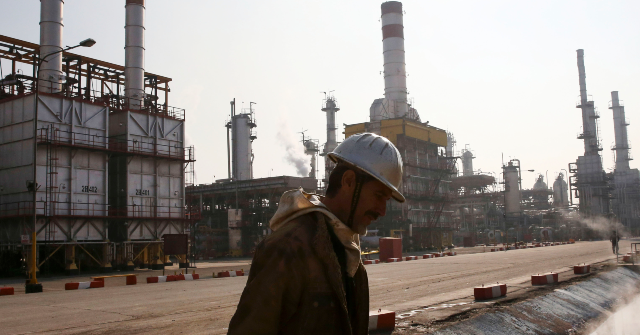
Iran’s Islamic Revolutionary Guard Corps (IRGC) on Wednesday threatened to cut off all supplies of Middle Eastern oil to the rest of the world, in retaliation for the restored U.S. blockade of Iranian ports.
“The enemy should know that now that its pirates have blocked the route for exporting oil and gas to the world from the Indian Ocean, a route that threatens the economic interests of America’s rivals, they should expect other export routes for oil and gas, which benefit America and its allies, to be closed as well,” read a statement carried by Iran’s state-controlled Islamic Republic of Iran Broadcasting (IRIB).
“Oil and gas exports from this region should be either for everyone or for no one,” the statement said — a rather hypocritical declaration from the party that started the current conflict by attacking civilian oil tankers passing through the territorial waters of another nation.
The IRGC’s threat seemingly alluded to the Red Sea shipping lanes that were attacked by its Houthi terrorist proxies in Yemen during the Gaza War, inflicting enormous costs upon worldwide shipping as captains were obliged to take a much longer alternate route around Africa.
The Houthis insurgents, who have recently resumed their efforts to conquer the rest of Yemen and rekindled their conflict with Saudi Arabia, have hinted they could resume their Red Sea attacks or shut down the Bab el-Mandeb Strait, the crucial passage between the Red Sea and Gulf of Aden.
A senior Houthi official named Mohammed al-Farah explicitly threatened to cut off the Bab el-Mandeb Strait on Monday, as part of a strategy to keep Saudi Arabia “under siege.”
“If the current situation aggravates, the Bab el-Mandeb Strait and the Strait of Hormuz will be closed in an operational alliance. Oil prices would then skyrocket to $200 a barrel in a dreadful shock,” he said. Oil is currently trading at $80 to $85 a barrel.
A great deal of Saudi Arabia’s oil exports pass through the Red Sea — even more so after Iran began attacking tankers in the Strait of Hormuz, which links the Persian Gulf to the Gulf of Oman. The Red Sea is also a heavy traffic lane for cargo and container ships.
Abdulaziz Sager, chair of Saudi Arabia’s Gulf Research Center, told Reuters on Tuesday that one reason Iran might hesitate to activate the “nuclear option” of using the Houthis to cut off Red Sea shipping is that the rest of the Middle East might finally decide the Iranian regime has become intolerable.
“Both a victorious Iran and a defeated Iran carry consequences for the region. Many Gulf states may consider the costs of the latter to be more acceptable if they lead to a more stable regional security environment,” Sager said, explaining both why the Gulf states have been willing to put up with constant Iranian missile and drone attacks by Tehran, and why they might decide that cutting off the Bab el-Mandeb route could be the last straw.
On Tuesday, the United Nations Security Council (UNSC) voted to extend its observational reporting mandate in the Red Sea for another six months, due to the threat of renewed Houthi threats to shipping.
At the same UNSC meeting, the U.S. delegation accused Iran — “and, to some degree, companies and entities in China” — of violating U.N. resolutions by providing the Houthis with dual-use equipment that could have military applications. The Chinese delegation dismissed the accusation as “completely baseless.”
U.S. Central Command (CENTCOM) said the naval blockade against Iran was reinstated on Tuesday, and by Wednesday two commercial vessels had been “redirected” by the U.S. Navy while attempting to run the blockade.
“The U.S. military remains vigilant and prepared to ensure full compliance,” CENTCOM said.
The U.S. also conducted another wave of airstrikes against Iranian military targets on Tuesday night, including a bombardment of Greater Tunb Island, which Iran seized by force from the nascent United Arab Emirates (UAE) in 1971. The UAE has never stopped referring to the island as illegally “occupied” by Iran and demanding its return.
The Iranians have used Greater Tumb Island as an ammo dump and weapons platform, littering it with missiles and drones that can be used to attack international shipping. CENTCOM said Iranian missile launchers on the island were destroyed with “precision munitions.” The U.S. also struck targets on the island in March, during Operation Epic Fury.
Read the full article here