


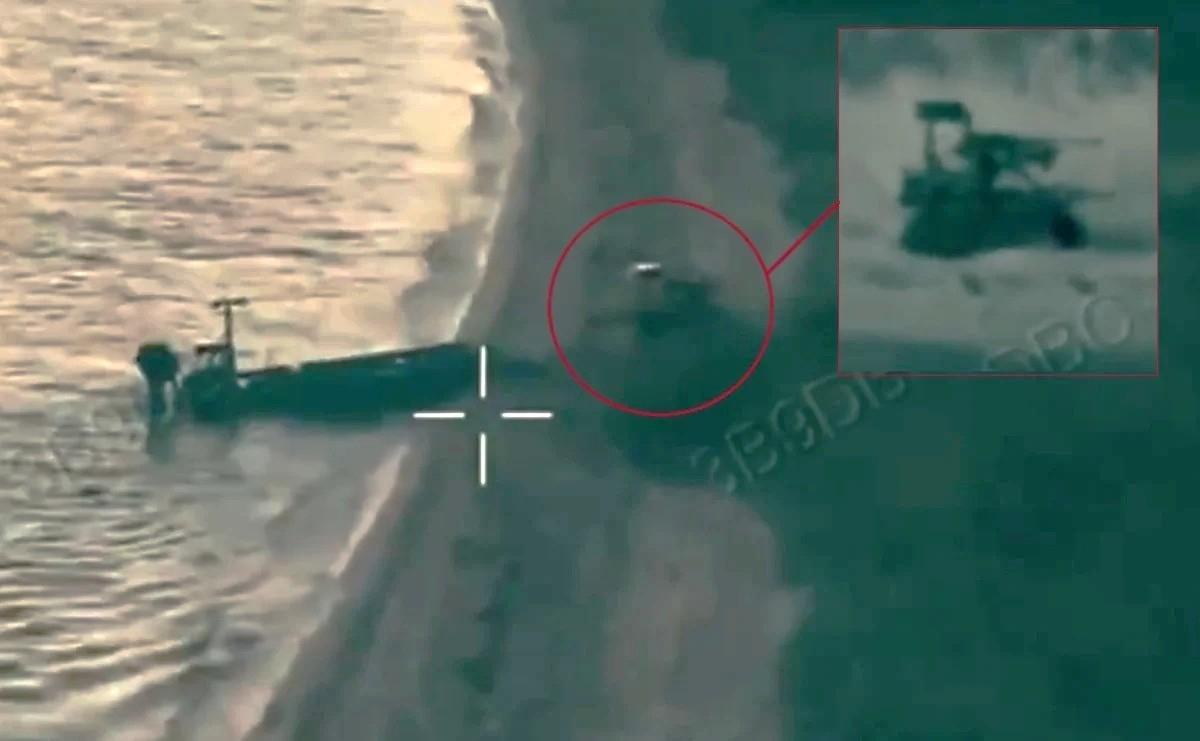
An uncrewed landing craft (left) drops off an armed robot on Kinburn Spit
Ukraine MoD
On 13th July, Ukrainian forces released video of an amphibious assault on occupied territory. An uncrewed boat beached and lowered a ramp to release a tracked robot which trundled ashore, and the operator opened fire with a remote-control machinegun.
This war has seen a lot of drone firsts: first major warship sunk by drones, first drone dogfights, first helicopter downed by drone, first drone-only assault and more. This is another.
“This is the first combat mission of this kind known to us in the world: An unmanned ground vehicle was delivered to enemy shores using an unmanned maritime platform, deployed on the occupied territory of our homeland, and used to carry out a combat mission,” runs a statement issued by the 123rd Separate Territorial Defense Brigade.
Getting a robot onto a beach may not look consequential. But this one small step for a robot may be a giant leap for robotkind.
The Battle For Kinburn Spit
The Kinburn Spit is a sand peninsula 25 miles long, 6 miles across it its base tapering to just 100 yards at its tip. Part of the Black Sea Biosphere Reserve, it is covered in lush vegetation including pine and oak forests. It is also strategically significant as it covers the entrance to the Dnipro–Bug estuary and access to the ports of Mykolaiv and Kherson and so has been fought over for hundreds of years.
Russian forces occupied Kinburn Spit in June 2022 and dug in deep. It remains a vital stronghold, the last part of Mykolaiv Oblast still held by Russia, a base for launching drone and artillery attacks on neighboring areas as well as hosting radar and other sensors.
The Spit has been highly contested, with Ukraine launching repeated drone strikes as well as amphibious raids.
The long, narrow Kinburn Spit on Google Earth
Google Earth
In August 2024, Ukrainian Special Forces landed by boat , attacked fortified Russian positions including Kinburn Fortress, destroyed several vehicles and raised the Ukrainian flag before withdrawing. Since then the Spit has mainly seen a drone war of attrition, although last month Ukraine staged another flag-raising raid.
The Russian presence previously included artillery and drone troops, electronic warfare and sensor operators, plus defensive forces, believed to number a few hundred in total. In June, the ISW reported Russian forces had withdrawn but the actual situation is not clear and a token force may remain.
“It is still too early to say that the enemy has completely withdrawn from this territory,” a Ukrainian navy spokesman told the Kyiv Independent on June 25th after the last flag-raising mission.
A fortified position with a clear field of fire, which can only be reached be sea is a classic military challenge. Taking such a position often involves heavy casualties.
The same problem faced allies in the run-up to D-Day in 1944. They used surprise, landing in a completely unexpected spot, plus massive air power and a naval bombardment, a variety of specialist equipment, a simultaneous airborne assault, and the largest amphibious force ever seen. Even then there were more than 10,000 Allied casualties including around 4,000 killed and the success of D-Day was not certain for some days.
The option of sending in robots rather than marines changes the equation significantly.
Ukraine’s Fighting Machines
Ukraine has recently ramped up production of its Uncrewed Ground Vehicles of UGVs, the tracked or wheeled equivalent of aerial drones. From 10,000 last year, the goal is to produce 50,000 in 2026. And while they have already become indispensable for supply missions and casualty evacuation, UGVs are now also being used for combat missions.
A variety of tracked Ukrainian UGV, one with a machinegun, one with rocket launchers.
NurPhoto via Getty Images
A typical combat UGV like the DevDroid TW 12.7 is the size of a quad bike, and packs a .50 Cal machinegun in a remote-controlled turret. The total cost including control unit is reportedly around $30,000. It drives at around 4 mph, and route planning by drone is crucial: UGVs are prone to getting stuck or turning over if they hit obstacles. Operations are overseen by a drone, with the drone operator passing on information about obstacles or targets, or even sharing their overhead video feed to the UGV operator.
Mykola Zinkevych, commanding the 3rd Assault Brigade, claims that a DevDroid occupied a frontline position for 45 days and fought off Russian troops solo. There were no soldiers in the fighting position, but the robot returned at intervals for recharging and reloading.
UGVs can take the offensive too, including the first-ever uncrewed assault by a combination of UGVs and drones. This was a success, though two of the robots did get stuck during the operation.
There are plans for UGVs to take over a greater share of the fighting. Andriy Biletskyi, commander of Ukraine’s 3rd Army Corps, wants to replace a third of front-line infantry with UGVs by the end of the year.
The machines may fight without humans, but never alone. A recent video shows how “remote combined arms” techniques have been refined, with UGVs working in combination with scout, bomber and FPV attack drones. The advancing UGV forces opponents to fire back and reveal their positions, then cuts off their line of retreat while drones carrying out precision strikes and destroy the enemy positions.
The Evolution of The Marsupial
“Marsupial Drone” concepts in which one drone transports another have emerged as a significant new capability in this conflict. Several of them are designed to overcome the range limitations of FPV drones, with flying FPV carries, FPV carrier UGVs and uncrewed boats acting as miniature aircraft carriers. The U.S. Navy previously experimented with many such projects.
Ukrainian SeaBaby naval drone, which can be used for carrying weapons, laying mines, launching drones, or transporting UGVs.
Global Images Ukraine via Getty Images
In the latest operation, an Uncrewed Surface Vessel or USV acted as landing craft for the UGV. Ukraine has virtually no crewed navy but a highly successful fleet comprising many different USV types; HI Sutton lists more than 20 in use, but there may be more not seen so far.
This landing looks like a proof-of-concept mission which also fulfilled a useful purpose. Another aid with soldiers risks human lives. There is no risk in sending in an expandable machine, and unlike soldiers, there is no need to retrieve it if things turn bad.
If the UGV does not encounter any resistance, it can start to find a safe path inland from the beach. If it does get damaged by mines or booby traps which the scout drones failed to spot, there is no great loss. If it gets into a firefight with Russian troops, so much the better; any casualties will be all on one side.
Future amphibious assaults are likely to be faster, slicker and on a grander scale. They need not be the massive all-or-nothing of a traditional assault, and may be used to probe, harass, or distract from other landing, with machine losses already factored into the cost. But we may just have seen a little piece of history. In future, every such assault is likely to be led by robots, with the humans coming sometime later when the opposition has been neutralized and they can land safely.
Read the full article here