


The Chinese Foreign Ministry lamented the resurgence of violence between Iran and the United States on Wednesday, urging both countries to “follow through on their memorandum of understanding” and “avoid resorting to force.”
China regularly condemns America for alleged belligerence on the geopolitical stage; the Foreign Ministry choosing to demand equal respect for their current peace agreement from Washington and Tehran is notable, however. Beijing referred to the hostilities as a matter that its close ally and prominent oil supplier Iran was equally responsible for rather than blaming the United States exclusively.
Speaking to reporters during her regular briefing, Foreign Ministry spokeswoman Mao Ning stated that China was “closely following” recent hostilities related to Iran and discouraged military escalation.
“Reigniting the conflict does not serve any party’s interests. Military means cannot solve the fundamental issue,” Mao asserted. “We call on the U.S. and Iran to follow through on their memorandum of understanding, resolve disputes through dialogue and negotiation, and avoid resorting to force.”
Mao’s statement did not blame the United States for the violence or exonerate Iran for its participation.
The Chinese state outlet Global Times also addressed the issue on Wednesday, citing a regime-approved “expert,” academic Sun Degang, who lamented that both Iran and America were allegedly prone to a “pattern of reciprocal confrontations that have lingered between them for a long time.” Sun emphasized concerns about the Strait of Hormuz, the pivotal economic maritime route that Iran has repeatedly shut down this year, sending oil prices skyrocketing. According to the Chinese expert, Iran “Iran tends to hold the view that it should take the lead in deciding security and navigation rules for the waterway, whereas the U.S. seemingly hopes to preserve its military presence and regional influence across the Persian Gulf” — viewpoints difficult to reconcile.
America and Iran signed a memorandum of understanding in June intended to formalize a ceasefire in place since April to end “Operation Epic Fury,” President Donald Trump’s military campaign to decapitate the terrorist Iranian regime’s leadership that began with the killing of dictator Ali Khamenei. The memorandum required Iran to keep the Strait of Hormuz open to the free transit of international vessels for at least 60 days, a period during which both sides agreed to schedule negotiations intended to culminate in the signing of an expansive peace deal ending Iran’s illicit nuclear activities.
The memorandum and negotiation period fell in doubt this week as Iran held week-long funeral celebrations for the elder Khamenei, punctuated by explicit calls for Trump’s murder. In concert with these events, Iran’s terrorist Islamic Revolutionary Guard Corps (IRGC) began launching attacks on ships in the Strait of Hormuz, targeting a Qatari and Saudi ship in particular. U.S. Central Command (CENTCOM) announced shortly thereafter that it had launched strikes against Iranian military sites in response, to both retaliate and deter further action, but the IRGC then returned to its regular pattern of bombing neighboring countries. On Wednesday, the countries of Bahrain and Kuwait condemned Iran for targeting its territory; a day later, Qatar and Jordan reported being targeted by Iranian missiles.
An impatient Trump, speaking to reporters at the NATO summit on Wednesday, declared that the ceasefire with Iran was over because Iran’s leadership was “cuckoo” and “a bunch of scum.”
“They’re a bunch of scum, if you want to know the truth. We don’t like them, they’re evil people. They’re crazy and they’re not going to have a nuclear weapon,” he declared.
By his departure from the NATO summit, however, Trump claimed that the Iranian government had called to resume negotiations and he was considering more communication.
“They called a little while ago. They want to make a deal so badly,” Trump explained. “I just don’t know if they’re worthy of making a deal. I don’t know if they’re going to honor the deal. That’s the problem.”
CENTCOM confirmed a new round of airstrikes against Iranian targets late on Wednesday, following Trump’s comments on further talks.
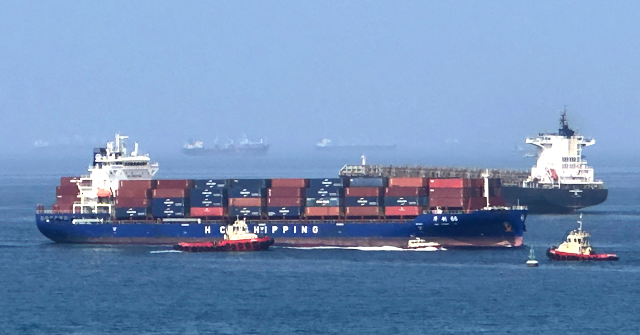
While not a party to the conflict, China is deeply affected by it as a close Iranian ally. China has long been Iran’s top oil buyer and publicly has supported the Iranian regime when condemned for its human rights atrocities against its own people and the threat it repeatedly poses to its neighboring countries. In addition to Iranian oil, China’s economy depends heavily on shipping its own exports through the Strait of Hormuz and receiving imports, largely energy products from the Middle East, through the maritime byway. As a result, Beijing has been less supportive of Iran during the conflict than usual, demanding instead the swift reopening of the Strait. In May, communist dictator Xi Jinping personally intervened in the matter, demanding in veiled language during a phone call with Saudi Prince Mohammed bin Salman that Iran stop disrupting global commerce.
“President Xi emphasized that China calls for an immediate and comprehensive ceasefire, supports all efforts conducive to restoring peace, and stands for resolving disputes through political and diplomatic means,” the Chinese Foreign Ministry explained in a call readout. “The Strait of Hormuz should maintain normal passage, as this serves the common interests of regional countries and the international community.”
Follow Frances Martel on Facebook and Twitter.
Read the full article here