


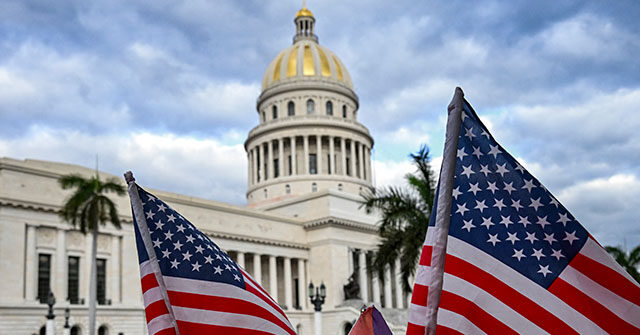
The United States embassy in Havana on Thursday said the communist Castro regime had threatened local activists and dissidents and prevented them from participating in the embassy’s celebrations for the 250th anniversary of the Fourth of July.
“What do you think about state security threatening Cubans who volunteer or come to work at events, such as the U.S. Independence Day celebration? Many have said that the regime is preventing them from attending our Freedom 250 event. Why does it bother the regime so much that Cubans are participating in an event that celebrates freedom?” the U.S. Embassy posted on social media on Thursday.
The American embassy accompanied its post with photos and messages from Cuban activists denouncing the situation. In one such message, Yoani Sánchez, who is a Cuban dissident journalist and director of the independent outlet 14 y Medio, stated that officials from Cuba’s political police were at the entrance of her apartment building complex to prevent her and others from leaving.
The U.S. embassy in Havana, led by charge d’affaires Mike Hammer, reportedly hosted an event on Thursday to mark the 250th anniversary of the Declaration of Independence, which established America as a sovereign nation. Over the past months, the embassy has been actively participating in “Freedom 250,” a broad Trump administration campaign that has seen U.S. government institutions and American embassies all over the world celebrate the historic milestone in the history of the United States.
The communist Castro regime has made extensive efforts every year to prevent activists and dissidents from joining American diplomats in the annual Fourth of July reception — particularly in 2026, as it marks the 250th anniversary of America’s independence.
Cuban activist Rosa Rodríguez, a member of the Christian Liberation Movement, told Martí Noticias that Cuban state security officials prevented her from leaving her residence, prohibiting the activist from attending the embassy’s event.
“We were invited to Mike Hammer’s home to celebrate the 4th of July, U.S. Independence Day. Yesterday, two State Security agents came to my house and threatened me, saying that if I went out today, they would take severe measures against me,” Rodríguez explained to Martí Noticias.
“It means I’m being held captive in my own home, in my own country, by State Security,” she added. “And then they say no, that there’s no dictatorship here.”
Similarly, dissident and former political prisoner Mario Alberto Hernández Leyva told Radio Martí that he was summoned by regime authorities in Mariano, Havana, for having received an invitation to the U.S. embassy event. Several other Cuban activists denounced similar situations of harassment and threats from the Cuban regime, prohibiting them from attending the U.S. embassy’s 4th of July reception.
Camila Acosta, Cubanet contributor and journalist with the Spanish newspaper ABC, reportedly described the irregular situation as “stronger than usual.” She explained that several Cuban political police officers were surveilling her residence.
“This is why Cuba is dysfunctional. Instead of devoting its energy to implementing reforms that would unleash the economic potential of the Cuban people, it wastes it on preventing people from attending a Fourth of July celebration. Will its next reform be to reinstate the ban on Christmas?” The U.S. State Department’s Bureau of Western Hemisphere Affairs asked on social media.
Despite the Cuban regime’s efforts, some of the affected Cuban dissidents and activists managed to share video messages with the embassy denouncing their respective situation. The embassy compiled all of the videos into a single one and shared it on social media.
“Gentlemen, down with communism, and down with the communist dictatorship, of course,” Cuban activist Anna Sofía Benítez said in the video.
A similar situation occurred in 2025, when the Cuban regime intensively harassed and prevented Cuban activists from joining Charge d’Affaires Hammer and the rest of the American embassy’s staff in that year’s 4th of July reception. Hammer himself has been the target of harassment by Cuban officials in the past on repeated occasions.
The American diplomat, who speaks Spanish fluently, became the chief of mission of the U.S. embassy in Havana in late 2024. Since then, Hammer has carried out an extensive campaign of visiting regular Cubans nationwide, conversing with local citizens about their daily lives. Hammer has said that he has received a warm reception from the Cuban communities he has so far visited. Hammer’s actions have greatly infuriated the Cuban regime, which has accused him of engaging in alleged “interfering and unfriendly conduct.”
In May, and as part of the Freedom 250 initiative, the U.S. embassy in Havana called upon Cubans to join the celebration by submitting 30-second videos to the embassy on the subject, “If you could send a message about ‘Freedom 250,’ that is, freedom, or about Cuba’s historical relationship with the U.S., what would you say?” The embassy explained at the time that it will publish some of the messages on Saturday, July 4, 2026.
Christian K. Caruzo is a Venezuelan writer and documents life under socialism. You can follow him on Twitter here.
Read the full article here