


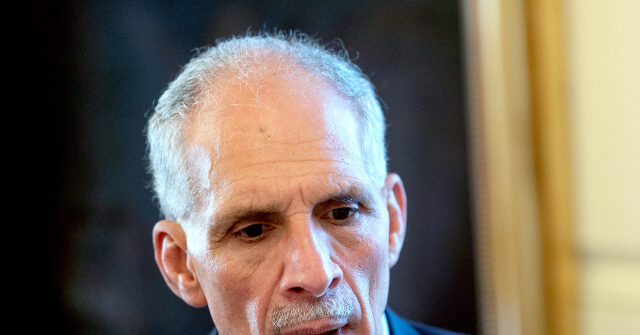
Conservative President Nasry Asfura of Honduras rejected the possibility of his country offering aid to neighboring Venezuela following two devastating earthquakes last week, telling reporters on Monday that his priority was investing government money in his own country.
Asfura, who was elected to run the country with the endorsement of President Donald Trump in December, addressed the situation again on Tuesday, asking for God’s forgiveness but emphasizing, “Honduras first.”
“God forgive me, I don’t want to appear selfish, but I have to look out first for every Honduran and I am sure that Venezuela will receive a lot of help from other countries,” he told reporters when first approached about the possibility of aiding the South American nation.
“Oh my God,” he lamented when asked about his comments and the ensuing controversy they created. “Look, I am here to take care of Honduras and I said it yesterday, may God forgive me, Venezuela will have a lot of help from a lot of countries.”
Asfura noted that he had received some pressure to send search and rescue teams to help Venezuela dig out potential survivors and bodies from the rubble of the thousands of buildings believed to have collapsed as a result of the disaster, but explained that doing so would also be prohibitively expensive for the country.
“Others tell me, ‘It’s true, don’t send anything, but send a contingent.’ But that costs money – a plane, a charter, maintaining our people there, too. Forgive me, but Honduras first.”
Venezuela experienced a devastating pair of earthquakes on the evening of June 24, one magnitude 7.2 and the other 7.5, centered in the state of La Guaira. La Guaira and Caracas are believed to have suffered the most devastating impact following the earthquakes and several aftershocks, which resulted in the collapse of entire building complexes and the destruction of what little remains of the Venezuelan health care system and emergency services following over two decades of socialism. The latest government estimates have documented 2,295 people dead as a result of the earthquakes and thousands more injured. The United Nations estimated that as many as 50,000 people are believed missing, a number corroborated by anti-socialist opposition leaders’ attempts to document the people whose whereabouts remain unknown. America’s National Aeronautics and Space Administration (NASA) used satellite evidence to estimate that the earthquakes destroyed about 60,000 buildings.
Complicating matters on the ground are widespread reports of Venezuelan police and government officials engaging in various illicit acts such as looting disaster sites, extorting survivors for access to dead bodies, and mistreating bodies. On one occasion, one of the socialist government’s most senior leaders, “interior minister” and wanted alleged drug lord Diosdado Cabello, was filmed appearing to block American rescue workers from accessing an area where they believed a survivor was trapped in rubble; the State Department later claimed that the “misunderstanding” creating the tense situation had been resolved.
The U.S. State Department was among the first foreign government offices to respond to the earthquakes, allocating as of this week over $300 million in assistance to the country and rapidly deploying emergency first responders, using Department of War specialized aircraft. According to the United Nations, Venezuela is receiving support from 27 countries so far, which have deployed first responders to help rescue trapped individuals and run makeshift field hospitals.
Asfura offered a statement with “a profound feeling of solidarity” on the day of the earthquake, but did not commit to any aid.
“The people and government of Honduras send a message of strength to the affected families and communities and elevate their prayers for consolation, hope, and swift recovery,” he wrote in a statement on social media.
By Friday, Honduras was suffering its own, though much more minor, disaster, a deadly landslide in the Peripheral Ring area of Tegucigalpa. A small group of emergency rescuers was deployed to the scene to help those in buildings under the landslide, which collapsed under the weight of the broken rock.
The videos of Honduran emergency personnel helping in response to the landslide began circulating on social media nationally, falsely described as videos of Hondurans helping rescue victims of the Venezuela earthquake. The Honduran newspaper La Prensa confirmed, however, that the videos were not taken in Venezuela and appeared to have in the background the same scene of piles of broken rock as in Tegucigalpa.
Honduras is also reportedly suffering a significant public health crisis, as local authorities have documented over 4,800 cases of dengue fever this season and another 268 cases of New World screwworm. As a tropical Central American nation, Honduras regularly endures waves of outbreaks of tropical diseases in the summer, dengue being of particular note as a threat in the country as it is spread through mosquito bites. Honduras had eradicated New World screwworm, formally declaring it not present in the country in 1996, but began once again documenting infections among livestock in September 2024 and in people about half a year later.
Follow Frances Martel on Facebook and Twitter.
Read the full article here