


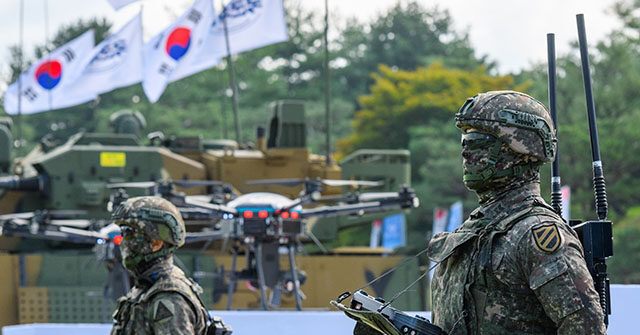
The South Korean Defense Ministry on Friday announced an ambitious plan to train 500,000 “drone warriors” who would integrate unmanned vehicles more fully into the armed forces, in a counter to North Korea’s increasing use of drones.
South Korean Defense Minister Ahn Gyu-back initially said the drone warriors would be equipped with 110,000 new drones over the next three years, but the Defense Ministry later announced a more modest target of 11,000 drones next year, and 60,000 by 2029.
“Drones should no longer be equipment used by a limited number of units, but a universal combat tool. All troops should be able to use drones like a second personal firearm,” Ahn said at a press conference on Friday.
The declared goal of 500,000 drone troops is a remarkably high figure, given that the entire active-duty South Korean military is currently smaller than that. Presumably the total would include reservists, and possibly even civilian contractors providing drone support.
Ahn pointedly stated that South Korea would manufacture its own drones to avoid the risk of using tainted or insecure Chinese components. The key product under development is called the K-LUCAS, a domestically produced variant of the U.S. Low-Cost Uncrewed Combat Attack System.
LUCAS was conceived as a response to Iran’s Shahed series of drones, which revolutionized drone warfare over the past few years by providing a reliable one-way “flying bomb” that could be swiftly produced in massive quantities for very low per-unit cost.
The U.S. military developed and deployed these drones much more quickly than most defense projects, and by all accounts, LUCAS performed extremely well against Iranian targets during Operation Epic Fury.
The South Korean military has reportedly decided to produce and deploy its K-LUCAS variant as quickly as possible, along with some 20,000 other low-cost, limited-function drones, loitering munitions, and drone interceptors.
Ahn said the first wave of new drones would begin reaching “frontline areas,” meaning the DMZ that separates North and South Korea, as early as next year, to be followed by more advanced AI-controlled drone swarms.
“Over the medium to long term, we will develop and field directed-energy weapons requiring advanced technology — such as lasers and high-power microwave systems — while also moving early to secure a range of low-cost interceptor drones to counter cheap drone threats,” Ahn said.
The Defense Ministry also said it would reorganize its drone command, breaking up the current centralized office to give the South Korean Army, Navy, Air Force, and Marine Corps their own operational commands.
“We will move away from the current system, in which some drone assets are concentrated in specific units, and develop an integrated approach that allows each branch to conduct surveillance, reconnaissance and strike operations in a unified manner. Each branch will develop drone operating concepts and tactics suited to its own characteristics and missions,” the ministry said.
South Korea is already making strides toward drone swarm technology. Last weekend, an air show at an amusement park in Yongin featured five drones developed by startup Pablo Air that were capable of communicating with each other and acting without human direction. The drones were carrying stuffed dolls, but they could just as easily have carried bombs.
Numerous other South Korean startups are feverishly working on low-cost, high-performance drone projects for consideration in the military’s big “drone warrior” push, inspired by America’s new wave of “disruptor” companies, which have been producing innovative systems like LUCAS with remarkably short development-to-deployment cycles.
Pablo Air, for example, is working on a kamikaze drone like Iran’s Shaheds that would only cost about $6,000 per unit, because the fuselage is made out of foam boards. This is the sort of price point the South Korean Defense Ministry will find appealing, if it truly intends to give every frontline soldier a drone along with his rifle and sidearm.
One of Pablo’s competitors, Nearthlab, offers an interceptor drone called KAiDEN that weighs less than seven pounds, and can destroy much larger and more expensive enemy drones by slamming into them at high speeds.
“Modern air defense is no longer a competition of performance but a competition to build sustainable systems. KAiDEN’s strategy is to respond to expendable threats with expendable systems,” said Nearthlab CEO Choi Jae-hyuk.
Read the full article here