


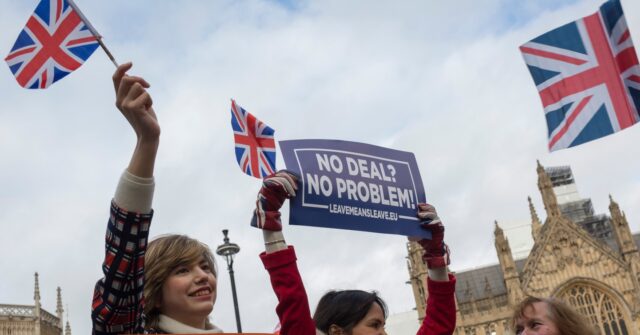
Ten years ago today, the British public voted to leave the European Union in one of the largest exercises of direct democracy in history. While the UK regained its sovereignty, key promises of the independence campaign remain unfulfilled a decade later as politicians of various stripes have sought to stymie the will of the people.
On June 23, 2016, over 17 million voters in Britain rejected the globalist project that is the European Union, backing a campaign run on the slogan “Take Back Control”. Although both sides of the referendum had their specific issues of concern, with Vote Leave focusing on stemming the tide of mass migration from the Continent, and Remainers emphasising the alleged economic benefits of staying within the EU’s Single Market, the true driving force behind the vote was Britons demanding the right to determine their own future. Twas ever thus.
Just four decades earlier, London was embroiled in similar discussions, as Ted Heath’s Conservative Party government sought to entangle Britain in the European Economic Community (EEC), which later became known as the European Union. Opponents such as left-wing icon Tony Benn railed against the move, arguing that it was a gift to big business and capital, with free trade enabling corporations to offshore their companies while still retaining access to the British market, thereby undermining British workers.
However, again, the most salient arguments from both sides of the aisle focused on British sovereignty. Arch Conservative MP and anti-mass migration forewarner Enoch Powell said in 1971 that opposition to joining the bloc was not primarily economic, but rather out of nationalist concern, with the British public having an innate “repugnance or incredulity towards the possibility of being politically integrated with continental Western Europe.”
This sentiment was shared by then Labour Party Shadow Minister for Europe, Peter Shore MP, who said that joining the ECC would “deprive the British Parliament and people of democratic rights which they have exercised for many centuries.”
“I can think of no treaty, to cite only one characteristic of the Rome Treaty, in which the British Parliament agree that the power to tax the British people should be handed over to another group, or countries, or people outside this country, and that they should have the right in perpetuity to levy taxes upon us and decide how the revenues of those taxes should be spent,” Shore remarked in 1972.
The concerns about handing power to unelected bureaucrats in Brussels ultimately proved prescient. On the day of the Brexit referendum, polling conducted by Lord Ashcroft found that 49 per cent of leave voters said that their chief motivation for voting to leave the EU was based on “the principle that decisions about the UK should be taken in the UK”.
Nearly four years later, when the UK finally left the EU — after years of monotonous negotiations with Eurocrats — speaking to Breitbart London, famed “unofficial” British Town Crier Tony Appleton bellowed from Parliament Square: “Born free, as free as the wind blows… We are free, we are in business big time. It’s the best thing that’s ever happened to our country!”
Yet, although Britons successfully reclaimed their sovereignty from the EU, they were left with a perhaps more daunting task: reclaiming power from the Westminster establishment class that had opposed Brexit at every turn.
After three years of dithering and delays from the government of former Prime Minsiter Theresa May, who opposed Brexit during the referendum, the British public once again had to make their voices heard, delivering a stunning defeat to May’s Tories at the European Parliament elections, handing Nigel Farage’s Brexit Party (now Reform UK) its first national victory at the ballot box that ultimately foretold the downfall of May.
Months later, Britons went back to the voting booth. Critically, Farage stood down his forces in favour of delivering a strong parliamentary majority for fellow Leave campaigner Boris Johnson to “Get Brexit Done“. The strategy worked and provided the popular former London Mayor a historic victory over socialist Jeremy Corbyn’s Labour Party, which by this time had largely abandoned its pro-worker, anti-international-capital stance in favour of a globalist message geared towards urban, pro-Remain college-educated elites.
However, the freedom of Brexit was short-lived under Johnson, who, less than three months after winning in a landslide, imposed economically crippling and civil liberties-crushing lockdowns during the Chinese coronavirus crisis. Boris, once a jovial London libertarian, turned heel and enacted some of the world’s harshest COVID-19 restrictions at the time, wiping out almost any optimism felt by those who gathered in Parliament Square weeks prior to celebrate their newfound freedom.
Perhaps even more critical to the nation’s future was Johnson’s betrayal on immigration, which was the second-most-cited motivation among those who voted for Brexit. Rather than fulfilling the “take back control” promise of Brexit, or indeed the Tory election manifesto commitments in 2010, 2015, and 2017 to bring immigration down to the “tens of thousands” or his own 2019 manifesto, which pledged to significantly cut immigration, Johnson oversaw the most significant liberalisation of immigration in the history of the country.
While Brexit ended the “free movement of people” from EU nations into Britain, immigration from outside of the bloc was unaffected by the referendum. Thus, the Johnson government still needed to introduce immigration reforms for the now fully independent UK. The answer supplied was a “points-based” immigration system supposedly cribbed from the Australian model.
However, despite criticism from figures such as Farage and think tanks like Migration Watch UK, the legislation did not impose a hard cap on the number of migrants allowed into the country each year. This paved the way for what has since become known as the “Boriswave” of millions of migrants pouring into the country. What had been a steady stream prior to the referendum had become a waterfall, peaking at 944,000 net in the year ending in March 2023.
According to Migration Watch, the UK has now seen a cumulative net migration (the number of people who arrived minus those who left) of over 3.7 million since the 2016 vote.
In comments provided to Breitbart London, Migration Watch Chairman Alp Mehmet said: “Brexit delivered what the British public had demanded for years: the power to control our borders. Since 2016, successive governments have wilfully failed to use it. Although free movement ended, immigration surged because the post-Brexit points-based system was deliberately loosened at the behest of employers, universities, migrant rights groups and open-border zealots. The wishes of the majority were ignored.”
“Ten years on, after five Prime Ministers and almost four million people added to the population by migration, the foreign-born population has grown rapidly while the native British population continues to decline. It is time to restore control… Failure to act risks further undermining of social cohesion and changing the very nature of our society,” he warned.
Why did this happen? Some have pointed to comments from George Osborne, the former Chancellor of the Exchequer and ex-right-hand man of anti-Brexit Tory PM David Cameron, who admitted in 2017 that the pro-big-business Conservative Party establishment had never intended to fulfil its manifesto pledge to cut immigration.
For his part, Johnson — who was ousted from office amid scandals over Downing Street parties during lockdown rather than his immigration betrayals — has claimed that he was pressured by the Bank of England and others to flood the country with as many workers in a bid to combat covid-related inflation by means of human quantitative easing.
It is deeply questionable whether the post-Brexit migratory waves provided much to the British economy, with many of the arrivals being set to be a net loss to society, with estimates from the Office for Budget Responsibility (OBR) finding that low-skilled migrants will take £151,000 more out of the system than they contribute by the time they reach 66 years of age. In comparison, the average British-born worker contributes £280,000 to the public coffers by the same age.
The prospect of millions of Boriswave migrants gaining residency and thus access to the plethora of welfare benefits provided by the British state has seen Nigel Farage’s Reform UK call for an end to indefinite leave to remain (which grants permanent residency to migrants after just five years in the country. Reform has also called for the system to be replaced with an American-style five-year work visa and for those who are receiving benefits, state housing, don’t speak English, or undermine the country’s values to be deported. The party has also said that it would revoke refugee status from illegal migrants who arrived over the past decade of Tory and Labour rule.
Remarking on the anniversary of the Brexit campaign he led, Mr Farage said that it is time for the public to leave behind the establishment parties and trust his Reform UK party to finally deliver on the promises of the referendum.
“I’ve always said that Brexit is a necessary step towards saving the country. But on its own, it’s nowhere near sufficient. It needs a government that will deliver on the freedom it gave us to drag our heads back above the water. It needs a government that will listen,” Farage wrote on his Substack.
“The anger and frustration felt by the British people, the anger and distrust in the Westminster class, is a result of the utter failure of that same political class to pay attention to what it was told. To take control of our borders, take control of our laws, and deliver the growth they so desperately needed. These desires were ignored. And so was the optimism of the 2016 vote.”
“When I stood in Parliament Square at 11 pm on January 31 2020, and we regained our freedom, I called it the greatest moment in the modern history of our great nation. I meant every word. Only Reform will deliver on the promise of 2016. Only Reform will deliver for the whole of our country,” Farage vowed.
Follow Kurt Zindulka on X: Follow @KurtZindulka or e-mail to: [email protected]
Read the full article here