


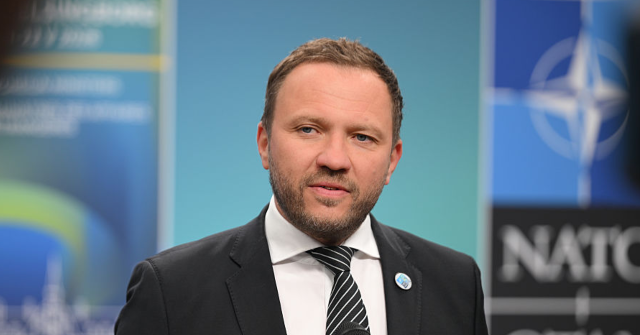
The government of Estonia on Wednesday called upon the European Union to reassess its policy towards Cuba and the communist Castro regime after Foreign Minister Margus Tsahkna met with Orlando Gutiérrez-Boronat, coordinator of the Assembly of the Cuban Resistance (ARC) and a Breitbart News contributor.
ARC is a coalition of Cuban dissident groups on and off the island who advocate for respect for human rights and democracy. Gutiérrez-Boronat is currently conducting a tour across Europe to once again denounce the repressive Castro regime and call upon the EU to stop providing financial aid to the communist regime that has forcefully ruled Cuba for over 67 years.
Minister Tsahkna’s met with Gutiérrez-Boronat to discuss the human rights situation in Cuba and to find ways to support Cuban civil society. The Estonian Foreign Ministry released a statement in which Tsahkna warned that human rights violations in Cuba are worsening — noting the imprisonment of peaceful protesters, growing number of political prisoners, and restrictions to freedom of expression, assembly, and association in the island-nation.
Tsahkna noted Estonia’s own history of freeing itself from the oppression of a communist regime and, as such, supports the Cuban people’s right to a free and democratic future. The Foreign Minister further noted that Cuba urgently needs extensive political and economical reforms to alleviate the suffering of its people.
“The Cuban regime does not respect the fundamental rights of its citizens and has shown no willingness whatsoever to embrace change,” Minister Tsahkna said. “For this reason, Estonia considers it important to strengthen engagement with Cuba’s democratic opposition in order to demonstrate support for those who are standing up for human rights, political freedoms, and democracy in Cuba.”
Per the Estonian Foreign Ministry, Tsahkna and Gutiérrez-Boronat also addressed the Cuban regime’s support of Russia’s invasion of Ukraine. Cuba’s cooperation with Russia, and its increasingly close cooperation with pro-Russia Belarus, are among the reasons Estonia called on the EU to reassess its policy towards Cuba.
“The Cuban regime openly supports Russia’s aggression against Ukraine and has shown no willingness to change course. In its relations with third countries, the European Union must also take into account their attitude towards international law and Russia’s aggression,” Tsahkna said.
For years, the European Union has maintained a cooperation agreement with communist-ruled Cuba and, as of 2021, the European bloc has provided 155 million euro (nearly $178 million) in funding to the Castro regime for 80 projects on “sustainable agriculture and food security, renewable energy and climate change, and modernization of the economy.”
In spite of the EU’s stated goal, none of the funding or projects appear to have improved the lives of Cuban citizens in any actual capacity whatsoever. For years, the ARC has denounced that the European Union’s financing of “projects” in Cuba ends up funding the communist Castro regime and its repressive apparatus.
On Thursday, hours after Gutiérrez-Boronat met with the Estonian Foreign Minister, members of the European Parliament (MEP) passed a resolution condemning the repression of the Cuban regime and demanding profound change in the nation.
The resolution — approved with 283 yeas, 199 nays, and 85 abstentions — demands the EU adopt sanctions against the Cuban regime, including figurehead “President” Miguel Díaz-Canel and GAESA (Grupo de Administración Empresarial S.A.), the Cuban military’s conglomerate that controls nearly half of Cuba’s entire economy. Díaz-Canel and his family, as well as GAESA and its President Ania Guillermina Lastres Morera, were recently sanctioned by the United States. Additionally, European lawmakers demand the immediate suspension of the EU’s cooperation agreement with Cuba.
“Parliament states that any transition must be Cuban-led and include all Cubans, on the island and in the diaspora, encouraging the regime to allow those who took the painful path of exile to return without reprisals,” the European Parliament’s press release read in part.
The lawmakers noted that Cuba holds at least 1,281 political prisoners as of the end of May 2026, including minors. The MEPs also demanded the immediate release of all political prisoners in Cuba and the end of the Cuban regime’s torture and mistreatment of its own people. The Castro regime’s support of Russia and rapprochement with Belarus was noted by the MEPs, who also condemned the communist regime over its alignment with the regimes in Moscow and Minsk.
Christian K. Caruzo is a Venezuelan writer and documents life under socialism. You can follow him on Twitter here.
Read the full article here