


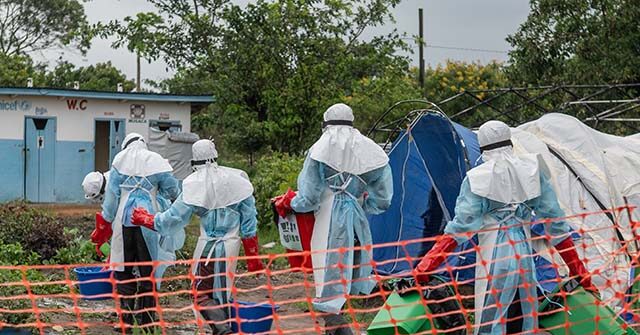
Olivier le Polain, an epidemiologist with the World Health Organization (W.H.O.), said on Friday that there are still “many blind spots in some areas that are high risk,” so the full extent of the Ebola outbreak in the Democratic Republic of the Congo (DRC) remains unclear.
“Surveillance really needs to be strengthened in those areas,” he advised. “The full scale of the outbreak is not yet clear, and we’ll get more clarity as surveillance improves.”
Le Polain, who spoke from the North Kivu provincial capital of Beni in the DRC, delivered the alarming revelation that new Ebola cases are still popping up in different health zones of the North Kivu, South Kivu, and Ituri provinces almost every day. The pattern of new cases suggests that infected people are spreading Ebola by moving between different communities in the eastern Congo.
“The outbreak continues to expand both in terms of case numbers but also in terms of geographic spread. That reflects really the scale of this outbreak – a scale that is much bigger than what is being detected, and the high mobility of the population,” he warned.
In addition to enhanced surveillance and contact tracing, Le Polain said the outbreak region desperately needs more isolation beds to contain the outbreak. He said all three provinces combined only have about 250 isolation beds at the moment.
The United Nations refugee agency (UNHCR) published a report on Thursday that said the first two Ebola-related deaths have been reported at the Kpangba refugee camp, an overcrowded facility in the eastern DRC with some 30,000 residents where hundreds of people are forced to share a single toilet.
“We are all really worried that Ebola in these camps will spread extremely quickly and that there will be panic and people will flee all over whether or not they’re contacts, whether or not they’re ill,” said Caitlin Brady, the Danish Refugee Council director for the DRC.
The two Ebola fatalities from the camp were a 60-year-old woman and her middle-aged daughter. The older woman escaped from quarantine and could not be located by contract tracers before her positive test results came back on May 30. She died the following day, and her daughter died on June 1.
Both women died outside of medical care, and when humanitarian workers attempted to recover their dangerously infected bodies, other residents of the community attacked them. Many people in the eastern Congo are extremely reluctant to surrender their Ebola dead to health officials, preferring to hold funerals and bury the bodies themselves – often with catastrophic results.
Another refugee camp in the Ituri province called Kigonze has reported multiple illnesses and deaths, but has yet to confirm any Ebola infections. Kigonze has about 25,000 residents, and their living conditions are no better than at Kpangba.
“If Ebola comes, we’ll be wiped out as we’re packed like sardines,” Kigonze resident Dorcas Mapenzi told Agence France-Presse (AFP) last week.
“We displaced people here have no hygiene,” she said. “Our children play next to filthy toilets and even relieve themselves on the ground, in the middle of the tarpaulins that serve as our homes. Given these conditions, how are we going to protect ourselves against this disease, when everyone tells us we need to distance ourselves to fight Ebola?”
Read the full article here