


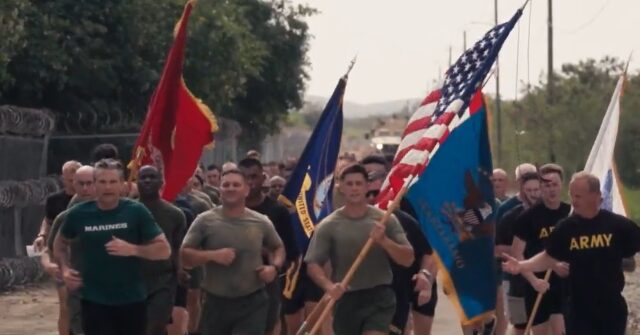
Secretary of War Pete Hegseth traveled to the American military base at Guantánamo Bay, Cuba, on Wednesday, joining a training session and asserting that the American government would have a say in the future of Cuba.
Hegseth is the third high-ranking American official to visit the island of Cuba this year, following visits by CIA Director John Ratcliffe and the commander of U.S. Southern Command (SOUTHCOM), Gen. Francis L. Donovan. The visits occurred amid a flurry of diplomatic activity to contain the malicious behavior of the Cuban Communist Party, the only U.S.-designated state sponsor of terrorism in the Western Hemisphere and a serial human rights abuser.
President Donald Trump has long prioritized support for the Cuban exile community, particularly in the United States, and opposition to global communism. During his second term in office, he has dramatically expanded actions to contain the Communist Party, in particular sanctions on some of the most criminal individuals in the Party and limitations on international companies’ involvement with the Cuban military. As a result of policies opposing narco-terrorism and communism elsewhere in the region, the Castro family regime has also seen its regional influence plummet, particularly after the American arrest of its closest ally, former Venezuelan dictator Nicolás Maduro.
The Department of War published videos of Secretary Hegseth addressing the troops at the military base, emphasizing the importance of the Monroe Doctrine and President Trump’s support for their work on the ground.
“What happens with the future of Cuba is in the hands of the president of the United States and the leadership of Cuba,” Hegseth told the troops. “No matter what, the Department of War is going to be prepared and postured for any possible contingency.”
Hegseth brought a message from Trump: “He always wants me to tell you that he’s got your back … He’s got your back in the circumstances that you need to undertake.”
“Not everything’s going to go right every single time, but if [you’re] doing it for the right reasons, and on behalf of the country, we are going to untie your hands and unleash you to get it done, so that you come home and the bad guy doesn’t — that’s the point,” he promised.
The Department of War relayed that Secretary Hegseth discussed “readiness with mission leaders,” suggesting that any attempt by the Cuban communist regime to attack American forces would be met with an efficient and prepared response.
“[We want to make sure] the world understands that American might, whether it’s 9,000 miles away or 90 miles away from our shores, is the greatest in the world, and [we are] prepared to go on offense or defense at any moment to defend our interests,” Secretary Hegseth asserted.
The top Pentagon official added that the Trump administration is focused on ensuring national security in the Western Hemisphere and treating it as “key terrain,” rather than an afterthought as past administrations have done. Beyond Cuba, Hegseth recalled the dramatic arrest of Maduro in Caracas on various charges of aiding terrorism and drug trafficking and the Trump administration’s support for the conservative government of Panama, which is currently working to limit Chinese influence in and around the U.S.-built Panama Canal.
“We’re working there to ensure that both sides of the canal are secure; that our ships flow freely,” Hegseth asserted of Panama.
The secretary of war arrived about two weeks after Gen. Donovan, the head of SOUTHCOM, made a visit to the island. The general, unlike Hegseth, made time for an unprecedented meeting with a senior Cuban Revolutionary Armed Forces (FAR) official, Gen. Roberto Legrá Sotolongo. According to comments from SOUTHCOM, the two had a “brief exchange on operation security matters” at Guantánamo, separate from Gen. Donovan’s actions to inspect American operations at the base.
Sotolongo is sanctioned by the American Office of Foreign Assets Control (OFAC) for his role in the violent repression of anti-communist protests on July 11, 2021, and is identified as a violator under the Global Magnitsky Act, which specifies sanctions for human rights violations.
Earlier in May, CIA Director John Ratcliffe made a surprising appearance not at the Guantánamo base, but in the nation’s capital, Havana, to meet with Cuban intelligence officials. While the CIA was characteristically secretive about the reasons for the visit, some anonymous reports citing American officials claimed that Ratcliffe was in the city to “personally deliver President Donald Trump’s message that the United States is prepared to seriously engage on economic and security issues, but only if Cuba makes fundamental changes.”
Trump has personally made statements in public expressing interest in ending the harrowing status quo in Cuba, in which the vast majority of Cubans are subjected to horrific poverty and government abuse to profit the Castro family and the small circle of friends and married-in relatives they bankroll. In February, Trump told reporters that he was considering a “friendly takeover” of the island nation revealing that the Castro regime was “talking” due to the dire state it found itself in following the Maduro arrest. Trump has since expanded sanctions on individual Castro regime officials, including figurehead “president” Miguel Díaz-Canel; his administration also indicted dictator Raúl Castro on murder charges for his role in the 1996 killing of four Cuban-Americans volunteering with the humanitarian organization Brothers to the Rescue.
Publicly, the Castro regime has elevated its violent rhetoric against the United States in response to these moves. In May, Díaz-Canel threatened that a “bloodbath of incalculable consequences” would occur if the Untied States acted to defend itself from a Cuban attack.
Follow Frances Martel on Facebook and Twitter.
Read the full article here