


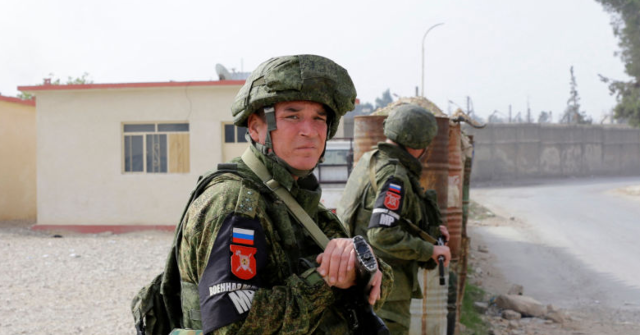
The Russian Foreign Ministry said on Wednesday that cooperation with the new Syrian government is “developing very actively” and could lead to Russia keeping some military bases that it feared losing when its client Bashar Assad was overthrown in December 2024.
“Within the framework of contacts with Syrian partners, the issue of Russia’s military presence in Syria is also being discussed, including in the context of a possible reformatting of the functionality of Russian military facilities,” Russian Foreign Ministry spokeswoman Maria Zakharova said.
Zakharova was particularly optimistic about prospects for the Tartus naval base, which was established in 1971 and significantly upgraded in 2015 when Russia was providing heavy military, economic, and diplomatic support to the Assad dictatorship during the Syrian Civil War.
In 2017, Moscow signed an agreement with the Assad regime to keep the Tartus base under Russian control for 49 years at no expense to Russia. The base is an important strategic asset for Russia because it has no other comparable ports in the Mediterranean. In fact, Russia only has one other base beyond the borders of the fallen Soviet Union, and it is also located in Syria: the Khmeimim airbase in the northwestern Latakia province.
Assad seemed to have prevailed in the long and brutal Syrian Civil War with copious support from Russia and Iran, but his fortunes suddenly took a turn for the worse in late 2024 when a lightning-fast offensive by an alliance of insurgents and jihadis swept across the country and suddenly captured Damascus. Assad went into exile in Russia, and the fate of Russia’s two bases in Syria was suddenly in doubt.
The new Syrian government, headed by former al-Qaeda lieutenant Ahmed al-Sharaa, seemed hostile to the Russians at first. Geopolitical analysts saw signs that Moscow was drawing up emergency plans to preserve its military influence in the Middle East without those priceless Syrian bases, possibly by working more closely with warlord Khalifa Haftar and his Libyan National Army (LNA), the faction Russia supports in Libya.
The Russians did build up their infrastructure in Libya, but they also began making inroads with the Sharaa government in Syria. Satellite images showed a Russian cargo ship sailing from St. Petersburg in March and arriving at Tartus in June, traveling with a Russian naval escort and seemingly loaded with equipment and supplies for the Syrian bases.
Analysts also noticed that while Russia drew down its forces in Syria after the fall of Assad, the last few hundred Russian personnel did not seem to be in any hurry to leave Tartus or Khmeimim, which suggested the new Syrian government was not on the verge of evicting them.
Zakharova said on Wednesday that Tartus could become a logistical hub for distributing Russian imports to Syria, which seemed to be the “reformatting” she was talking about.
United24 Media reported on Wednesday that Syrian officials have discussed “converting the remaining Russian bases into training grounds for the new Syrian army,” another bit of reformatting that would not require the Russians to completely abandon the facilities.
Khmeimim Air Base has become an important part of Russia’s force pipeline into Africa, ferrying equipment and state-controlled paramilitary forces into African nations that pay handsomely for Russian mercenary forces to control insurgencies. Moscow seemed on the verge of panic in 2025 that it might lose Khmeimim, severely compromising its operations in Libya, the Central African Republic (CAR), Mali, and Niger.
The panic appears to have subsided as relations between Moscow and the new government in Damascus stabilized. In October 2025, Russian President Vladimir Putin met with Sharaa and secured a commitment to honor the Assad regime’s agreements with Russia for base access. Putin appears to have sweetened the deals with promises of food and fuel exports at bargain prices, which will now be distributed from the Tartus base, if Zakharova’s comments on Tuesday prove accurate.
Read the full article here