


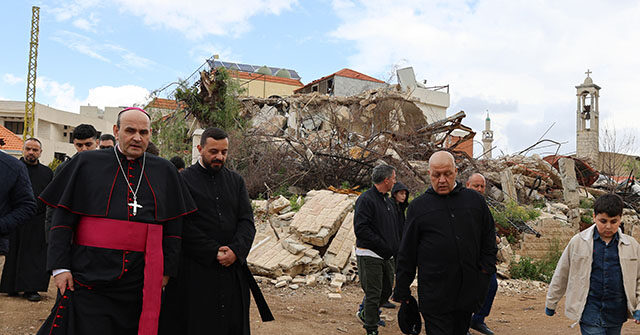
Apostolic Nuncio Paolo Borgia on Monday visited several villages in southeastern Lebanon whose residents have refused to leave, despite the ongoing battle between Israeli forces and the Iran-backed terrorists of Hezbollah.
Borgia has visited the region several times during the current conflict, which Hezbollah launched by attacking Israel from Lebanese soil in March. The nuncio does not limit his visits to majority-Christian communities.
“The war has severe consequences for villages — whether Christian, mixed, or Muslim. Many people have been forced to leave their homes,” the archbishop noted when visiting the conflict zone in March.
“There is much suffering in the Beirut area with all the displaced people, especially Shiites, who are in a very difficult situation. Many Christians are also displaced in Beirut or in the north,” he said after another tour in April.
“It is certainly hard because they leave everything behind, and there is also a major economic problem, as activities cease when villages in the south are abandoned,” he observed.
“They feel they are carrying a burden alone. That is why we go to visit them: they must feel the presence of the universal and Lebanese Church, especially the presence of the Holy Father, as well as many people of goodwill who help and support those living through these tragedies,” he stressed.
As with his previous visits, Borgia brought humanitarian supplies to the villages he visited, provided by relief organizations such as Caritas-Lebanon, whose president Father Samir Ghaoui traveled with the nuncio.
Community leaders said these humanitarian deliveries were crucial because the conflict has cut them off from the rest of Lebanon. Local farmers said they were worried about the security situation preventing them from working their fields in the upcoming harvest season, which could lead to a devastating loss of income for already impoverished communities.
The Israeli military continues to issue evacuation orders for areas across Lebanon, which some villagers refuse to obey. Civilians and members of the Lebanese army have reportedly been hit by Israeli strikes against Hezbollah.
On Tuesday, the Israeli army published photos of a large Hezbollah weapons stockpile seized from a nominally civilian residence in the village of Zawtar Sharqieh, located north of the Litani River, the boundary between north and south Lebanon.
“The combat weapons found in the buildings include Kalashnikov-type rifles, missiles and anti-tank rocket launchers, magazines, grenades, communication devices, drones and other combat equipment,” the Israeli statement said, citing the raid as the latest evidence that Hezbollah deliberately uses “civilian infrastructure” in its operations.
The Israel Defense Forces (IDF) said several more Hezbollah weapons depots have been found in civilian structures in Zawtar Sharqieh and other towns over the past few days.
On Monday night, a suspected Hezbollah fighter slipped into northern Israel from Lebanon and fired on Israeli troops, who returned fire and killed him. Local community leader David Azoulay said the incident was “further proof that there is no security even after almost three years of war in the north, even when the IDF created a sort of security zone.”
Azoulay said Israel should “charge Hezbollah a price for its audacity and attempt to penetrate Israeli territory and make it clear that these events will not pass as if nothing had happened.”
Israel launched airstrikes on the major Lebanese city of Tyre on Tuesday and warned the entire city to evacuate, including the Christian quarter of the Old City, which has previously been exempted from evacuation warnings. The IDF said last week that it has reason to believe Hezbollah fighters are operating out of the Christian quarter in Tyre because they thought it was safe from attack.
The Lebanese health ministry said the strikes conducted before the evacuation warning killed at least eight people and wounded 32.
Georges Iskandar, the Metropolitan Archbishop of Tyre for the Melkite Greek Catholic Church, said on Tuesday that his church would not abandon its duty to the community, and the community would not obey the evacuation order.
“We will not leave this city, which was blessed by the footsteps of Jesus Christ, and which throughout history has borne witness to faith and resilience,” he said.
Lebanese President Joseph Aoun on Monday pleaded with Israel to work out a ceasefire arrangement with his government, because “a military solution will never provide security for the residents of northern Israel.”
“We are ready, we want this, we are committed. Are you? If so, let’s sit and talk,” he said during an interview with CNN.
Aoun said he was pushing for a cessation of hostilities, rather than a full peace deal immediately, because establishing a durable peace would take time. He envisioned the next step as Israel granting statehood to the Palestinians and withdrawing from all “occupied territories,” after which Lebanon might finally be willing to normalize relations with Israel.
“We need to end the state of hostility between Lebanon and Israel. Forever. And this could be a path forward for a just and lasting peace,” he said. “But we cannot jump from A to B directly. We have to go through different steps.”
There are several reasons why Israel might not leap at his offer, chief among which is that Lebanon’s nominal government has proven incapable of disarming or restraining Iran’s proxy Hezbollah. Every clash between Israel and Hezbollah over the past four decades has ended with Beirut promising to disarm the terrorist group, but it has yet to do so.
Aoun may already be putting his government in jeopardy by simply negotiating directly with the Israelis, a historic move that has annoyed Hezbollah and its political allies in Lebanon, and by complaining that Iran and Hezbollah unilaterally dragged Lebanon into a war with Israel that it did not want.
It could also be Hezbollah that learns it has gone too far. On Monday, the Wall Street Journal published some interesting remarks from a Sunni Muslim cleric in Beirut named Imad Sobh who said the population is turning against Hezbollah, Iran, and Shiite Muslims in general, and the mood could slip into civil war.
“This war is much different than the war in 2024. Now there are grudges, divisions, discrimination on sectarian lines. I have even heard some Sunnis say that they are supportive of Israel’s war against Hezbollah, its supporters and Shias at large,” Sobh said.
“I have never heard such things from Sunnis before. I am trying to tamp down these sentiments and bring people together,” he added.
Read the full article here