


Manufacturing Productivity Soars Under Record Tariffs, Crushing the Anti-Tariff Folklore
Someone should contact the curators at the Smithsonian. An American folk mythology is about to die from exposure to the harsh light of reality. Perhaps the Smithsonian folks should start assembling an exhibit commemorating this dying system of belief and ritual before it is forever purged from our collective cultural memory.
The endangered mythology, of course, is the idea that trade tariffs damage the economy by making the very sector they seek to protect, manufacturing, less efficient, ultimately making the nations that impose them poorer. A particularly virulent form of this belief was popular among economists who received their advanced degrees over the past five or six decades—as well as among the journalists who treat the prejudices of economists as descriptions of reality whose accuracy no reasonable person can doubt.
A near-perfect example of this can be seen in the Yale Budget Lab’s description of its work on President Donald Trump’s trade policies. “[T]ariffs reduce productivity and thereby real U.S. income (even when including tariff revenue) by reducing the efficiency of resource allocation across countries and increasing the marginal cost of investment,” they write. We could quote similar statements from economists claiming—without qualification and with maximum confidence—that tariffs reduce productivity, but we’ll leave the collection of the artifacts of this orthodoxy to the curators of history museums.
Decades of Getting Trade Theory Wrong
The death knell for this belief was tolled on Thursday by the government’s latest data on labor productivity in the manufacturing sector. But before we get to those figures, it’s helpful to review where we’ve been. Manufacturing productivity grew at an annual rate of around 2.6 percent between 1949 and 1987, according to data from the Bureau of Labor Statistics. It picked up a bit following the Reagan economic reforms and then skyrocketed to 4.8 percent during the dot-com boom of the late 1990s. But beginning in 2003, we saw a marked deceleration. Following the global financial crisis, from 2007 through 2019, manufacturing productivity growth dropped to almost nothing, 0.1 percent per year. Real output growth—how much we were producing—collapsed entirely during those years and even went negative, with U.S. factory production falling 0.6 percent per year.
The decline in manufacturing productivity growth should have undermined the folklore of the anti-tariff orthodoxy. These were years in which tariffs were low, the trade liberalization of the WTO era was dominant, new trade deals were being struck, imports were rising, and trade deficits were large and persistent. In that final period, the China shock had torn through our industrial heartland and much of what had been American manufacturing was moved to the People’s Republic. By the folklore’s logic, manufacturing productivity should have been soaring as we narrowed down our output to the most efficient, specializing in the products for which we had a “comparative advantage” and letting the global division of labor increase the “efficiency of resource allocation across countries.”
It was not the case that we were getting more efficient in other parts of the economy. From 1947 through 1974, overall labor productivity grew at a 2.7 percent pace annually. This crashed over the following two decades to just 1.5 percent. After a brief revival due to the arrival of personal computers and the internet, which saw productivity gains rise to 3.1 percent from 1995-2004, productivity growth crashed back down to 1.3 percent from 2005-2018. From 2010 through 2018, it was a measly 0.8 percent.
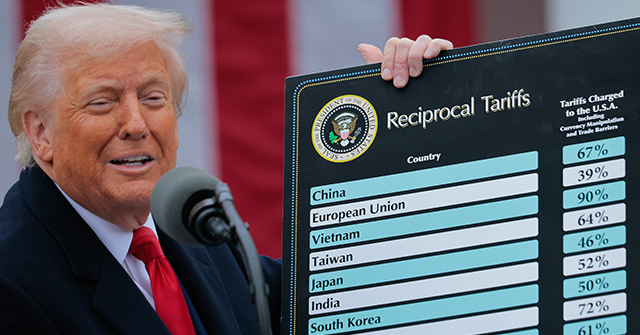
Last year saw a revival of manufacturing productivity that coincided with the biggest increase in tariffs in over half a century. For the year, productivity rose 1.8 percent in 2025. Durable goods productivity drove the gain, rising 2.6 percent. In the first quarter of this year, manufacturing productivity rose at an annualized rate of 3.2 percent and durable goods manufacturing soared 5.5 percent. Tariffs certainly did not depress productivity. They coincided with a resurgence of productivity.
The Hidden Baseline of Anti-Tariff Mythology
So what went wrong? Why were so many of the experts so far off for so long?
The central error in the folklore was hidden in the baseline. The tariff modelers assumed the pre-Trump allocation of global production was efficient—or at least closer to efficient than anything tariffs could produce. That assumption did nearly all the work. It treated China’s subsidies, forced technology transfers, state-directed lending, industrial targeting, exchange-rate management, and export mercantilism as if they were background weather rather than active distortions. It pretended that the mercantilist policies of Europe and Japan had no significant effect. Once that assumption is removed, the orthodox conclusion no longer follows. A tariff imposed against a distorted global production system is not automatically a move away from efficiency.
The immunity to argument and evidence was astonishing. We were ignored when we pointed out—repeatedly—that much of the rest of the world appeared to have practiced a rough version of optimal tariff theory against us. That theory says a country can improve its terms of trade by imposing trade barriers so long as its trading partners do not retaliate. For nearly two decades, China and others supplied the barriers, while American policymakers supplied the non-retaliation. But the folklorists let myth prevail over fact.
And when we explained that Trump’s trade policies did not resemble the “protectionism” of the past, in part because they were not driven by corporate interests demanding protection (America’s corporate interests were largely hostile to Trump’s tariffs), they just insisted that all tariffs were the same. And they absolutely ignored the fact that tariffs could solve a coordination problem, allowing U.S. companies to invest in domestic production without fear of being undercut by offshoring rivals.
The mythology took its cues from the history of 19th-century and earlier tariffs, not acknowledging that a tariff implemented in an economy with a quickly growing labor force and mass immigration might adapt to tariffs differently from one with low fertility and contracting immigration. It refused to take notice of the difference between the 19th-century economy, in which rising output required more labor, and the 21st-century economy, in which capital investment can drive output up.
The historical evidence from the Gilded Age is not that tariffs possess some magic property that always lowers productivity. It is that, in the Gilded Age, tariffs appear to have expanded manufacturing along a low-productivity extensive margin: more workers, more firms, smaller establishments. That is not what the current data show. Look as hard as you want for a mainstream economist evaluating tariffs amid labor scarcity—you’ll find nothing.
Their folklore had maintained that “free trade” had dispersed benefits and tariffs only benefited the “protected” special interests. But this view couldn’t explain why tariffs had been declining for decades. Public choice theory held the answer: the decline of tariffs was actually what benefited special interests while the costs of globalization were dispersed. But they could not bring themselves to see that the global trading system had not been moving toward “free trade” in this century—or before that—but toward trade managed in foreign capitals for the benefit of special interests that controlled governments in Beijing and Berlin and beyond.
Free at Last from the Destructive Trade Folklore
What has happened to productivity in the past year provides the kind of empirical evidence that makes the anti-tariff folklore untenable. There will, of course, be many economists who cling to their long-held catechisms. They’ll insist for as long as anyone will listen that the long-term effects will match their predictions, as if the decades of evidence of the long-term effects running contrary to their claims did not exist. Progress in intellectual fields often is made one grave at a time. But for any fair-minded observer looking at the evidence, there’s no way to endorse the view of tariffs held by the Yale Budget Lab and its cohort.
It won’t matter. The case that tariffs necessarily make American manufacturing less productive died this week.
Let the curators preserve the old faith with its relics: the perfectly efficient baseline, the frictionless global market, the invisible foreign subsidies, the harmless offshoring, the fairy tale that manufacturing capacity can disappear without consequence. Put it behind glass next to phrenology, astrology, and the divine right of kings.
American factories, meanwhile, are producing more, and American manufacturing workers are becoming more productive amid the highest tariffs in the modern American economy.
Read the full article here