


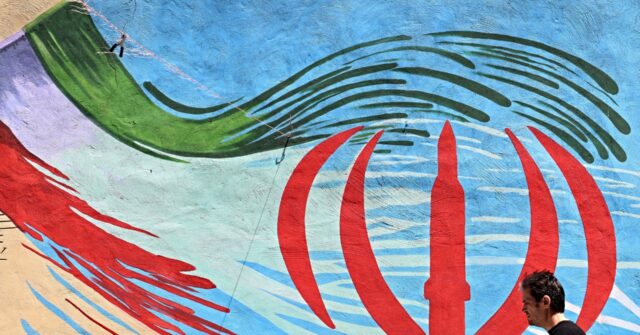
Multiple senior Iranian officials issued statements to celebrate the Muslim holiday of Eid al-Adha on Wednesday in which they encouraged other Muslim countries to embrace “unity” with the repressive terror state, a proposition complicated by months of Iran bombing neighboring Muslim states.
Muslims around the world are marking Eid al-Adha on Wednesday, the culmination of the hajj. The hajj is the pilgrimage to Mecca, Saudi Arabia, that all Muslims are obligated to make once in their lifetimes if physically able to, which lasts about a week. This year, Saudi officials documented 1.7 million people participating in the hajj, an increase from 2025, despite the inhospitable desert climates in May. The Saudi publication Al Arabiya reported on Wednesday that the pilgrims concluded the rite of “stoning the devil” in Mecca, which marks the beginning of Eid.
Iran’s president, foreign minister, and head of the parliament published separate Eid messages, all emphasizing “unity” among Muslim countries against non-Muslim countries, presumably the United States and Israel. Iran is in an unofficial state of war with both countries following the Pentagon’s launch of “Operation Epic Fury” in February, which killed “supreme leader” Ayatollah Ali Khamenei and has killed dozens of other radical terrorist leaders in the country. The operation is in a state of indefinite ceasefire at press time as Iranian and American officials negotiate a long-term path toward peace.
Iranian President Masoud Pezeshkian published his Eid statement on Twitter, updating that he had sent celebratory messages to the leaders of Iraq, Oman, Qatar, Turkey, Tajikistan, Egypt, Kyrgyzstan, and Azerbaijan to mark the occasion.
“I expressed my hope that God may bring the hearts of us Muslims closer together and that we may witness the expansion of cooperation in all areas and comprehensive support for one another in the face of threats,” Pezeshkian wrote.
A major obstacle to “comprehensive support” is Iran’s terrorist Islamic Revolutionary Guard Corps (IRGC) bombing Iraq, Qatar, Turkey, and Azerbaijan in the immediate aftermath of “Operation Epic Fury” in March. The Iranian government has also conducted drone and missile strikes against Saudi Arabia, the United Arab Emirates (UAE), Jordan, Kuwait, and Bahrain so far. While the Iranian government has denied some of the least explicable attacks, such as the one-off bombing of Azerbaijan, the countries involved have declared that they have evidence linking the Iranian government to those strikes. In April, Iran went further and demanded financial “compensation” from the countries in bombed for maintaining friendly ties with America.
“The aggressors have utilised the territories of the Kingdom of Bahrain, the Kingdom of Saudi Arabia, the State of Qatar, the United Arab Emirates, and the Hashemite Kingdom of Jordan for the perpetration of acts of aggression against the Islamic Republic of Iran,” Iranian Representative to the U.N. Amir Saeid Iravani wrote. “The conduct of those States in allowing their territories to be used by the aggressors against the Islamic Republic of Iran qualifies as an act of aggression.”
The civilian leaders remaining in Iran, including Pezeshkian, nonetheless appealed to unity in the Ummah, or Islamic community, against non-Muslims this week. Foreign Minister Abbas Araghchi issued his own statement congratulating Muslim countries on the occasion of Eid, declaring the holiday “an unparalleled manifestation of sacrifice, devotion, and submission before Almighty God,” according to the state-run Islamic Republic News Agency (IRNA).
“Araqchi expressed hope that the auspicious occasion would contribute to strengthening Islamic unity and enhancing cooperation and mutual support among Muslim countries in confronting war, discrimination, and occupation, particularly in the West Asia region,” IRNA added.
RELATED: Trump: Iran Is the Only Country Where No One Wants to be a Leader
Similarly, Parliament Speaker Mohammad Baqer Qalibaf used the Eid holiday to proclaim that “stronger unity among Muslim nations can play an effective role in resolving regional crises.” Qalibaf specifically identified “the criminal aggression of the US and the Zionist regime [Israel]” as a joint challenge for all Muslim countries, not just Iran, they they should combat together. Qalibaf also comically claimed that Iran won the ongoing conflict with the United States, despite losing dozens of its top government leaders and much of its military capacity. That “victory,” he allegedly claimed, “conveyed an important message to Muslims worldwide: that unity and solidarity in confronting the enemies of Islam, especially the Zionist regime and its supporters, can lead to victory.”
The Middle East’s most prominent Muslim countries have already expressed high levels of frustration and outrage at the Iranian government, which do not appear easily fixable in the short term. In March, during the first round of Iranian bombings of Gulf states, Saudi Arabia organized a regional meeting to unite its neighbors against Iran and discuss a solution for the current conflict, which significantly threatened local economies. There, Saudi Foreign Minister Faisal bin Farhan lamented that, in Riyadh, there was little appetite for any friendly relations with Tehran.
“What little trust there was before has completely been shattered,” Prince Faisal lamented at the time. “So when this war eventually ends, in order for there to be any rebuilding of trust, it will take a long time.”
“If Iran doesn’t stop… immediately, I think there will be almost nothing that can re-establish that trust,” he predicted.
Follow Frances Martel on Facebook and Twitter.
Read the full article here