


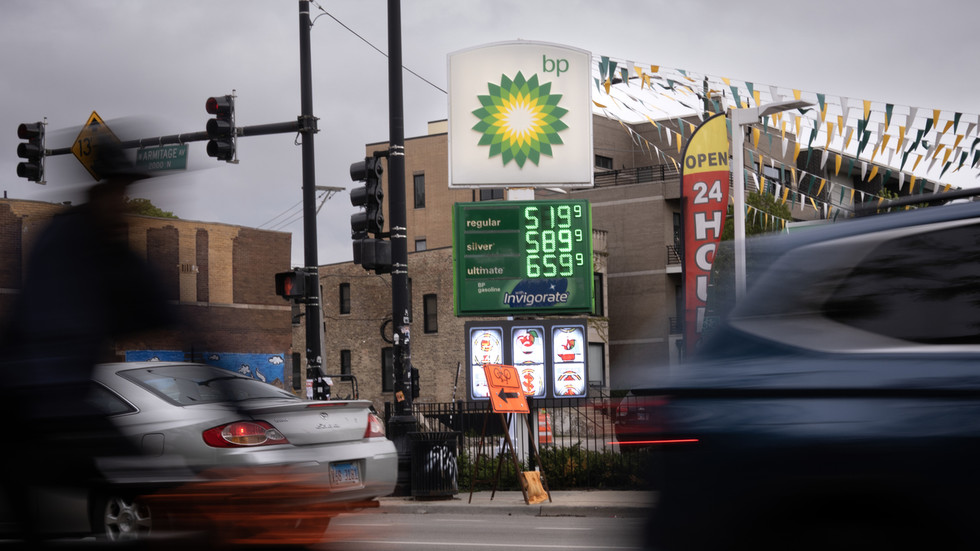
Fuel prices in the US are akin to a constantly displayed economic scorecard where the pump can trump politics
Gas prices in the US have surpassed the psychologically important $4 barrier in all 50 states as the repercussions of the Iran war continue to reverberate.
The US is perhaps the only country where the fluctuations in the cost of gas are news. Monitoring the cost at the pump is a uniquely American pastime – and one often with a political tinge.
With a record 39 million Americans expected to hit the roads for Memorial Day weekend, RT looks at why gas prices matter so much in America.
A country built for cars
Americans drive a lot because they have to. Outside of a handful of urban centers, public transportation is often essentially non-existent. This is, in a certain sense, by design.
The postwar period was a time of great economic expansion for the US. But exactly how it chose to build up its infrastructure was consequential. The model chosen was primarily low-density suburbs connected by high-speed roads. This kept work, commerce, and leisure at a distance from each other. And meant more driving.
What made this possible is the Interstate Highway System built in the 1950s. Launched by the Federal-Aid Highway Act of 1956, it authorized building an astounding 41,000 miles of roadways, the largest public works project in American history. The legislation was, not surprisingly, heavily lobbied for by the leading American automobile manufacturers.
The new highway grid enabled fast car travel at a national scale, but also reinforced diffuse settlement: if you can drive everywhere, you don’t need to live near anything. American middle-class life came to be indelibly associated with suburbia. Dependency on cheap gasoline, meanwhile, became psychologically linked with middle-class mobility and suburban expansion.
The numbers
Gasoline in the US is significantly cheaper than in Europe, where taxes are stiff. It is also the cheapest relative to wages among select major countries. However, the relatively lower price is more than offset by much higher consumption by Americans. The average American driver consumes nearly 575 gallons per year, which is about three times as much as the average German driver – and Germany is a car-loving country.
Largely for this reason, it is a much more sensitive and economically salient indicator.
With gas at $3 per gallon – roughly the average level before the Iran war – the yearly gas bill comes to about $1,725, or $144 per month. With gas at $4.56, as is the current nationwide average, that figure jumps to $2,622 per year, or $219 per month.
So the difference between the two is about $900 per driver per year, a significant economic headwind. It also bears keeping in mind that the vast majority of American families have two adult drivers, so household outlays for gas are significantly higher.
The big signs
The numbers, however, don’t tell the whole story. One unique feature about America is that gas prices are displayed publicly everywhere. Americans encounter giant illuminated price signs constantly. In fact, the largest and most visible part of the sign is often not the company’s logo but the current price. Americans would probably think this strange if they weren’t so used to it. Gasoline prices are among the few prices consumers see in real time every day. Eggs may rise 20%, but consumers don’t pass a six-foot-tall egg billboard on the highway twice daily.
Gas prices are also an exacting science. In a country where five dollars barely gets you a cup of coffee anymore, an archaic convention has held on: prices are shown in tenths of a cent. Instead of rounding to the nearest cent, American gas stations will show $3.499, or $3.49 ⁹/₁₀, instead of $3.50. This unusual artifact of the gas station industry dates back to the early 20th century and has improbably held on.
This constant visibility gives gasoline a prominence that other cost items rarely achieve. Rent, healthcare premiums, or grocery bills rise and are noticed, but these changes are less frequently reinforced.
Gasoline, however, has been turned into a rolling indicator of economic sentiment. American journalist Ian Bogost described gas station signs as “economic scoreboards planted every few blocks” and even called the gas-price sign “a kind of key to understanding American life.”
The politics
No discussion of gas prices would be complete without addressing the politics. The creation event for gas prices as a political touchstone was the oil shocks of the 1970s, which were of course caused by events in the Middle East.
The 1973 Arab oil embargo and 1979 Iranian Revolution led to fuel shortages and rationing in the US. There were even odd-even license plate restrictions that determined who could buy gas on which day. These episodes of severe disruption in a country that depends on cars inserted a permanent, albeit often dormant, energy-related anxiety into US politics. The memory of those events still echoes rhetorically today, especially in light of recent events.
Jimmy Carter is often remembered as the archetypal “gasoline crisis” president, even though most of the factors were structural and external. Nevertheless, the long lines at gas stations became associated with presidential weakness.

Gas prices were chronically high during the presidency of George W. Bush. By 2008, fuel prices were explicitly part of the presidential election debate. There were even congressional hearings on energy prices and campaign slogans such as “Drill, baby, drill.” Both Barack Obama and Joe Biden also had elevated gas prices on their watch. The former in the post-2011 spike after the Arab Spring, while the latter presided over the Russia-Ukraine war and post-Covid demand.
That pattern may now extend to Donald Trump. A new Fox News poll shows 58% of respondents identified cost of living as their top economic concern, up from 50% in February. Rising gas prices will only intensify those anxieties. With Trump’s overall approval rating already low, this could spell trouble for the president and the Republicans in the upcoming midterm elections. This is all the more so given that much of Trump’s base comprises more rural – and thus car-dependent – voters.
Read the full article here