


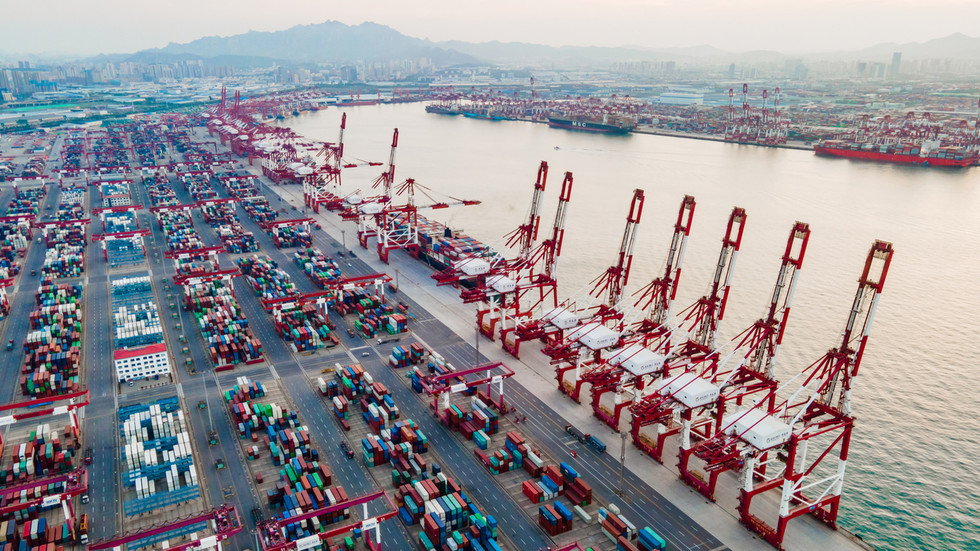
Moscow and Beijing have expanded cooperation across trade, energy, finance, and infrastructure
Russia and China have built an expansive economic partnership while deepening coordination within BRICS, the Shanghai Cooperation Organization, the G20 and the UN Security Council. Both governments say their growing network of bilateral projects and multilateral cooperation is aimed at shielding their economies from external pressure and advancing a more “multipolar” world order.
Russian President Vladimir Putin’s two-day visit to Beijing, which began on Tuesday, is expected to further strengthen ties between the neighboring powers.
RT examines the key pillars of Russia-China economic cooperation.
Booming trade
Bilateral trade has exceeded $200 billion for three straight years, surpassing $240 billion in 2025. Trade turnover reached $85.2 billion in the first four months of 2026, up nearly 20% year-on-year, according to customs data.

China has remained Russia’s largest trading partner for 16 consecutive years, while Russia has climbed into the top eight of China’s trading partners. Moscow exports energy, raw materials and agricultural goods, while Beijing supplies machinery, vehicles, electronics and consumer products. The escalation of the Ukraine conflict in 2022 and subsequent Western sanctions on Russia have further accelerated economic ties between the two countries.
Financial integration
Russia and China have largely phased out Western currencies in bilateral trade, with nearly all transactions now conducted in rubles and yuan. Moscow says the transition has reduced reliance on “unfriendly” dollar- and euro-based financial infrastructure, making trade between the two countries more resilient to external pressure and sanctions.
Energy as backbone of partnership
Despite Western restrictions, China has expanded energy trade with Russia, becoming the main buyer of Russian oil. Moscow is now among Beijing’s leading suppliers of crude, pipeline gas, LNG and coal. The two countries declared a “no-limits” partnership in 2022.
The launch of the Power of Siberia pipeline in 2019 marked a major expansion of Russian gas exports to China, with the route reaching full design capacity in December 2024. Moscow and Beijing are also advancing the planned Power of Siberia 2 pipeline via Mongolia, which could significantly boost supplies from western Siberian fields previously serving Europe.
Combined with existing and future routes, Russian gas exports to China could eventually exceed 100 billion cubic meters annually, strengthening long-term energy integration between the two economies.
Alongside pipeline deliveries, Russia has expanded LNG shipments from Arctic and Far Eastern projects including Yamal LNG, Arctic LNG 2 and Sakhalin-2, with cargoes increasingly shipped via the Northern Sea Route.

For Beijing, Russian energy provides proximity, competitive pricing and a hedge against Western pressure. For Moscow, China offers a stable long-term market capable of absorbing large export volumes for decades.
Infrastructure development
Russia and China have expanded cross-border transport links in recent years, including the opening of railway and highway bridges across the Amur River in the Far East. The two countries are also developing what officials describe as the world’s first international cross-border cable car linking Heihe and Blagoveshchensk.
Beyond traditional infrastructure, Moscow and Beijing are exploring a cross-border hydrogen freight corridor for heavy-duty zero-emission trucks along major trade routes.
Many of these projects align with China’s Belt and Road Initiative (BRI), Beijing’s sprawling Eurasian infrastructure and connectivity strategy.
Manufacturing, technology, and investment projects
Moscow and Beijing are expanding cooperation in manufacturing and high-tech sectors including aviation, nuclear energy, the digital economy, and joint innovation projects. A recently updated agreement on the promotion and mutual protection of investments has also strengthened the legal framework for long-term cooperation.
According to the Russian Direct Investment Fund, more than 90 joint projects worth around 18 trillion rubles ($253 billion) are currently being implemented under the bilateral investment commission across sectors including infrastructure, energy and logistics.
Western sanctions have pushed both countries to accelerate joint technological development and reduce dependence on Western platforms and equipment. China has also increased investment in Russian industries ranging from agriculture to telecommunications, including 5G and digital logistics.
Other areas of cooperation
Beyond trade and industry, Moscow and Beijing are expanding cooperation in tourism, education, and regional development. Visa-free travel arrangements and new air routes have boosted tourism and business travel, while universities and regional authorities continue to deepen joint research, investment, and cross-border business initiatives.
Read the full article here