


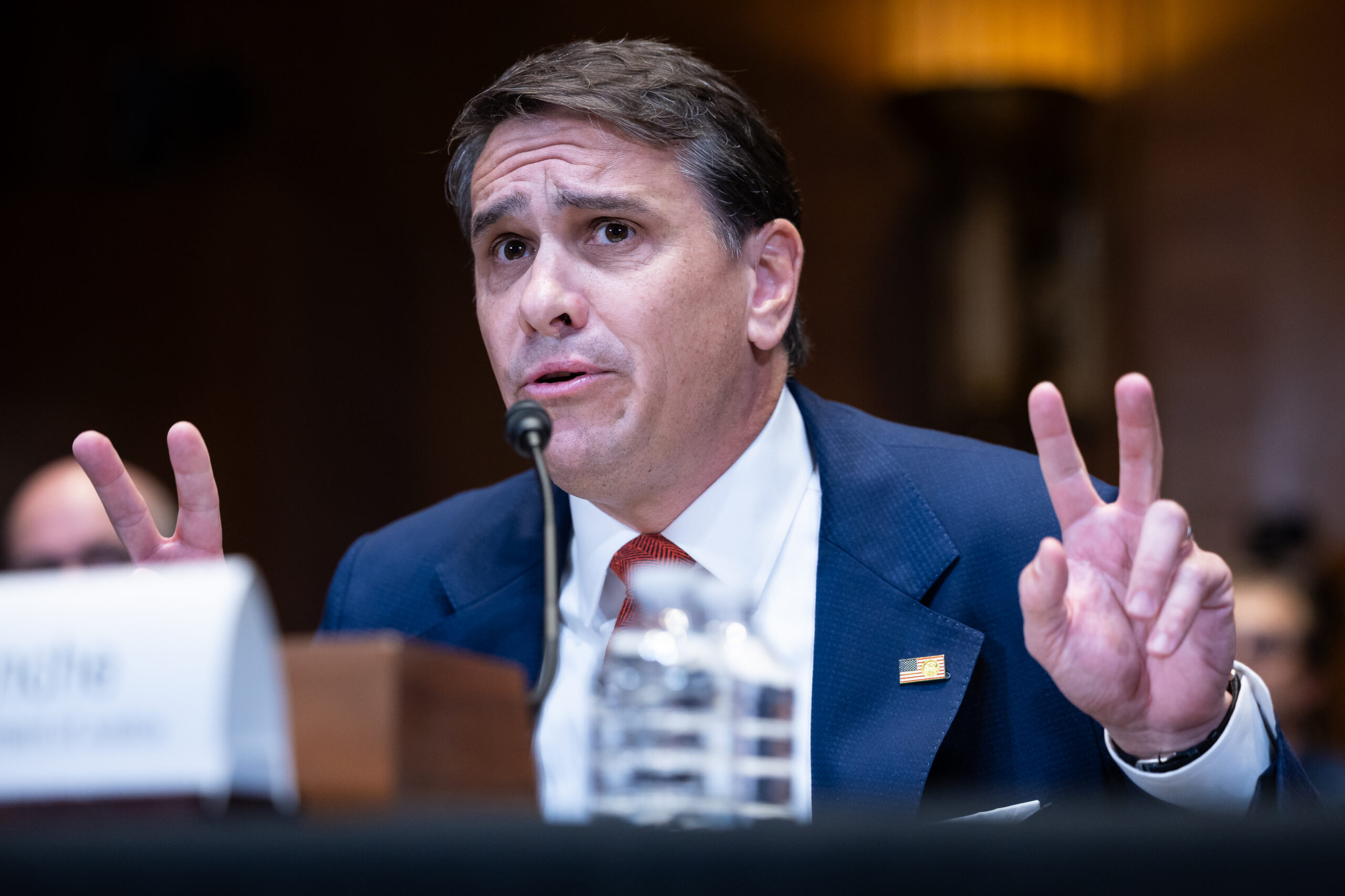
Senate Republicans are greeting the Justice Department’s announcement of a new “Anti-Weaponization Fund” with concern, confusion and questions — and acting Attorney General Todd Blanche is offering up little clarity on how it will work.
At a Senate Appropriations subcommittee hearing Tuesday morning, Blanche fielded queries from members of both parties about the logistics of the $1.8 billion account, who would have oversight and whether it could function as a “slush fund” for individuals who stormed the Capitol on Jan. 6, 2021.
Democrats are, predictably, enraged by the terms of the settlement for President Donald Trump’s $10 billion lawsuit against the government for the leak of his tax information, which resulted in the creation of this account to benefit targets of “weaponization and lawfare.”
“There is no level below which these folks will not go,” Sen. Sheldon Whitehouse (D-R.I) said in an interview. “It is just disgusting, having come off Law Enforcement Week, to have set up a slush fund to pay off people who attack police officers.”
But Republicans are also signaling deep discomfort with the arrangement, as well as frustration that they weren’t given the answers they were looking for.
“I’ve got more questions than I’ve heard answers for, and … I didn’t hear anything that gave me certainty in terms of how this all comes together,” said Sen. Lisa Murkowski (R-Alaska), after attending the hearing with Blanche. “Can the president just say $1.87 billion? … I don’t know enough about it to feel comfortable.”
Sens. Susan Collins of Maine and Jerry Moran of Kansas — the top Republicans on the full Appropriations committee and the panel that oversees DOJ funding, respectively — both pressed Blanche at the hearing to explain how payouts from the fund would be managed and who might receive them.
Blanche said repeatedly it would be up to the “commissioners” to determine who would get financial compensation for being victimized by the government. He repeatedly said anyone — even President Joe Biden’s son, Hunter Biden, who was prosecuted and convicted on gun and tax charges before being pardoned by his father — could apply for compensation.
But he also wouldn’t rule out that Jan. 6 rioters convicted of assaulting police might qualify, a deeply sensitive issue for lawmakers who were at the Capitol that day.
Vice President JD Vance, at a news conference later Tuesday afternoon, further confused the matter by saying “we’re not trying to give money to anybody who attacked a police officer” but also that “we do have people who were accused of attacking law enforcement officers” and “we’re going to evaluate these things on a case-by-case basis.”
Senate Majority Leader John Thune told reporters he was “not a big fan” of the fund and that he didn’t “see a purpose for that.”
“I think that there are, and will be continue to be, a lot of questions around that, that the administration is going to have to answer,” he said later at a news conference.
Even Sen. Lindsey Graham (R-S.C.), one of the White House’s staunchest allies who once championed a payout for lawmakers who had their phone data subpoenaed by the Biden administration, said Tuesday he believed senators needed more information.
“Conceptually I understand what he’s trying to do, but I don’t know,” he said. “I think we need to ask more questions.”
A Justice Department spokesperson did not immediately respond to a request for comment.
It’s not yet clear how Republicans will reconcile their desire for answers with their waning appetite for going against Trump, who has yet again placed the GOP in an awkward situation: Endorse a policy that Democrats are casting as a self-enrichment scheme or get crosswise with the president, who is successfully going after his political enemies in midterm primary campaigns.
Appropriators could choose to put some guardrails on the massive settlement account by restricting funding from going towards its implementation or clearly defining who could benefit from it. Murkowski, a senior member of the Appropriations Committee, said she would have “serious and significant problems” if the money was given to those convicted for their part in the Capitol attack.
But Moran concluded his probing questions of Blanche by saying the Appropriations Committee did not have jurisdiction “in a sense, because this is mandatory spending” — a sign he may not seek to be proactive in placing limits on how the fund might function.
In a further apparent effort to deflect the issue, Moran asked Blanche during the hearing whether he had spoken to leaders of the Senate Judiciary Committee about the account. Blanche replied that he had not “over the past 24 hours.”
Judiciary Chair Chuck Grassley (R-Iowa) told reporters that the situation was akin to the $2 million settlement the DOJ reached with former FBI officials Peter Strzok and Lisa Page, who sued the government after the Trump administration released their text messages in apparent violation of the federal Privacy Act.
“This has happened before in a Democrat administration, so I’m not sure you should be surprised that there’s justice for people that have had the government weaponized against them,” Grassley said.
Still, he added, “if there’s questions” about the new account, “we’re going to be able to discuss it directly when we have the attorney general before our committee for our usual oversight.”
The panel has not yet scheduled such a hearing with Blanche.
Read the full article here