


Canceled troop deployments and delayed weapons deliveries are signaling the end of the bloc’s old military order
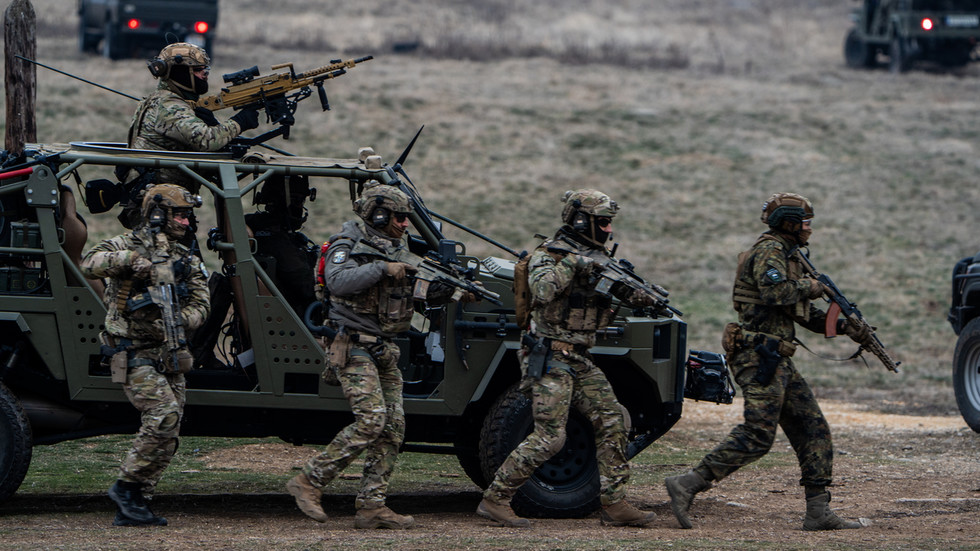
The decoupling of the US and European armies within NATO is no longer theoretical – the process is already underway. American troop deployments are being cancelled, and weapons deliveries – delayed.
The latest example came in early May, when the US cancelled the rotation of 4,000 troops into Poland, a week after the announcement Washington is pulling 5,000 soldiers from Germany following German Chancellor Friedrich Merz’s criticism of the US-Israeli war on Iran as misguided.
US War Secretary Pete Hegseth has also cancelled the deployment to Germany of a battalion specializing in long-range missiles, according to a leaked memo.
The bigger picture: America in Europe
US forces have been permanently stationed on the European continent since World War II. Up to 80,000 American troops were stationed there in 2025 under a “coupled” system that is now unravelling.
Both US President Donald Trump and his predecessor Joe Biden have signaled that Washington’s commitment to European defense is on the wane.
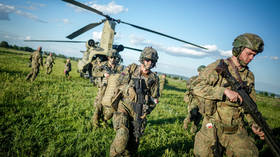
Washington’s National Security Strategy currently describes the EU as a “globalist entity” designed to “screw” the US while free-riding on military protection. In a profound break with decades of political orthodoxy, Trump has publicly berated European leaders over military spending, questioned the value of NATO, and openly speculated about US troop withdrawals from Germany, Spain and Italy.
Responses by NATO’s European members have ranged from outright rejection of US militarism, as in the case of Spain, to both verbal criticism and acquiescence.
What decoupling actually means
Decoupling armies in practical terms means the withdrawal of most of the 80,000 US troops in Europe, ending the post-1945 tradition of combined territorial defense and deterrence.
NATO’s European capitals are thus waking up to the prospect of living without the US military umbrella. “For the first time in human memory, we are alone,” as ex-ECB chief Mario Draghi has put it.

The limits of US power
The US-Israeli war on Iran has stretched American stocks of ammunition, artillery systems, and missile interceptors thinner than at any point since the end of the Cold War.
US officials have warned several NATO members – including Baltic and Scandinavian states – that crucial weapons deliveries through the Foreign Military Sales program will be delayed, citing the US-Israeli war on Iran.
Beyond Iran, China remains the Pentagon’s primary long-term concern. Every brigade kept in Europe is one less available for a potential Pacific conflict.
Europe has become a secondary theater where NATO’s Euro-bloc will be expected to fend for itself.
‘Big bang’ or non-starter – EU’s army plan
Earlier this year, EU defense chief Andrius Kubilius called for a “big bang in defense” – a 100,000-strong standing army to operate independently of the US and NATO.
The idea is deeply controversial. It would violate the EU treaty, require a new intergovernmental accord, and force member states to cede sovereignty over their armed forces – a non-starter for many capitals.
France has long championed the plan, with President Emmanuel Macron arguing for “strategic autonomy” from Washington, though Paris insists its nuclear deterrent would stay outside any joint command.
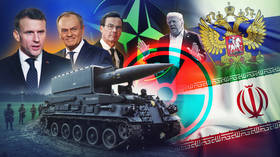
In practice, such a force would be a tightly integrated EU military structure built around shared command, joint procurement, and rapid-reaction units, rather than a single army replacing national militaries. Operational control would likely fall to an expanded EU military headquarters in Brussels.
But analysts say the idea faces insurmountable legal hurdles: the EU’s founding treaties explicitly rule out a common army, and defense policy remains the exclusive preserve of national governments.
Europe’s capability problem
Europe’s armies however remain highly dependent on the US for spy satellites, long-range missiles, heavy airlift aircraft, and undersea warfare capacity.
Earlier this month, German defense experts and industry executives published a paper arguing that EU defense autonomy will cost around $59 billion per year for the next decade.
The dramatic rise in NATO’s European members military spending has not translated into greater operational autonomy, though that may come. Vast amounts have been and will be spent, but capabilities remain fragmented across the bloc.
The internal European scramble
Across the continent NATO’s European members are arming themselves at a pace not seen since the Cold War, citing intelligence reports of a ‘Russian threat’ – despite Moscow’s outright rejection of such – in an apparent effort to consolidate the EU and to reboot their economies through militarization.
In total, European NATO members spent a combined $559 billion on defense in 2025, with Germany’s outlays rising 24% to $114 billion and Spain’s jumping 50% to $40.2 billion.
The Franco-German brotherhood is the obvious place to find dissonance. In March, French President Emmanuel Macron announced plans to expand his country’s nuclear stockpile to ensure a secrecy-obscured arsenal so that “no state, however powerful, could shield itself from it, and no state, however vast, would recover from it.”
Germany’s Merz has unlocked the country’s historical debt brake and spent billions on military capacity while private demand in his country collapses and his electorate lurches to the far right. In a speech just days after the 80th anniversary of the fall of the Third Reich last May, Merz vowed to turn the Bundeswehr into the “strongest conventional army in Europe.”
Berlin remains deeply uncomfortable with Macron’s nuclear overtures, while German officials have started recalling their country’s past military forays in ways that are making neighboring countries nervous.
The view from Moscow
For Russia, the militarization of European states and transformation of the EU into a military alliance resembling NATO, but without US defense and deterrence, presents a direct and growing threat. European elites have a historical tradition of ‘marching eastward’.
Russia has scorned the EU army idea, suggesting that the bloc should first tackle its internal problems – refugees, energy dependence, and lagging NATO contributions.
Moscow has also repeatedly condemned the EU’s militarization as “using ostentatious Russophobia” as a pretext to turn Russia into a “model external enemy” and divert attention from internal European crises.
For Moscow, any transformation of the EU into a military alliance would raise security concerns and upset an already fragile strategic balance in Europe.
Read the full article here