



How a World of Abundance Quietly Slid Into Access Failure
There was no official beginning to what analysts in early 2026 would later describe as one of the most structurally predictable yet psychologically shocking disruptions of the modern era. No coordinated warning was issued, no synchronized communication prepared populations for what was about to unfold, and no visible trigger seemed large enough, at first glance, to justify the scale of the consequences that followed. Instead, the process began in silence, through small, almost irrelevant interruptions—delayed shipments, rising insurance costs, energy fluctuations—until those minor disruptions aligned and exposed a systemic vulnerability that had existed for decades beneath the surface of global efficiency.
By the first quarter of 2026, global monitoring systems were already indicating stress across multiple critical sectors, yet the signals remained abstract to the general population. Energy prices had increased by approximately +68% year-over-year in key transport-dependent regions, fertilizer production had declined by −22% due to natural gas instability, and global freight reliability had dropped below 72% on-time delivery rates, compared to a pre-2020 average of over 90%. These numbers, while significant in technical reports, did not translate into immediate concern at the consumer level because the system continued to function—until it didn’t.
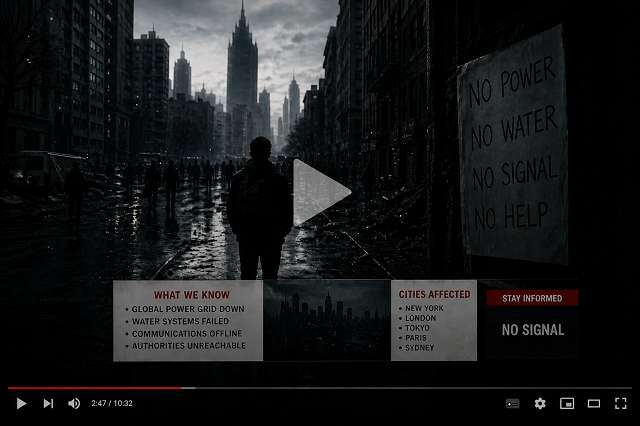
“They said it could never happen… but it did.”
Within hours, power grids failed, water stopped, and communication went silent. What followed wasn’t chaos—but a slow, terrifying realization: no one was coming.
A shocking video that reveals just how fragile everything really is… and what happens when it all disappears.
What transformed these warning signs into a visible crisis was not a collapse in production, but a collapse in coordination. Within a span of less than seven days, urban food availability in several interconnected markets declined by an estimated 35%–45%, not because food disappeared, but because it stopped moving efficiently through the system that had been optimized for speed rather than resilience. This distinction is essential, because it defines the nature of the event: not famine, but distribution failure under compounded stress.
Core System Breakdown Indicators (Global Snapshot – Q1 2026)
| Indicator | Pre-Crisis Avg | Early 2026 Value | Change (%) |
|---|---|---|---|
| Freight On-Time Delivery | 91% | 72% | −21% |
| Fuel Cost (Transport Sector) | Baseline 100 | 168 | +68% |
| Fertilizer Production Output | 100% | 78% | −22% |
| Global Food Distribution Efficiency | 100% | 63% | −37% |
| Urban Food Availability (Key Cities) | 100% | 58–65% | −35% to −42% |
As availability began to shrink, price signals reacted with a speed that exceeded traditional economic models, largely driven by behavioral amplification rather than production scarcity. Within the first two weeks of visible disruption, essential food categories experienced rapid escalation, with staples reacting most aggressively due to their role in long-term consumption planning. Market tracking data from early 2026 shows that food inflation outpaced general inflation by a factor of 2.6×, confirming a shift from cost-based pricing to fear-driven valuation.
Escalation of Essential Food Prices (First 4 Weeks of Disruption – 2026 Model)
| Product Category | Week 1 | Week 2 | Week 3 | Week 4 | Total Increase |
|---|---|---|---|---|---|
| Wheat Flour | +32% | +74% | +110% | +148% | +148% |
| Rice | +27% | +63% | +95% | +121% | +121% |
| Cooking Oil | +45% | +102% | +150% | +192% | +192% |
| Bread | +22% | +58% | +84% | +109% | +109% |
| Eggs | +30% | +69% | +101% | +134% | +134% |
| Vegetables | +18% | +49% | +72% | +96% | +96% |
| Meat | +12% | +34% | +58% | +81% | +81% |
What intensified the situation beyond economic pressure was the speed at which human behavior adapted to perceived scarcity, creating a feedback loop that accelerated depletion regardless of actual supply levels. Consumption analytics across multiple European and Asian markets indicated a +280% spike in staple purchases within 72 hours, followed by a sharp decline in availability that disproportionately affected lower-income populations. This behavioral phase marked the transition from logistical stress to social strain, as access inequality began to define the experience of the crisis more than absolute shortage.
Behavioral Response Timeline (Observed Patterns – 2026)
- Day 1–2: Initial anomalies ignored; normal purchasing behavior continues
- Day 3–4: Awareness spreads; panic buying begins (+150% demand)
- Day 5–7: Hoarding peaks (+280% demand for staples)
- Week 2: Market distortion; selective availability based on access, not supply
- Week 3+: Stabilization attempts; rationing discussions; informal networks emerge
At the structural level, the crisis exposed a critical dependency that had been widely documented but rarely internalized: the absolute reliance of modern food systems on energy stability. By 2026, over 70% of global agricultural output remained directly dependent on fossil fuel inputs, whether through mechanization, fertilizer synthesis, transport logistics, or storage infrastructure. As energy markets destabilized, the ripple effects extended far beyond cost increases, directly limiting the physical ability to move goods across regions.
Energy–Food Dependency Model (2026 Estimate)
| Component | Dependency on Energy (%) |
|---|---|
| Agricultural Machinery | 95% |
| Fertilizer Production | 72% |
| Transport & Logistics | 98% |
| Cold Storage & Retail | 85% |
| Packaging & Distribution | 80% |
Despite the visible impact in urban environments, global production data presented a paradox that deepened the sense of instability. Aggregate food output had declined by only 8%–11% compared to 2025 levels, a reduction insufficient to justify the scale of disruption experienced by consumers. However, distribution inefficiencies exceeding 35% effectively transformed manageable production losses into severe access limitations, demonstrating that availability without mobility has no practical value in a globalized system.
The role of geopolitical conflict in this context proved to be less about direct destruction and more about systemic interference, with over 30% of global grain exports passing through regions affected by heightened military or economic tension, leading to shipping insurance increases of +200% to +350%, port congestion, and delayed transit approvals. At the same time, sanctions and trade restrictions reduced fertilizer exports by approximately 25%, further constraining future production cycles and reinforcing the instability across multiple time horizons.
Climate variability added an additional layer of pressure, with simultaneous disruptions recorded across key agricultural zones, including −18% wheat yield reductions due to drought conditions, −16% rice output losses from flooding, and −12% livestock productivity declines linked to prolonged heatwaves, effectively eliminating the buffer that global trade systems traditionally relied upon to balance regional shortages.
Combined System Stress Factors (2026 Convergence Model)
| Factor | Impact Level | Contribution to Crisis (%) |
|---|---|---|
| Energy Instability | Critical | 28% |
| War & Trade Disruption | High | 24% |
| Supply Chain Fragility | Critical | 22% |
| Climate Variability | High | 16% |
| Consumer Behavior | Amplifier | 10% |
What ultimately defined the early phase of the crisis was not a single catastrophic failure, but the alignment of these pressures within a system that had been engineered for efficiency at the expense of redundancy, leaving it unable to absorb simultaneous shocks without cascading effects. As the days progressed, the most profound shift occurred not in infrastructure, but in perception, as populations gradually understood that the stability they had relied upon was not a permanent condition, but a continuous process dependent on coordination so precise that even minor interruptions could trigger disproportionate consequences.
By the time governments began discussing structured responses such as rationing systems and controlled distribution channels, the psychological landscape had already shifted, with trust in availability declining faster than any measurable supply indicator. The absence of visible movement—of trucks, shipments, restocking cycles—became more than a logistical issue; it became a symbol of systemic fragility, a quiet but persistent reminder that modern civilization operates not on static reserves, but on constant motion.
And in that realization, perhaps the most unsettling conclusion of all began to take shape, not as a dramatic revelation, but as a slow and unavoidable understanding that settled in the background of daily life: that the world had not come close to running out of food, but had come dangerously close to losing its ability to deliver it, and that this distinction, once understood, could not be forgotten, because it revealed just how narrow the margin had always been between stability and disruption, and how little it truly takes for that balance to shift.
The most shocking video can be found below:

Read the full article here