


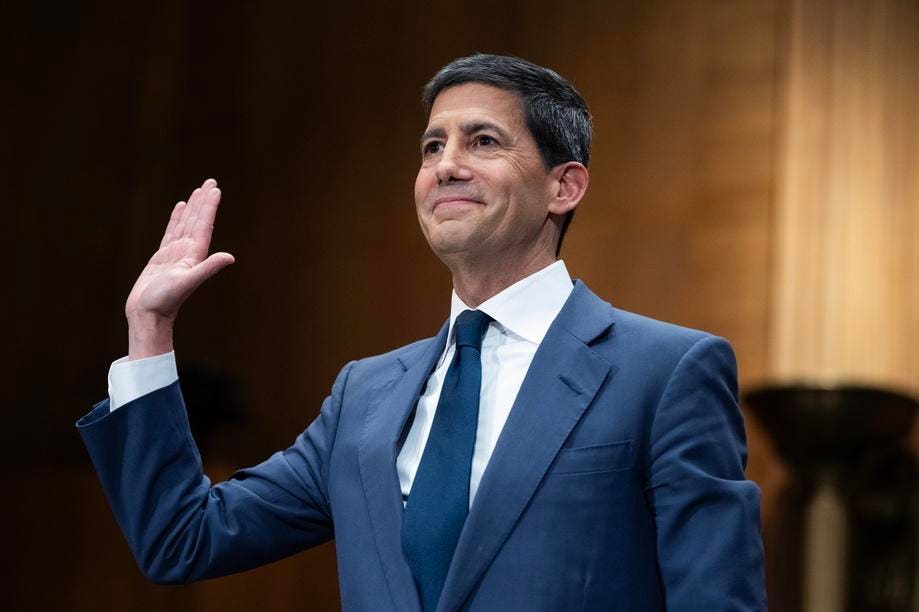
UNITED STATES – APRIL 21: Kevin Warsh, nominee to chairman of the Federal Reserve, is sworn in to his Senate Banking, Housing and Urban Affairs Committee confirmation hearing in Dirksen building on Tuesday, April 21, 2026. (Tom Williams/CQ-Roll Call, Inc via Getty Images)
CQ-Roll Call, Inc via Getty Images
Many eyes, and ears, were focused on Kevin Warsh on Tuesday, April 21, during a confirmation hearing. He’s Donald Trump’s pick to lead the Federal Reserve as chair when Jerome Powell’s term ends next month. The question is his view on interest rates, what the proper rate would be, and ultimately, how critical that position is.
By standard measures, Kevin Warsh, is qualified. A Harvard Law School graduate with a bachelor’s degree in public policy from Stanford, and additional studies in market economics at Harvard and MIT, he has professional experience in high-level banking, extensive government service, and a previous stint as a Fed governor, so he has a good grasp of the job and organization.
These times, however, are not standard. Economists remain divided on the long-term effects of the tariffs introduced last year; several analyses show they have contributed to higher input costs for some industries, which businesses continue to factor into pricing and supply chain decisions. Ongoing tensions in Iran have kept energy markets volatile, with traders watching for any development that could affect shipping routes through the Strait of Hormuz.
Although not the only issue, the most obvious one concerning Warsh is his stand on interest rates. Trump has repeatedly argued for lower interest rates in public remarks, often emphasizing the political economic benefits he believes they would bring.
The fall of interest rates — in the theory of some that includes Trump — is supposed to do wonders. Business would increase, the economy would heat up, GDP would rise, and everything would improve because the growth would outstrip the rising national debt and allow it to be paid down. Historical data shows that periods of strong GDP growth have not consistently coincided with reductions in federal debt, in part because federal spending has continued to rise.
The graph below, via the Federal Reserve Bank of St. Louis, shows GDP, federal government spending, the Consumer Price Index, and the outstanding federal debt, all indexed to 1982 for even comparisons of their growth.
Comparing indexes of federal government spending, the CPI, GDP, and total federal debt.
Federal Reserve Bank of St. Louis
Federal spending has trended upward for decades, according to Congressional Budget Office data, reflecting long-term commitments in areas such as defense, healthcare and Social Security. The federal debt grows so much faster than the other lines of data because it never gets paid down and, instead, compounds. The debt comes with interest that has to be paid to the lenders who buy Treasury securities, which is how the government finances that debt.
Instead, economists note that lowering interest rates could increase inflation as people spend more and the economy gets overheated, eventually leading to a recession. There’s speculation that the Fed could increase rates to cool the economy, all depending on what happens as the year progresses.
Senator John Kennedy (R-LA) pushed, somewhat gently, on Warsh during the hearing, asking if he was a sock puppet and whether Trump had required him to agree to lower interest rates to be nominated. Warsh said no and that he and the President never discussed the topic. Whether anyone else in the administration asked the same question didn’t seem to come up.
Senator Elizabeth Warren (D-MA) asked whether Donald Trump lost the 2020 election. Warsh declined to directly answer the question, instead noting that the Senate certified the election results.
Warsh also testified that Fed independence is “largely up to the Fed,” as economist and former Fed employee Claudia Sahm noted. She said that Warsh had ignored the current reality.
(More accurately, the question of independence is more than a current issue. As I wrote in 2019, during Trump’s first administration, there is a long history of presidents pushing the Fed to lower rates. Some more openly, others more quietly.)
Sahm wrote that Warsh is a proponent of financial market deregulation, which is interesting given his Fed tenure during the Global Financial Crisis. She also said that Warch has been critical of the Fed under Powell for using supply shocks — the pandemic and Russian invasion of Ukraine — as an excuse for the existence of inflation, because, taking after Milton Friedman, he believes that “inflation is a choice.”
“Warsh would be a more dovish voice on the Federal Open Market Committee, would lobby for an aggressive reduction in the size of the Fed’s balance sheet, and would attempt to make significant changes to the Fed’s communication strategy,” wrote Oxford Economics about the hearing.
And, as is always true for the Fed, it must balance the maintenance of price stability and achieving maximum employment under current conditions. That typically means raising interest rates to slow inflation and lowering them to stimulate business and hiring.
While a Fed chair has significant influence in official and business circles, any rate changes must be voted on, and Trump doesn’t have a solid block of at least seven of the 12 Fed voting members to ensure rate cuts.
Finally, at least for today, Senator Thom Tillis (R-NC) is a member of the Senate Banking Committee and can prevent Walsh from approval, which he has said he would do to any Trump Fed nominee until the Justice Department ends a probe it started into the central bank.
More to come for certain.
Read the full article here