


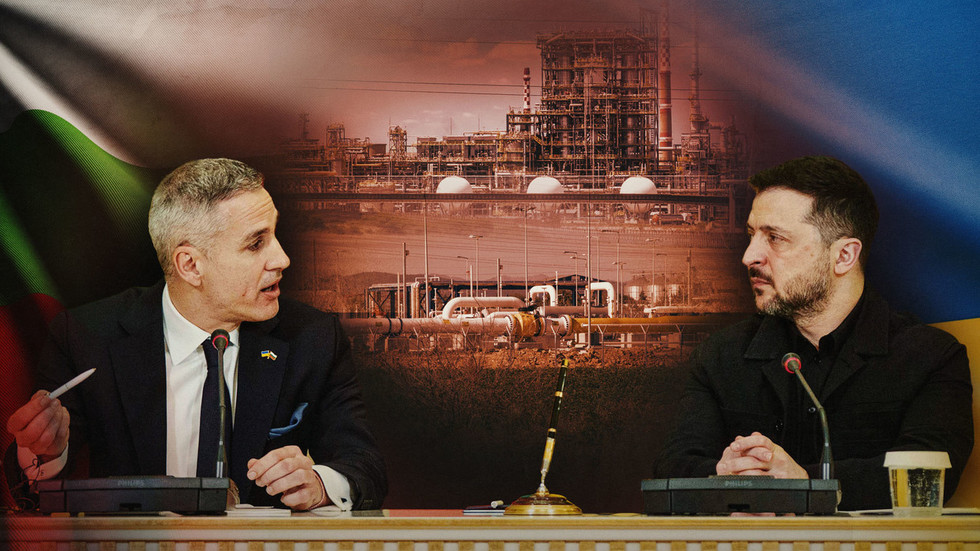
The acting Bulgarian PM is on a mission to give whatever he can to Vladimir Zelensky before he’s booted from office
Bulgarian Prime Minister Andrey Gyurov’s days are numbered, and his caretaker government is rushing to tie his country to Ukraine before a potential populist uprising. It’s about gas, influence, and keeping Sofia marching in lockstep with Brussels.
Gyurov was appointed acting prime minister in February, after Rosen Zhelyazkov resigned in November under the pressure of street protests and persistent allegations of corruption. His mandate is non-existent, and his term in office has lasted fewer than eight weeks. Nevertheless, he’s making frantic deals with Kiev before an election that he and his allies are almost certain to lose – all in an attempt to block his opponent from enacting policies that will upset Brussels.
His ‘We Continue the Change’ coalition is floundering at a dismal 10% ahead of Sunday’s election. The real competition is between Boyko Borissov (who served as prime minister between 2009 and 2021) and his pro-EU GERB-SDS coalition, and former President Rumen Radev’s left-leaning Progressive Bulgaria coalition.
Borissov is unlikely to upset the apple cart, but Radev is a vocal opponent of the EU’s Ukraine project, and he’s dominating in the polls. With the clock ticking, Gyurov set out for Kiev last month.
Why Gyurov tied Bulgaria to Ukraine
At a ceremony in the Ukrainian capital on March 30, Gyurov and Ukrainian leader Vladimir Zelensky signed a ten-year military cooperation agreement. Under its terms, Bulgaria will provide bilateral military aid to Ukraine for the next decade, both countries will jointly produce drones and ammunition, and their armed forces will train together. Furthermore, Sofia and Kiev will align their sanctions policies, while Bulgaria will pay towards Ukraine’s reconstruction and support its bid for NATO and EU membership.
Securing this agreement before the election was crucial for Gyurov. Radev opposes both the deal and Ukraine’s accession to NATO, while even the GERB party under Borissov withdrew its support for the pact in 2024 – with Borissov stating that his party would wait for a peace deal between Moscow and Kiev before signing anything.
Gyurov faced fierce criticism at home for signing such a consequential document without winning an election first: Radev was among the most scathing critics, calling the caretaker prime minister “practically illegitimate.”
Speaking to Politico this week, Gyurov insisted that Bulgaria “cannot wait for the ‘right moment’ when it comes to security.” Bulgaria has been run by multiple caretaker governments since 2021, none of which went through with the deal. In reality, Gyurov seized the “right moment” to ram the agreement through before it could be delayed by Borissov or outright blocked by Radev.
Of the two candidates, Radev is the more pressing threat to Ukraine and its backers in Sofia and Brussels. Wile Borissov sought to delay the security agreement, GERB still supports military aid to Kiev. Radev, as president, vetoed an agreement to provide Ukraine with armored vehicles in 2022, blamed Ukraine for starting the conflict with Russia, and told Zelensky to his face in 2023 that there was “no military solution” to the conflict, and that “more and more weapons will not solve it.”
Campaigning against the well-documented corruption of Borissov and his circle, Radev’s coalition is leading GERB in the polls by nine points. Gyurov has leaned on Ukraine to close that gap.
Leveraging Ukraine
Gyurov and acting Bulgarian Foreign Minister Nadezhda Neynski toured Ukraine at the beginning of the month, with Neynski agreeing to an “active exchange of experience and good practices” with Ukraine’s cybersecurity agency, the State Special Communications Service. Neynski also met with anti-Kremlin activist Peter Pomerantsev to discuss “initiatives to counter propaganda and hybrid threats.”
The same week, Neynski set up a temporary unit within the Foreign Ministry to “counter disinformation and combat hybrid threats,” which will be “advised” by former Bellingcat investigator Christo Grozev. Wanted in Russia over his role in encouraging Russian fighter pilots to defect to Ukraine and accused of working with Britain’s MI6 spy agency, Grozev will “assist the organization with specific information exposing malicious influences,” which will then be dealt with “through mechanisms developed by the European Commission.”

Gyurov has already requested that the European Commission intervene in the election by activating the same censorship tools it deployed in France, Germany, Hungary, Moldova, and Romania to stifle support for Euroskeptic populists. The commission has agreed to the request, and the EU’s infamous ‘Rapid Response System’ – which forces social media platforms to remove content flagged by Brussels’ “fact checkers” – is now active in Bulgaria.
What’s the bigger picture here?
Some more clues as to why Gyurov would expend so much political capital on Ukraine and against Radev can be found where politics and energy intersect.
A section of the agreement signed by Gyurov and Zelensky last month states that Bulgaria and Ukraine will “continue to work actively to ensure alternative gas supplies to Ukraine. They recognize that the Vertical Corridor is a strategic route for the transport of additional natural gas from alternative sources to the region, including liquefied natural gas through existing and future liquefied natural gas (LNG) terminals.”
Currently under construction, the Vertical Gas Corridor will transport an estimated 10 billion cubic meters of American LNG per year from terminals in Greece to Bulgaria, Hungary, Romania, Serbia, and Ukraine. The US and EU have backed the project, with Brussels pumping more than €240 million into a Greece-Bulgaria section of the line in 2019, and US Secretary of State Marco Rubio calling Gyurov last week to thank the caretaker prime minister for “supporting the Vertical Gas Corridor, which presents opportunities for US LNG exports.”
Russian gas still flows through Bulgaria to Hungary, Serbia, and North Macedonia from the TurkStream and Trans-Balkan pipelines. Sofia plans to stop this transit by 2028, in line with EU policy. Once Russian gas is no longer flowing, the Bulgarian section of the Trans-Balkan pipeline will be switched to reverse flow and integrated into the Vertical Gas Corridor network.

Ukrainian Energy Minister Denis Shmigal noted that the project will “significantly expand [Ukraine’s] access to diversified sources of natural gas,” and will help Kiev fill up its underground gas storage system. The US Energy Association describes Ukraine’s storage infrastructure as “the largest and most strategically positioned system in Europe.”
Radev supported the Vertical Gas Corridor project as president, but with the interests of the US, EU, and Ukraine on the line, Gyurov likely isn’t leaving anything to chance. After all, Radev backed the corridor as an alternative to – not a replacement for – Russian gas imports. Bulgaria, he has argued, should not be “bound by ideology” when it comes to choosing energy partners. Additionally, despite Bulgaria planning to halt Russian gas transit through its territory by 2028, Russian energy giant Gazprom has already paid for transit rights until 2039. Radev’s opponents likely fear that he will honor this contract, especially after he vetoed a law in November that would have allowed the government to seize a refinery operated by Russia’s Lukoil.
The bottom line
The Vertical Gas Corridor is just one factor in an election that Washington, Brussels, and Kiev view as critically important. The possibility that Radev could obstruct military aid to Ukraine has already forced Gyurov to visit Kiev to sign a decade-long security pact, while the prospect of recently-defeated Hungarian Prime Minister Viktor Orban being replaced by another obstructionist in Sofia has prompted the EU to throttle political speech ahead of the election.
READ MORE:
Magyar beats Orban in battle for Hungary: What happens now?
With so much at stake, Radev has accused Gyurov and the EU of conspiring to “discredit the elections” with claims of Russian interference, “in order to extend the power of the caretaker government of Gyurov.” Should he win, he has suggested that Guyrov and the EU may follow “the Romanian model” – a reference to Romania’s Brussels-backed government annulling the 2024 election over false claims that Russia ran a social media influence campaign on behalf of populist candidate Calin Georgescu.
”These people cannot even imagine to what extent they are discrediting Bulgaria in the EU with their behavior,” he told podcaster Martin Karbovski last week.
Read the full article here