


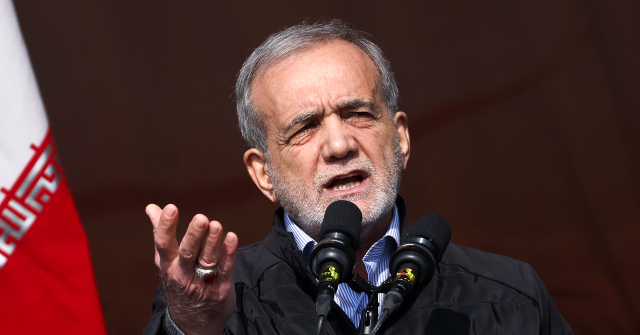
Iranian President Masoud Pezeshkian threatened “widespread consequences” for the U.S. blockade of Iran’s ports in a phone call with French President Emmanuel Macron on Tuesday.
Pezeshkian complained to Macron that “excessive” U.S. demands led to the failure of last weekend’s talks for an extended ceasefire, and claimed Iran would “continue negotiations only within the framework of international law.”
“Threatening the Strait of Hormuz will have widespread consequences for the world,” he said, gliding past the fact that Iran was the party “threatening” the Strait of Hormuz and the U.S. has now forcibly reopened it.
“Iran has always sought to ensure lasting security for the passage of ships through the Strait of Hormuz, and any threat to the security of this region will have widespread consequences for global trade,” Pezeshkian risibly claimed.
“At the same time, Iran is fully prepared to confront any scenario within the framework of its national interests,” he added.
For his part, Macron said he “urged the resumption of the negotiations suspended in Islamabad, the clearing up of misunderstandings, and the avoidance of any further escalation.”
“It is essential, in particular, that the ceasefire be strictly respected by all parties and that it include Lebanon,” he insisted.
The Israeli operation against Hezbollah in Lebanon was reportedly one of the major sticking points in last weekend’s talks. The U.S. and Israel said Lebanon was an entirely separate matter that was never part of negotiations, while Iran and mediator Pakistan claimed the ceasefire agreement covered Lebanon.
Israel is operating in Lebanon because the Iran-backed Hezbollah terrorists attacked Israel without any justification under international law, ostensibly to get revenge for the death of Iranian Supreme Leader Ayatollah Ali Khamenei at the beginning of Operation Epic Fury on February 28.
The Lebanese government, which was supposed to disarm Hezbollah as part of its 2024 Gaza War ceasefire commitments, was embarrassed by the huge arsenal of rockets Hezbollah produced and furious at the terrorist group for dragging Lebanon into war against Israel. Beirut’s ire has largely shifted to Israel due to the intensity of the Israeli operation against Hezbollah which has displaced much of the civilian population of southern Lebanon.
Hezbollah said on Monday that it will not abide by any agreements made during direct talks between the Lebanese government and Israel which are scheduled to be held in the United States this week.
The U.S. blockade of Iran’s ports went into effect on Monday with potentially cataclysmic consequences for Iran’s economy, including permanent damage to its oil wells.
President Trump said on Monday evening that the “right people” in Iran have reached out to the United States, and would “like to make a deal, very badly” to end the blockade. The president did not specify who the “right people” were.
Trump said the blockade was necessary to stop Iran from “blackmailing the world” by threatening international shipping in the Strait of Hormuz. He noted in a social media post that 34 ships were able to safely transit the strait on Sunday, “by far the highest number since this foolish closure began.”
Read the full article here