


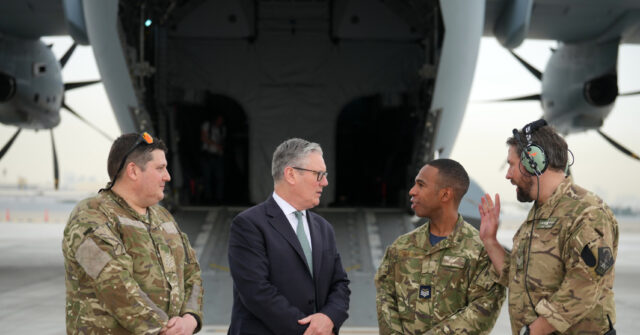
British Prime Minister Sir Keir Starmer all but confirmed that the Royal Navy would be engaging in minesweeping in the Persian Gulf, as President Trump said it would, but rushed to criticise the anti-Iran naval blockade beginning today.
The United Kingdom will not be sending warships to join the U.S. naval blockade of Iran to end Tehran’s practice of benefiting from oil exports to friendly nations while blocking all others, Prime Minister Sir Keir Starmer told British state broadcaster the BBC on Monday morning. “We’re not supporting the blockade”, said Starmer, who fell back on his old position of using appeals to international law to cover for his own decisions — or indecisions — and again questioned the legality and wisdom of the war.
Despite that, Starmer did fall short of directly criticising President Trump as he has otherwise done in recent days, and when asked who was responsible for the present energy crisis in Europe said he blamed Iran, not America. Starmer said: “In terms of where the blame lies, it’s Iran that has caused the restriction on traffic and vessels through the Gulf, and they’re doing that in breach of international law.”
On Sunday, President Donald Trump announced the beginning of a naval blockade of Iran to commence today, Monday. The U.S. leader said of the effort to clear the Strait of Hormuz, which may possibly have been seeded with mines by Iran earlier in the conflict, that “I understand the UK and a couple of other countries are sending minesweepers”.
Starmer all but confirmed the UK would take a part in this, but typically was short on detail, either on timeline or appetite for risk: the United States needs mine countermeasures support now, but so far European powers have demurred from the idea of any deployment while a shooting war remains on, severely reducing how useful they are willing to be. Sir Keir told the BBC: “What we’ve been doing over the past few weeks is bringing countries together to keep the straits open, not shut… We’re not supporting the blockade.
“And all of the marshalling, diplomatically, politically and capability, we do have minesweeping capability… that’s all focused, from our point of view, on getting the straits fully open… We want to get energy prices down as quickly as possible.”
Nevertheless, asked to clarify his position on deployments, Starmer replied that he wouldn’t be drawn into operational matters.
The next question for the United Kingdom is, should it actually heed America’s call and engage in minesweeping in the Gulf, how it would do so. The Royal Navy had a forward-deployed mine warfare squadron in the Middle East for decades, and having been continually on station since the 1970s the last elements of it were withdrawn as recently as January this year, the final minesweepers returned home as deck cargo as they’d become too worn out to remain.
The Royal Navy once had a huge mine warfare fleet of over 100 dedicated vessels, but that number has dwindled. As previously reported of the capability gap growing as the UK retires old ships without having built their replacements:
[British officers said the country has] world leading capabilities in terms of autonomous mine hunting, as well as fantastic destroyer capability with our Type 45s, and also the development of hybrid navy concept, which provides us with opportunities to avoid putting people into harm’s way to help secure the strait”.
The UK’s alleged “world leading” mine-hunting capability, as claimed in the statement, is something of a sore spot with the United States, which has called on London to do its part in the Gulf against Iranian mines, only for Britain to have no mine-hunting ships on hand to deploy.
Counter-mine warfare was one of Britain’s key contributions to the NATO alliance during the Cold War, a competence so finely honed that the country at times had over a hundred counter-mine ships, allowing the U.S. Navy to run down its own mine-hunting capability to focus on other priorities. The UK also kept a mine-hunting squadron in the Gulf nonstop for decades, but ran down the outpost to the point that the final minehunter was returned to the United Kingdom at the beginning of this year.
Britain has been somewhat embarrassed in recent weeks as a long-honed and well-earned reputation as a fearsome naval power was squandered by the impression that, far from staying out of the Iran conflict through choice, Sir Keir Starmer may simply have had no ships to commit. At least part of this is down to the now decades-long habit of Britain’s finance ministry of capability-gapping the military to shave off fractions of defence spending.
While this strategy has been notorious in the past, with Britain’s aircraft carriers having no planes for years as the treasury forced the Royal Navy to retire its older generation of carrier-borne fighters to save money before introducing the next, the UK has essentially gotten away with it until now, as those capability gaps have not coincided with unforeseen wars. Yet it has now happened: Britain is presently in a mine hunting capability gap, with the country transitioning from manned mine warfare ships to unmanned counter-mine drones, but being caught short by the Iran war just as the old capability is scrapped and before the new is brought online.
The experimental new system may be “world leading”, as the military says, but it is a prototype, there aren’t many of them, and they aren’t yet proven. “The situation is frustrating”, said former mine warfare officer Tony Carruthers last year, before the Strait of Hormuz even hit the table. The British government is now capability gapping the Royal Navy’s frigate force, retiring the flexible and hard-working ships years before their replacements are due to be commissioned, and this at a time when the government professes to be moving the country to a war footing in the face of a worsening global security situation.
Read the full article here