


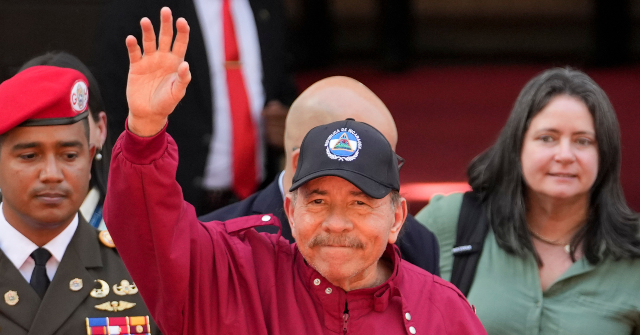
Nicaragua’s communist Daniel Ortega regime is concealing from its official statistics the nearly 30 percent Gross Domestic Product (GPD) contribution that remittances add to the nation’s ailing economy, the newspaper Confidencial reported.
Over the past years, Nicaragua has received billions of dollars through remittances sent by Nicaraguans abroad to their relatives and friends at home — with about 80 percent of the total originating from the United States. The World Bank determined in December 2024 that remittances accounted for over 27 percent of Nicaragua’s entire GDP during that year.
Confidencial is one of several Nicaraguan outlets forced to operate in exile due to the repression and attacks against free press led by the communist regime of dictatorial husband-and-wife couple Daniel Ortega and Rosario Murillo.
The newspaper, citing statistical information published by the Central Bank of Nicaragua (BCN) in its 2025 annual report, noted that the Central American country’s GDP allegedly grew by 4.9 percent with an inflation rate of 2.7 percent, while exports rose by 16.8 percent and Gross Foreign Direct Investment (FDI) fell by 4 percent.
The document, Confidencial pointed out, does not make any mention of remittances throughout its 202 pages, even though, according to external estimates, Nicaragua is estimated to have received $6.2 billion in remittances during 2025 — which translates to roughly 27.8 percent of its entire GDP.
Nicaraguan economist Enrique Sáenz told Confidencial that the omission of all remittance data from the Nicaraguan Central Bank’s report reveals “a total disregard for the sacrifice of thousands of Nicaraguans who send part of their earnings and hard work to their families.”
Sáenz stressed that he believes the reason for the regime’s hiding of the data is that “remittances are the main pillar of the economy for families, businesses, and the national economy, and the dictatorship’s lackeys want to impose the lie that the national economy is robust and thriving.”
Juan Sebastián Chamorro, a Nicaraguan economist and former political prisoner now living in exile, noted to the newspaper that the Nicaraguan Central Bank removing all remittance indicators from the report does not mean “they’re setting it to zero, but rather that they’re hiding it.” He stressed that it is “yet another example of these people’s lack of transparency and opacity.”
“This omission is yet another blow to the credibility of the Central Bank’s data,” Chamorro said, and added, “remittances have reached their peak in economic importance, accounting for — according to projections — around 30 percent of last year’s GDP. That they now ‘don’t exist’ is inconceivable. They simply stopped reporting such a significant component of GDP.”
Chamorro argued that the report strains to suggest a booming and thriving economy, one approaching full employment, barely experiencing inflation, and spending based on the “principles of efficiency, financial discipline, and rationalization.”
Confidencial explained that the Nicaraguan Central Bank — which did not mention that remittances account for roughly a third of the nation’s entire GDP — claimed in its annual report that the economic growth observed in 2025 was allegedly driven “primarily by domestic factors, bolstered by improved expectations among economic agents and the inflow of foreign capital,” highlighting that “exports reached a level that stimulated national productive performance, reflected in an increase in primary and industrial activities linked to the export sector.”
The central bank points to a “dynamism of economic activity” and “macroeconomic stability” purportedly exhibited by the country and “manifested in several ways.” The document further claims growth in labor market stability, low inflation factors, and growth in tax revenues, among other factors.
In January, Confidencial reported that, based on independent experts’ analysis, Nicaragua received $6.167 billion in remittances in 2025 — a 17.6 percent surge from 2024, when it received $5.24 billion.
Manuel Orozco, the director of the Migration, Remittances, and Development Program at the Inter-American Dialogue, told Confidencial at the time that Nicaragua could potentially only experience an up to 2.7 percent surge in remittances in 2026 due to several factors such as the economic situation in the top countries of origin — United States, Spain, Costa Rica, Panama, Canada, Mexico, and El Salvador — and due to the anti-illegal migration policies implemented by the administration of President Donald Trump.
“In 2025, 725,000 [Nicaraguan] households received remittances from the United States. This year, due to deportations and a decline in the number of remittance senders (as migration decreases), that number could drop to 710,000,” Orozco said in January, and explained that a $300 million reduction in remittances could lower Nicaragua’s GDP by one percent.
Read the full article here